

Thursday, October 8, 2026


- Article
- Comments (0)
A BUSINESS OF DISCREDITING
India Inc is gung ho about the clutch of big-ticket reforms announced by Manmohan Singh and P Chidambaram. But global credit rating agencies are unconvinced and threatening to downgrade India's credit ratings. KS Narayanan tells us why...
KS NARAYANAN | Issue Dated: October 19, 2012, New Delhi
Tags : reforms in retail | aviation | banking pension | S&P | gdp... |
Tags : reforms in retail | aviation | banking pension | S&P | gdp... |
.jpg) It is almost as if a patient woke up from a coma and started sprinting right away. Dr Manmohan Singh, along with P Chidambaram, seems hell bent to show that his UPA is not a regime of policy paralysis but of speed and deft moves. But credit rating agencies across the world do not seem to be buying this spiel.
It is almost as if a patient woke up from a coma and started sprinting right away. Dr Manmohan Singh, along with P Chidambaram, seems hell bent to show that his UPA is not a regime of policy paralysis but of speed and deft moves. But credit rating agencies across the world do not seem to be buying this spiel.
After three years of silence, UPA II has initiated several reform measures in sectors like retail, aviation, banking pension and others over the past few weeks. But that has not deterred agencies like Standard & Poor's and Fitch to threaten a further downgrade of India's sovereign credit ratings. A couple of weeks ago, S&P had gone so far as to say that there was a "one-in-three chance of the country's sovereign rating being junked” within the next two years – a move likely to place India in the non-investment grade level. If that happens, many investors will be forced to sell Indian securities or stop incremental investments, further depressing capital flows.
Notably, S&P had revised its long-term sovereign credit rating outlook on India to 'negative' from 'stable' in April this year, citing lower GDP growth prospects and the risk of erosion in external liquidity and fiscal flexibility. The World Bank and International Monetary Fund (IMF) have also cut India’s growth forecast for the current fiscal to 6 per cent and 4.9 per cent respectively.
Why are global agencies seemingly unimpressed even as India Inc and domestic rating agencies seem enthused about the slew of reforms? The answer perhaps is in the level of uncertainty they find in India's political and policy climate given scams, scandals and coalition compulsions, leading to a much-weakened government at the Center. They also cite India's rising fiscal deficit as a cause of serious concern. S&P expects the government's fiscal deficit to be higher than the budgeted estimate at 6 per cent of GDP for the financial year ending March 2013.
Independent analysts concur with the 'uncertainty' of rating agencies about the India growth story. They say that the reform blitz may have changed the perception of the government but the outcome is far from assured. The government's plans to raise foreign ownership caps in the insurance and pension sectors for instance, still have to be cleared by India's fractious Parliament. Even FDI in multi-brand retail may not really have the desired impact given that just nine out of India's 29 states have agreed to embrace the retail reform.
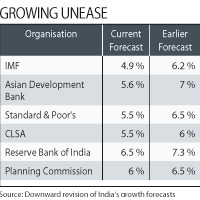 Stock analyst Ashok Jainani adds that policy initiatives such as raising diesel prices and capping subsidised LPG cylinders are also not enough to contain fiscal deficit. “In the wake of elevated energy prices, raised interest rates and slowdown in demand as a result of high inflation, only the deluded can hope for near double digit growth. The global rating agencies' concerns, viewed in this macro-scope, seems absolutely justified,” he explains. He further cites how cumulative (five months) April-August IIP growth of 0.38 per cent against 8.7 per cent in the same period last year speaks for itself about the manufacturing growth and its likely impact on corporate earnings and thereby, the government's revenue collection. Industrial slowdown is likely to adversely impact jobs growth as well in times to come, Jainani points out.
Meanwhile, the gloomy picture painted by global credit rating agencies about India's growth prospects has not gone down well with policymakers who believe that the reform storm is something that needs applause and not skepticism. They believe that it is high time that global credit rating agencies took India off the negative list.
But that is looking easier said than done. S&P's outlook reiterates: "A downgrade is likely if the country's economic growth prospects dim, its external position deteriorates, its political climate worsens or fiscal reforms slow.” The agency says that it may revise the outlook back to stable if the government implements initiatives to reduce structural fiscal deficits and improves the investment climate. “Fiscal measures to lower deficits could include a more efficient use of fuel, fertiliser, and agricultural subsidies, or the implementation of a goods and service tax," it adds.
The recent wave of reform initiatives by the Manmohan Singh government has improved the sentiments of the business community for now. But in case of a further downgrade in ratings, investor confidence will take a further beating. “The cost of borrowing for Indian corporates in the overseas market will also go up which will have a cascading effect on the overall projects in the pipeline,” points out TS Ramachandran, Professor of Finance at Christ College, Bangalore.
P Chidambaram remains unfazed however, and is putting up a strong defence of the economy to the global audience. In Tokyo for the G-24 meeting earlier this month, he denied that India faces any immediate serious threat of a credit rating downgrade and promised more reforms in the coming months. "Two years is a long time. You will see a lot of reforms, a lot of change, a lot of strengthening of the Indian economy. I do not think there is a serious threat of downgrade,” he said, adding that the government will engage the rating agencies and convince them India does not deserve a downgrade.
India Inc seems to be backing the finance minister. Tired of years of alleged policy and decision paralysis, business leaders are content with the recent reform agenda. Rajkumar N Dhoot, parliamentarian and President, ASSOCHAM believes that S&P's threat to downgrade India’s rating is an exaggeration, overstatement and unwarranted. “It does not reflect the true state of affairs of the Indian economy where bold reforms process has already commenced with a bang and results will follow sooner than later,” says Dhoot.
Economists in India are also disquieted with the downgrades. They believe that these ratings have played a destabilising influence in the rest of the world (see box) and that one should not put too much stock by them. “It is an agenda drive. As long as it serves their agenda they paint India in rosy picture. When it fails to serve their purpose it is dismissed. No doubt the Indian economy is in a crisis. It is not operating in a vacuum. There is a global economic crisis. What about their assessment of the European economy, China or US? These rating are mere trash in my opinion", observes economist and foreign affairs expert Dr Suvrokamal Dutta.
Credit ratings notwithstanding, investors seem to have given a thumbs up to the UPA's race for reforms so far. This is manifest in the rise in stock markets immediately after the announcement. However, Chidambaram and his dream team will really have to burn the midnight oil to retain and sustain this optimism.
Losing their relevance?
Thomas Friedman once said, “There are two superpowers in the world today. There’s the United States and there’s Moody’s Bond Rating Service. The US can destroy by dropping bombs and Moody’s (credit rating agencies) can destroy you by downgrading your bonds.” A mild improvisation in the present day scenario would be how global credit rating agencies (CRAs) can seemingly destroy the fates of millions of investors by their irreverent ‘grading’ of various financial instruments, institutions and even economies. An S&P employee himself accepted the fact while joking about structured financial instruments. He ended up saying to a journalist in 2008, “It could be structured by cows and we would rate it.”
A few years ago, the US House Oversight Committee probing the role of CRAs found serious errors and blasted them for assigning investment grade ratings to instruments related to sub-prime even after the downturn became apparent. Chairman of the Committee Henry Waxman even called it a “colossal failure”. In April 2011, a US Congressional report concluded that Moody’s Corp and Standard and Poor’s were the main triggers for “the worst financial crisis in decades” as they inflated ratings for complex mortgage-backed securities and continued to do this even after the housing market collapsed. And then, when in July 2007, they were forced to downgrade their erstwhile inflated ratings, the start of the global financial collapse began.
In May 2010, Moody’s stocks collapsed. Reason, an investigation by the Security and Exchange Commission (SEC) confirmed that Moody’s European ratings committee first passed inflated grades in 2007 on a billion dollar debt vehicle, and then – after realizing that their ratings model had structural programming flaws – refused to correct the inflated grades as they feared their reputation would suffer. In June 2010, the Dodd-Frank Law was enacted which enables SEC to go after even overseas scams of agencies like Moody’s. The above are just a few instances that question the veracity of ratings assigned by global credit rating agencies. After all, they are commercial organisations, funded by big banks and corporations, and often have vested interest in reaching 'desired' conclusions. Given the growing skepticism about their role, should India give importance to these downgrade threats? It is a question that needs wide discussion.


 Issue Dated: Feb 5, 2017

