



- Article
- Comments (0)
Mission 2013
In its attempt to return for a third term, the state BJP has already gone into the election mode, reports Raju Kumar
Tags : Shivraj Singh Chouhan | BJP | Madhya Pradesh | Congress |
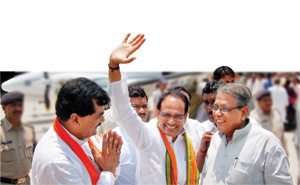 Coming back for third term, as Madhya Pradesh Chief Minister Shivraj Singh Chauhan knows, is an onerous task. So the state BJP has a job at hand as it begins planning and plotting for assembly elections, 2013.
At a recent review meeting, Chauhan drove home this point. It is important, he stressed, that the party take into account the rural vote, which has often been influenced by Maoist politics in Madhya Pradesh. For the poor and the marginalised, the extreme Left brand of politics offers more attractions than the staid promises of main stream political parties, most of which remain unfulfilled.
Despite anti-incumbency, poverty, terrible infrastructure, a rising crime graph and defective rehabilitation policies, the BJP appears to be ahead of its main rival Congress in the state.
The Congress, caught up in an internecine battle of attrition amongst its top leaders, has been unable to cash in on the failings of the state government. That also happens to be the ruling party’s strength.The BJP, keeping ‘Mission 2013’ in view, has got into the act much before its rivals, roughly about three years in advance. The results are there to see; it has won four assembly by-elections on seats held by the Congress: Gohad in September 2009, Kukshi and Sonkatch in February 2011, Jabera in June 2011 and Maheshwar in June 2012.
Says veteran BJP leader Sunderlal Patwa, “the Congress is in a bad state and that helps the BJP.’’
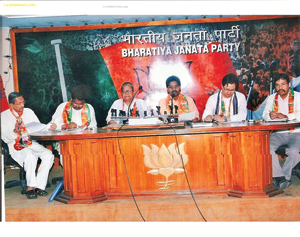 That does not mean it is going to be a cakewalk for the BJP. Journalist Shiv Anurag Pateriya sums it up, “The BJP faces problems on all fronts. On issues like roads and power, the government has failed despite being in power for nine years. But some schemes of the government like Ladli Lakshmi and Kanyadan have helped the image of the Chief Minister. The BJP may be enjoying the success of the schemes it has launched but the going will get tough for them if the Congress puts up a united front and come out of its internal squabbles.’’
Patwa sums it up well when he says that “no matter how advantageous your position is, no elections are ever easy.’’ The state BJP is acutely aware of this home truth.
Accordingly, the party is concentrating on its weak links, constituencies which it lost to the Congress in the 2008 assembly elections. That is why the state BJP president Prabhat Jha has mobilised senior party leaders to begin canvassing on seats considered Congress strongholds. Says Jha, “the Opposition has 77 assembly seats and we are concentrating on them.’’
Chief Minister Chauhan has been tasked with mobilising support in Muslim-dominated Bhopal North assembly constituency, a known Congress bastion. The minority cell of the BJP has been pressed into action and Chauhan himself during the month of Ramzan, did several rounds of the walled city trying to drum up support and meeting up with prominent leaders of the minority community.
Apart from its traditional upper caste constituents, the party has been trying to broad base its support amongst tribals, Dalit and Muslims. Jha, who took over as state president, has opened up BJP offices in tribal dominated Jhabua and Mandla. In the 2008 assembly elections, the BJP had lost 17 out of the 47 reserved seats in the state.
The party is going all out to woo Muslims. It plans to inaugurate a Haj House on the birthday of former Prime Minister Atal Behari Vajpayee, keeping up the pressure with a series of rallies and demonstrations, most unlike a ruling party. Says Patwa, “even after victory, the BJP worker is active. He does not sit at home.’’
But there is also the fear that too much activity before the elections could tire out the workers when the time to campaign actually comes, says journalist Pateriya, adding that all such organised activity costs money, time and energy.
It is not as if the BJP does not have warring groups, it is just that the infighting does not come out into the open as it does in the Congress. During the elections to the state BJP president, several moves were undertaken to scuttle the chances of Jha, including a petition by some women members of the BJP who demanded that a woman head the state BJP to give out a ‘positive’ signal. Jha managed to stay on along with Chauhan as Chief Minister, also because the party has not have major faces to show to the public.
The BJP is wisely trying to concentrate on areas which could be counter productive in 2013. The state of roads and power is so below par that the Chief Minister wants to take his entire cabinet to Delhi to raise a shindy with the Centre for allocating more funds for these two most crucial projects. A number of coal-based projects are yet to get clearance from the Centre. If the corruption-ridden state government has managed to get away with it, it can largely be ascribed to an Opposition which is weak and ineffectual – at least at this stage.
The party in an effort to address long standing demands intends to make a series of announcements on reducing petroleum taxes, pension for teachers and sops for unhappy government employees and other schemes for the weaker sections. The announcements, the party says, should come in the election year budget. That, it believes, is the best bulwark against a badly divided Congress.
neeraraju@gmail.com
State BJP chief Prabhat Jha talks to TSI in an interview. Jha says Congress is in no position to offer a fight.
Can the BJP return for a third time?
The Congress is a badly divided house and leaderless. It is in no position to offer a fight. Shivraj Singh Chauhan has become the state’s tallest leader, a jannayak. Many schemes launched by the government including waiving off farmers’ loans, consolidation of industries leading to employment opportunities, all these are going to help the BJP.
Is BJP’s strength merely based on a weak Congress?
No. The BJP has worked hard to broad base its organisation. There are more active members in the party today than ever before. We have concentrated on booth management. Proof of this lies in our electoral victories over well held Congress seats in the by-elections.
You have deployed your stalwart leaders in the constituencies where you were considered weak but they seem to be inactive.
To leave your own constituency and work elsewhere is not easy. Yet, these leaders have stuck to their task.
Do you plan to invite Uma Bharti for the MP elections?
She is a big leader who is active on the national stage. To say anything about her would be tantamount to party indiscipline from a small worker like me.


 Issue Dated: Feb 5, 2017

