



- Article
- Comments (0)
Book Review: The Last Love Letter
Story of a Glorified Brat
Tags : Minty Tejpal | The Last Love Letter | Hachette Publication | |
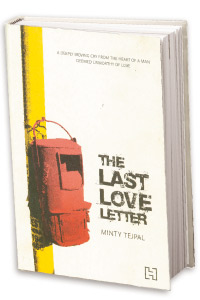 Minty Tejpal’s The Last Love Letter is designed to immediately grab your attention and it does. The back cover has a rather cryptic summing up of the story that reads “I am tired and confused. I am surrounded by darkness, and am groping for the right path. Only you can take me to the light, but unless you love me body, mind and soul, it won’t work... My life is in your hands, but do you want to help me anymore?” Right below it is a blurb by Zoya Akhtar saying, among other things, “Minty Tejpal gets naked and can’t but help (sic) gawk at his scars and guts”.
After reading the book, one tends to agree with Ms Akhtar. The only problem is, the way Tejpal paints himself in this novel, it is difficult to sympathise with him.
The book starts with protagonist Vikram Lal lamenting that he has destroyed his marriage to his one true soulmate. He goes on to describe how they fell in love at first sight, how the sparks flew and how she accepted the not-so-good-looking divorced man despite their age gap. And then he admits to having “pushed her around” in a fit of rage, something that prompts her to finally leave him.
Tejpal goes on to chronicle Lal’s life – the story of a restless drifter who flits from advertising to journalism to music production to writing for the screen to a myriad of other trades. However, the emphasis is obviously his three major romantic ties. The first was his girlfriend Alia Mathur who slipped into a coma following a car accident where he himself was the driver. His second great love would be a production assistant called Sandra D’Costa, who he met when he was working on an advertisement shoot. He marries Sneha but the marriage lasts only five years. The final love story is that between him and his wife, Sneha. This happens as Lal constantly shifts jobs and changes cities from Delhi to Mumbai and back and forth quite a few times.
Quite a few other characters walk in and out of the narrative. This includes Vikram’s brother Arjun and employees at his MyMedia, a media house; Sneha’s military father and her family and a bunch of quirky friends and colleagues of Vikram.
The narrative ends with Vikram, living alone in a rented accommodation, weeping for his children, However, he seems to have found some modicum of peace and is not “bitter anymore that I am twice divorced”. However, by that time, it is very difficult to either feel sorry for his loss or happy that he has finally found peace.
Instead of a great tragic hero or even a swashbuckling anti-hero, Vikram Lal comes across as an indisciplined and somewhat fickle man who has little, if any, control over his impulses. “I always felt that it was actually my groin that gave birth to all my ideas while my brain was a mere outpost,” he says. One tends to agree. He is also quite the escapist. In a large part of the narrative, he shows an incredible belief in the occult. While this is acceptable as his personal beliefs, his attempts to use this as a shield every time he messes up is annoying.
During the accident that kills Alia, he admits to have been quite a bit drunk. The autorickshaw in front of him stopped suddenly to avoid hitting a dog. In order to avoid hitting the vehicle, Vikram brakes and then, maybe owing to the fact that he was drunk or maybe because he was not a very good driver, he makes a cardinal error in driving – he swerves. The Gypsy topples, sending all three of the passengers into a coma. This does not annoy as much as his later feeble attempt to explain it by saying “The Accident was fated to happen... All three of us shared the same sun sign.”
He marries a woman with whom he shared nothing but their mutual love for hashish. Yet when it falls to pieces, he says that some godman had predicted it and it was all because the stars were not aligned. Even after manhandling his wife, he thinks a Khoja had caused it by “influencing her mind and corrupting the energy in our house”. A more logical explanation would be the booze and dope.
Tejpal drops a lot of names, thinly veiled. Sandy is easily recognised as Rabbi Shergil and Khayal Sartaj is as easily identified as Vishal Bhardwaj. Overall, the book is a rather unadorned and honest account, just that, one is not left feeling good about the protagonists after reading it.
Edition: Paperback
ISBN: 978-93-5009-279-8
Pages: 248
Price: Rs. 395
Publisher: Hachette


 Issue Dated: Feb 5, 2017

