


- Article
- Comments (1)
Book Review: The Day I Stopped Drinking Milk
Lessons in philanthropy
Tags : The Day I Stopped Drinking Milk | Sudha Murthy | Narayan Murthy | |
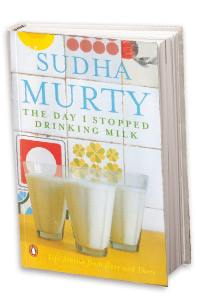 As corporate philanthropy becomes a buzzword among conscious, self-righteous and upwarly mobile business empires, there are few published documents which could vouch for its sincerity. The Day I Stopped Drinking Milk by Sudha Murty is once such attempt which tries to touch base with human emotions, hopes, greed, deceit and deception while running a philanthropic foundation. There are already eminent and well-meaning billionaires like Bill Gates and Warren Buffett who run similar philanthropic missions. Admittedly, Sudha’s foundation is no match when it comes to the funds they have set aside for their missions. The striking difference, however, lies in the richness of experience she has gathered on her journey as a grassroots philanthropist. This reflects in her writing when she confronts a myriad issues while providing succour to flood, tsunami, earthquake and cancer victims.
Chairperson of Infosys Foundation and wife of IT czar Narayan Murty, Sudha has carved her own niche and has won numerous literary and humanitarian awards for the causes she has espoused. The Day I Stopped Drinking Milk is neither fictional nor autobiographical; it is a recollection of her experiences as a teacher and social worker, as she admits herself, and could be partly bracketed in both the categories. It’s the life stories of people she encountered during her journey. The book is a collection of 23 stories about people whom she has sketched to the minutest detail. The protagonist in her stories are ordinary people, whom we encounter in offices, homes, neighbourhood, during train journey or in a hamlet, far away in the hinterland of Odisha.
Sudha is not alone in facing the perennial dilemma of philanthropy - who deserves help, how much and for how long? The challenge in human welfare is not about dearth of money but about money not reaching the right people and at the right time. Unfortunately, it has taken the shape of an industry that poor and affluent both want to milk for personal advantage. Sudha realises that it’s easy to understand computers as they behave on predicted lines while humans belong to unpredicted lots and take to subterfuge to mask their true motives.
In one chapter, the writer crosses swords with a popularly held opinion that running a mon-government organisation (NGO) is the best thing to happen if you don’t have anything worthwhile to stand for. The misconception emanates from the fact that there are thousands of NGOs existing for personal gratification rather than any genuine cause. Running a philanthropic mission, she says, doesn’t need only a warm and caring heart but also a sound and discretionary mind.
The book does not take a narrow look either at philanthropy or at India. The writer narrates in full length how India has emerged from anonymity to recognition for its miraculous performance in IT and other emerging sectors of the economy. The change in perception has resulted in cultural expansion. Sudha narrates how terms like bindi and saree were non-existent some 20 years back for Americans and are now commonly understood terms globally.
Sudha offers another example of a globalised India when she visits Cape Town. She realises that people consider Mahatma Gandhi one of their heroes pretty much like Nelson Mandela and Desmond Tutu. They reason out he was Mr MK Gandhi before he came to South Africa. It was here that he started his Non-Violence and Non-Cooperation Movement before moving to India as Mahatma Gandhi. He was, in fact, a true global leader and not just the Father of the nation in India.
The Day I Stopped Drinking Milk is a fine read for people who love calling a spade a spade. No mincing of words, no fringe decoration, no figure sof speech or literary punch. It’s straight from the heart of a person who likes simplicity and comes straight-from-the-shoulder. It’s an inspirational book for those who are moved more by simple incidents of life than by a revolutionary idea. The narration, language and syntax are simple, short and apt to the expectation. But if you are the type that revels in striking language skills and literary innovation, then it might not captivate your imagination. Nonetheless, it would offer some food to your literary liking.
Edition: Paperback
ISBN: 978-0-143-41865-8
Pages: 212
Price: Rs. 199
Publisher: Penguin


 Post Comments Post Comments
|
Posted By: preeti rai | Devlali | October 7th 2013 | 10:10 guys realy this novel is awesm......
|

 Issue Dated: Feb 5, 2017

