



- Article
- Comments (0)
Book Review: Accidental India
Propelled by happenstance
Tags : Book Review | Accidental India | Shankkar Aiyar | |
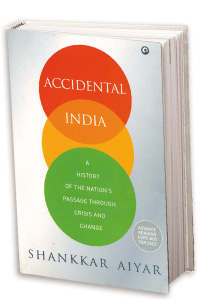 Accidental India: A History of the Nation’s Passage through Crisis and Change, authored by veteran journalist Shankkar Aiyar, is an effort to deconstruct the architecture and ancestry of the changes that have taken place in the country since India became independent in 1947. The book’s central argument is that “India’s ascent has been fuelled by serendipity; change has come about as a consequence of circumstance and crisis, and has always been the result of exogenous forces. Most often, that force has been a crisis.”
To buttress this argument, Aiyar discusses seven accidents and how the economic history of modern India is littered with instances of missed opportunities in every sector, in every decade. These include ‘Liberalisation of the Economy 1991’, ‘The Green Revolution 1964’, ‘The Nationalisation of Banks 1969’, ‘Operation Flood 1970’, ‘The Mid-Day Meal Scheme 1982’, ‘The Software Revolution 1990’ and ‘The Right to Information 2005’. Each of these themes is given a catchy title to grab the readers’ attention. The Green Revolution is titled Hunger Games and nationalisation of banks goes under the rubric Das Capital.
Each chapter begins with a date. Not without a reason. “It is to show how each change has taken tragically long to bring about accidental transformation. Not in just terms of time, but in terms of the trauma and pain to the people whom the politicians claim to care for,” he points out.
Aiyar, former managing editor of a leading national magazine, has witnessed these events sprout and break and challenge leaders and policy makers and become part of Indian history. The author has not rested the book merely on his published articles. Instead he has interacted with many of the who’s who of the Indian establishment, both past and present, while revisiting the nation’s history.
What bothers the author is the usual popular lament that India could have achieved a lot but failed to do so because it is poised at the intersection of hope and despair, of individual aspiration and frustrating institutional failure. “I have since, been studying the evolution of the country’s economy and my research reveals that every major change in modern India has come about in the wake of a crisis,” observes the author.
As a newsman, Aiyar has constructed each chapter with leading personalities, facts, figures and controversies while discussing the crisis. He has also packed in stories of those who succeeded against all odds and led us to the spectacular transformation that we are witness to today.
For instance, in the chapter Hunger Games, the author cites an incident involving Dr Guduru Venkata Chalam. On the way back from Manila, he was detained at Palam Airport with a kilogram of paddy seeds called Taichung Native-I. As Customs officials impounded it under the law, Dr Chalam declared that he was carrying the seeds for the government’s use and under the then Agriculture Minister C Subramanian’s instruction. The minister’s private secretary S Venkitaramanan, IAS officer, who later became Governor of RBI, knew Dr Chalam and his unconventional ways and requested the authorities to let him go. Thus was smuggled in the seeds of a revolution!
In the next chapter, Aiyar recounts an interesting political drama enacted by the then Prime Minister Indira Gandhi and her young turk Chandra Shekhar in the move to nationalise banks. It helped Mrs Gandhi in decimating the syndicate led by K Kamaraj and Morarji Desai within the Congress party.
In the first chapter, The Bonfire of the Vanities, the author deconstructs the popularly held myth in the media that Dr Manmohan Singh was the sole architect of liberalisation in 1991. He sets the record straight on the why, how, when, where and who of the 1991 reforms. Fast forwarding by decades to 2012, the author finds that governance in India is both a sham and a shame and believes that Dr Singh is yet to establish a legacy of his own.
The book has come out at a time when UPA-2 is rocked by scams and accused of policy paralysis even as India is faced with half a dozen silent crises – water, energy, poverty, corruption, national security and relations between the Centre and the states.
Taking the complacent political class to task, the author points to the inability of successive governments to think imaginatively and act decisively. “What India lacks is the kind of political leadership that entertains risks and takes decisions”, he notes, questioning the quality of India’s leadership. He calls for public good rather than private dividend. Such appeals are likely to fall on deaf ears.
However, one cannot dismiss the author’s conclusion that a crisis cannot be the prefix for change. Aiyar ends his book thus: “A nation of a billion people cannot wait endlessly for accidents. India deserves better”. One could not agree more.
Edition: Paperback
ISBN: 978-81-923280-8-9
Pages: 352
Price: Rs. 695
Publisher: Aleph


 Issue Dated: Feb 5, 2017

