



- Article
- Comments (0)
Book Review : Red Sorghum
A China draped in many hues
Tags : Red Sorghum | Mo Yan | Arrow publications | |
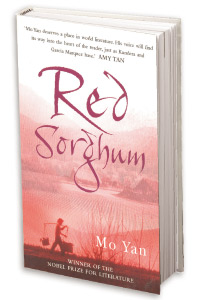 Let me start with a warning first. If you are one of those who conform to the Western stereotypes of China and the Chinese way of life, do yourself a favour. Do not torture yourself by reading this. If you are one of those who look for any possible reference criticising the Communist rule in China or try to go out of the way to manufacture such analogies, do not torture yourself either. If you love writers like Orhan Pamuk, who tell stories about their native country through the Western point of view, you too do not need to bother with it. If you are one of those who expect a breezy read, beware, it is anything but an easy read. It will question your sensibilities and everything you think you stand for every now and then. Mo Yan’s Red Sorghum is a world in itself. It is the China the world is yet to get aware of, let alone come to terms with.
It is the beginning of the 20th century and China is in turmoil. Without any preamble, the readers are ruthlessly thrown amidst the events. China is under Japanese occupation and life is anything but easy. The narrator, a man in his youth from the provincial backwaters, tells the inseparable histories of the Sino-Japanese War and that of his family that wades through the Chinese Civil War and culminates with the Cultural Revolution.
The story opens with a group of villagers led by Commander Yu, the narrator’s grandfather, who decide to thwart the advance of the Japanese occupation troops by going for an preemptive attack. As the Commander sends his teenaged son home to bring provisions for his troops, the Japanese advance is unperturbed. Yu’s wife carries the food for the troop through the sorghum fields but is caught in the enemy fire. And this becomes the single most important event of the novel. It is her death that joins the shifting narrative that eschews the sense of past and present and describes the war’s progress. In between are thrown other elements like strife between rival Chinese warlords and escapades of feral dogs. All these are linked in one way or the other with the history of his family. The author deliberately does not let any chronology take shape. So, it is not the events but the recollection of the same that drives the point home.
A short note on Commander Yu. A former bandit, he killed the husband and father-in-law of the girl he wanted to marry. He also murders his widowed mother’s lover who is also a monk. And he is the protagonist that the author compels you to love. Mo Yan has a way of building complex characters and Commander Yu is one of them. He plays the alternating motif of murder and betrayal with love and sacrifice and binds you in such a spell that sensibilities go for a toss.
In more ways than one, the style flirts with the magical realism of the Asian genre in the tradition of Murakami but still manages to create a separate style of its own. So although Mo Yan’s characters are complex, in the true Chinese tradition, they are larger than life too.
However, the strongest trait of this novel is the way the author plays with the sense of smell and colour. Red Sorghum is essentially a chromatic novel that uses the colour red in several metaphors. The red sorghum that grows in the fields of the narrator’s village symbolises blood and passion as opposed to the “black water river” that denotes stagnation and rot. That the Japanese troop decide to confront the defenders on the bridge over the same river tells a lot about the China of that time. Then you have a stinking lake where the water is monstrously green.
The author uses graphic violence liberally. He uses it to a point where he makes you so numb that you finally manage to see through it to greet other emotions. The metaphors are essentially rural, and hence, again graphic. For example, he once compares a dead malnourished new-born with a “skinned rat”. Or look at the matter-of-fact way in which he describes an execution.
“He warded off one with his knife, then neatly separated the soldier from his helmeted head, which sailed through the air, trailing a long howl before landing heavily on the ground, the thud driving the remnants of the scream out of its mouth… The cheeks were still quivering, the nostrils still twitching, as though it were about to sneeze.”
Chilling, isn’t it? But don’t look for the stereotypes of Oriental torture. If you do, you’d be crestfallen. The protagonist’s narration isn’t from an outside perspective. He is part of it and hence unaffected. And that explains the chillingly calm narration.
Red Sorghum is a celebration of China that is without any embellishments or prejudice. It clinically humanises a nation that has always been seen as larger than life.
Edition: Paperback
ISBN: 978-00-994516-7-9
Pages: 384
Price: Rs. 450
Publisher: Arrow (A Random House Imprint)


 Issue Dated: Feb 5, 2017

