


- Article
- Comments (0)
Bull in a China shop
As India picks up the threads after a Rehman Malik assault, the key question is this: can India ever engage with Pakistan to settle outstanding issues? Ranjit Bhushan looks at the options
Tags : Rehman Malik | Pakistan | India | Mumbai attacks | Captain Saurabh Kalia |
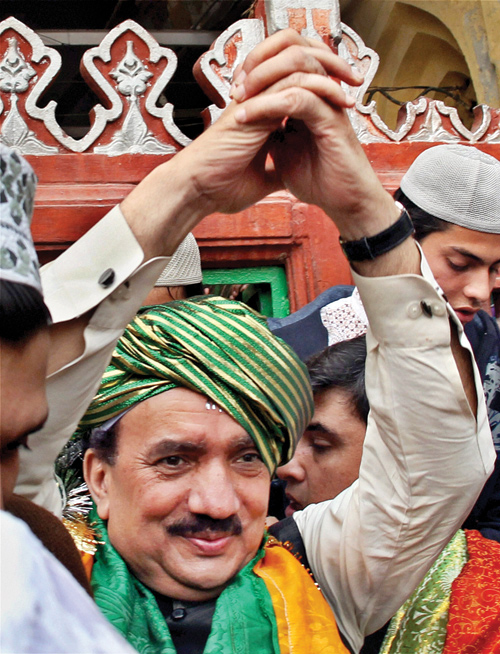 Interior Minister Rehman Malik, the acknowledged clown of Pakistani politics, had no intentions of humouring his hosts in New Delhi. As shell shocked Indian officials slowly recovered from the verbal onslaughts of the man from Rawalpindi, it become clear that there was definite method in his madness.
Malik’s roller coaster ride began the moment he landed in Delhi. On one issue after the other, the calculated design to offend his hosts was breathtaking in its scope: there is no criminal case against LeT chief Saeed Hafeez in Pakistan, Kargil martyr Captain Saurabh Kalia tortured brutally at the hands of Pakistani army could have died of high altitude cold, the 26/11 attacks can be compared to the demolition of the Babri Masjid; they all had the makings of easily derailing the peace process which is being worked rather tenuously with Islamabad.
The Indian response was tepid, to say the least. Union Home Minister Sushil Kumar Shinde was no match for the fireworks generated by his Pakistani counterpart - considering that both are retired policemen - apart from a feeble response to say that Pakistan was not honouring its commitments. That too was brushed aside no sooner had Shinde made his comment.
Sage commentators now want to know why New Delhi invited a freak like Rehman Malik in the first place. Would the Pakistani army and the ISI have been more amenable to good relations if India had not decided to lay out the red carpet for a man who is equally disliked in his own country? Now we know.
According to former Foreign Secretary Kanwal Sibal, Malik’s provocative statements simply implied that powerful people in Pakistan support such defiance of India on the core issue of terrorism. “New Delhi has long broken the link between dialogue and terrorism. The government, no doubt, reminds Pakistan periodically that we expect a quick trial of those accused in the Mumbai case, but then we must remember that we are appealing and not laying down pre-conditions to Pakistan. In fact, Pakistan has been given the political space to stall, without much cost, on the issue of terrorism. Malik came to India with the knowledge that he can continue to side-track India’s demands with disingenuous arguments.’’
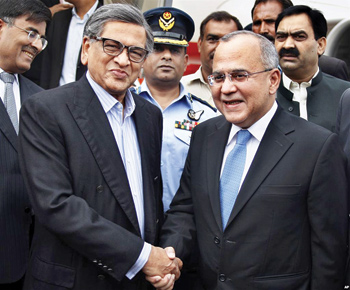
It was yet another demonstration that Pakistani diplomacy has the cutting edge which India with its soft soap approach, may be lacking. Despite virtually insulting his host, Malik walked away with the honours. He inked a liberalised visa regime pact with New Delhi and there was little that New Delhi could do at the stage, hemmed in by its commitment as it was.
To be sure there were apprehensions in India about extending the invite to Malik at a time when adequate progress had not been made on the 26/11 cases. Yet, New Delhi, taking a calculated risk and overlooking similar misdemeanors of the Pakistani establishment on previous occasions, decided to go ahead. Now it could well be ruing its decision.
Malik’s behaviour, when doves on both sides of the Radcliffe divide see some real chance of peace and easing of the visa regime, could not been more ill timed. As a retaliation, the Indian side cancelled the joint press conference scheduled to be held by Malik and Shinde, because as one official said, “we had enough embarrassments already to risk another round of muck raking.’’
Now hard line elements in India are demanding that Pakistan’s limited cricket tour of India later this month be called off.
To be sure, the Pakistani behaviour is not unprecedented. In July 2010, at a joint press conference in Islamabad, visiting Indian Foreign Minister SM Krishna was caught off guard when his then Pakistani counterpart Shah Mehmood Qureshi chose to attack Indian Home Secretary GK Pillai equating an interview he gave to the Indian Express with the utterances of LeT chief Saeed Hafeez. Krishna, clearly not used to undiplomatic behaviour by diplomats, was caught fumbling for words. Instead of taking on the Pakistani Foreign Minister, he did what Indians do best under pressure: pull up his own mandarin in front of a team of disbelieving Indian officials. New Delhi has since then quite been unable to live down this snub which in global diplomatic parlance could be considered outrageous.
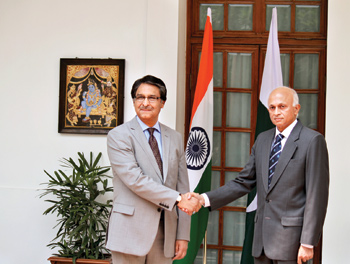 In an earlier visit, then Pakistani Foreign Secretary Salman Bashir, now its High Commissioner in New Delhi, had described details provided by the India on the 26/11 attack as a ‘piece of literature’. This year when Pakistan’s new Foreign Secretary Jalil Abbas Jilani came visiting New Delhi, he categorically ruled out any Pakistani hand in 26/11 saying the evidences presented to his side did not prove anything.
This when leading members of the Pakistani establishment have acknowledged that the plot was fashioned on their land and the FBI has copious details of how ‘state’ actors had planned and plotted the outrage in Mumbai from Karachi and elsewhere in the country.
Veteran journalists recall a yesteryear meeting when then Pakistani representative Zulfikar Ali Bhutto resorted to abusive language in the presence of India’s Foreign Minister Swaran Singh. If the idea was to provoke an ice cool Singh, it never happened.
Sadly for India, some diplomats say, Islamabad has already created – and India has in effect indirectly conceded – equivalence between 26/11 and the Samjahuta Express bombings as both cases find mention in the Indo-Pak joint statements. Malik’s behaviour and his reference to the Samjahuta Express case should then be considered a natural corollary as he decided to take on India single handedly. In the end, it turned out that he held the aces.
According to former Indian High Commissioner to Pakistan G Parthasarthy, the visiting Pakistani’s statements were certainly not off the cuff. “Remarks made in public and their fallout are usually discussed much before the actual meeting begins. Malik’s brief was to put India on the back foot. By giving the Babri Masjid demolition the character of an attack by Hindu terrorists on Muslims, he was insidiously speaking on behalf of Indian Muslims.’’
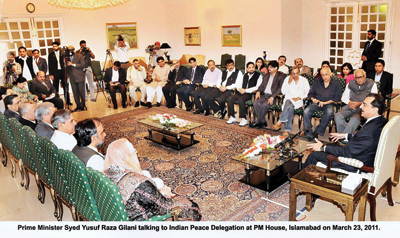
In the case of Pakistan, it is even more clearer: a line out of place will invite the wrath of its military and there is no politician (with the possible exception of Nawaz Sharif) who can afford to sound anti-Pakistan or even neutral when on Indian soil.
One thing is clear though. This latest visit by a Pakistani VIP has impressed upon the establishment in New Delhi that it ought to choose its visitors more carefully. Malik on his arrival in Pakistan, has clearly raised his stock sky high. He boasted openly of having withstood Indian pressure on Saeed Hafeez. Far from disrupting the trust-building efforts between the two countries, the Interior Minister conveyed to India ‘bluntly’ what the establishment in his country believes about 26/11.
Says Sibal, “Instead of paying a price for his provocative statements, Malik returned home with a prize: a liberalised visa regime, which is based on India’s hope of greater Pakistani restraint on India-directed terrorism, the reality of which the Pakistani minister was determined to deny.’’
In the end, most believe that Malik was in India where he knew the media would lap up whatever he said, in other words a media-op. Leading TV anchors fell over each other to get juicy bytes from the dignitary and boy, did he know what to dish out! The cross questioning of Malik was so poorly researched that he was hardly put in the dock. Little wonder that the Pakistani VIP was grinning from ear to ear and enjoying himself thoroughly during the so-called grilling.
The reaction of Indian officials was way too timid for the rough and tumble of south Asian diplomacy. While Home Minister Sushil Kumar Shinde was unable to contradict his counterpart on virtually any point, sitting it out glumly when he had to open his mouth decisively, the Home Secretary RK Singh termed Malik’s assertion that detained terror suspect Abu Jundal was actually an Indian agent as ‘ridiculous’. That is as hard as India got in the face of blatant provocation and that is not saying much.
As ever, India’s media management has come under a cloud. Reporters who covered the visit say that after Malik had met Prime Minister Manmohan Singh, they had to rely upon the Pakistani version of the talks as there was no formal or informal briefing by the PMO.
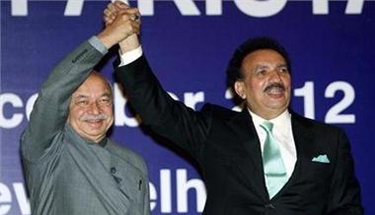 In hindsight, former Home Minister P Chidambaram during his tenure kept putting off a Malik visit to India for the visa agreement on the grounds that the Pakistani side needed to submit voice samples and show signs of fast tracking the 26/11 cases going on its country. More than anyone else, Malik sensed the opportunity with a clueless Shinde in office finally acceding to Islamabad’s request.
There is also the view that internal compulsions forced Malik to do what he did, with elections due there in a few months time. But it also showed that Pakistanis had done their home work well.
‘Malik asked us to get lost on 26/11’
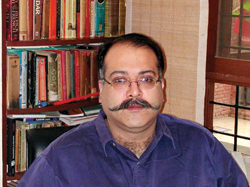 Sushant Sareen is regarded as a keen Pakistani watcher. As a consultant for the Pakistan Project at the Institute of Defence Studies and Analyses, he talks to TSI in an interview.
What does the Malik visit signify?
It just proves that our guest had low cunning. Malik's visit is proving to be a major embarrassment for the UPA government which is already on the defensive as far as Pakistan is concerned. What this visit has done is that it has helped Malik poke holes in India’s 26/11 case by insinuating that one man’s word, Ajmal Kasab, does not actually amount to the real truth. Then it needs to be asked what a Pakistani judicial commission is going to do here when its Interior Minister has already put question marks on the Indian investigations. He has tried to pre-judge. What more evidence can India give? After all, the planning was done in Pakistan.
Should we have invited Malik, given his proclivity to talk out of turn?
Who invited Malik, he invited himself. It is probably linked to elections in Pakistan where a caretaker government is soon going to be in place. Elections are due there in either March or April. Despite talk of consensus in Pakistan on their India policy, there is growing resistance to granting India Most Favoured Nation (MFN) status. There is stiff resistance. If there is no consensus on MFN, what is the hurry about liberalising visas. It is very doubtful how many Indians would want to go to Pakistan. He just wanted to come to India and behave like a bull in a china shop, probably go down as the man who liberalised the visa regime, but tell me, who remembers the last signatories of the visa regime today?
Yet you have to talk to Pakistan because geographies cannot be altered and they are our neighbours.
Literal geographies may not change but political geographies do. In the last 500 odd years, a number of states have disappeared and new ones have come into existence. Pakistan’s political geography was altered in 1971. It is good to maintain neighbourly relations but is that the prerogative of just one neighbour? You sponsor terror, counterfeit and drugs to India while we are keen to see that our neighbours are kept in good humour.
What about the Indian media?
They obviously lapped up Malik; there are a number of journalists here for whom Pakistan is a hobby. He was just allowed to speak and there were no counter questions or quality questions to put Malik in his place. His answers were what you would expect from a retired DSP level officer.


 Issue Dated: Feb 5, 2017
