


- Article
- Comments (0)
Territorial dimensions
Indian visitors to Pakistan come back with fond memories but the same cannot be said of those who represent the Indian state.
Tags : Pakistan | Rehman Malik | Kashmir | Indo-Pakistan border | Afghanistan |
 Pakistan’s Interior Minister Rehman Malik who recently visited India for talks with Home Minister Sushil Kumar Shinde, attempted to contribute to better India-Pakistan relations, but failed to do so. Evidently, diplomacy does not appear to be his forte. While Pakistan Foreign Minister Hina Rabbani Khar who visited India earlier, made a positive impact on bilateral relations, Interior Minister Malik had the opposite effect on these troubled ties. He said the wrong things and offended his hosts.
What is the future of India-Pakistan relations? Till now, the progress in bilateral relations appears to be poor. Considering the track record of their ties, for every one step forward, there are three steps backwards. Whether or not the future of their relationship will replicate the past and to what extent remains to be seen.
While the people-to-people relations between the two sides are terrific, the government-to-government relations are terrible. Indian visitors to Pakistan on private visits tend to return home with fond memories of their stay there. However, those Indians who represent the Indian State in Pakistan may not necessarily have similar experiences.
Former Pakistan President Pervez Musharraf recently highlighted in a newspaper interview that Intelligence agencies and diplomats in either countries are instrumental in imposing restraints on friendly relations between both the neighbours. How valid is his line of thinking? How does India formulate policies towards Pakistan? Clearly the Prime Minister’s Office drives policies with inputs from the Ministry of External Affairs (MEA), the Army and the intelligence agencies. The National Security Adviser is a key actor in policy formulation towards neighbouring countries, especially Pakistan and China. To that extent, the political vision of the ruling dispensation in New Delhi determines the contours of our Pakistan policy. Clearly it is a top down model.
India has attempted time and again to improve relations with Pakistan but the religious right in Pakistan does not desire to have friendly relations with India. What is New Delhi supposed to do under such circumstances? New Delhi has to keep talking with Islamabad and therefore the only course of action is to pursue diplomacy to ensure that misunderstandings through miscommunication do not arise. This has the potential to lead to war between both neighbours who have already fought each other four times, besides innumerable border skirmishes or patrol clashes from time to time thrown in.
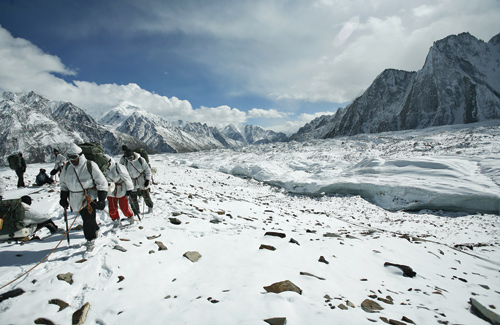
The Indian and Pakistani military deployments in Siachen are another unhappy reminder of the trust deficit and potential for war between the two neighbours. Given the hostile terrain in Siachen that kills more soldiers than enemy action, it makes strong sense to embark on military disengagement from the area. However, the Indian Army has strong reservations against disengagement. Considering the blood, sweat, toil and tears of our brave soldiers and airmen shed over Siachen, their views cannot be dismissed lightly.
After six-and-a-half decades of bilateral relations, tremendous trust deficit characterises Indo-Pakistan ties owing to four wars that the two countries have fought and sparked off a never-ending arms race, besides other manifestations of national insecurity like frequent cases of spying to ascertain military preparedness levels on either side of the border.
Otherwise India rakes up the issue of cross-border terrorism with Pakistan every time diplomatic delegations from the two sides meet each other for talks. Today Pakistan is also a victim of terrorism and unable to manage the 300,000 armed jehadis who hold the Muslim state hostage. Clearly the capability to channelise the energies of these armed jehadis externally towards India serves a two- fold purpose. Keep them externally engaged so that they prove that much less problematic domestically. Secondly, Pakistan can leverage these jehadis to keep the Kashmir issue alive vis a vis India. Especially considering the Muslim state has successfully privatised armed jehad and distanced itself from such violent activity, so much so that state involvement can be technically denied.
Apart from the age old Kashmir issue, India-Pakistan relations over the last two decades have another territorial dimension, namely Afghanistan. Now New Delhi and Islamabad fight their cold war in Afghanistan which only heightens the hostility in their bilateral relations. Pakistan experiences immense insecurity owing to an Indian presence in Afghanistan and the substance in New Delhi-Kabul relations.
Pakistan Interior Minister Rehman Malik’s recent visit to New Delhi therefore needs to be viewed in the backdrop of these realities that characterise ties between the two countries. What is the way forward to normalise relations between the two neighbours? The only hope is through increased people-to-people contact driven by enhanced economic and cultural engagement. India is traditionally a trader nation and Indian businessmen would find hungry markets in Pakistan ready to absorb their goods. For Pakistan, the attraction would be cheaper goods due to lower transportation costs.
Otherwise the cultural engagement already includes music groups who tour each other’s countries. An extension of this could be medical tourism with Pakistani patients who come to healthcare hubs like Bangalore and elsewhere for specialised treatment at affordable prices compared to similar facilities and resources in the western world. At the social and economic levels, this would appear to be the only manner to proceed on the path towards peace.
At the political level, the only way to manage the problem of territorial nationalism over Kashmir would be through conversion of the Line of Control (LoC) into an international border. India lacks the military muscle to recapture Pakistan Occupied Kashmir (PoK) and therefore should adopt a realistic solution.
Perhaps for Pakistan the time to engage India does not appear to be right at the moment with the Western military disengagement from Afghanistan scheduled to take place in July 2014. The exit of military forces will once again alter the regional strategic environment and have a bearing on India-Pakistan relations. Besides, with India due to go to the polls in 2014, perhaps a new leadership in New Delhi may view relations with Pakistan differently from the present dispensation.


 Issue Dated: Feb 5, 2017
