


- Article
- Comments (0)
Peace of the graveyard
Tags : Bodoland | Assam | Bodoland Territorial Area District |
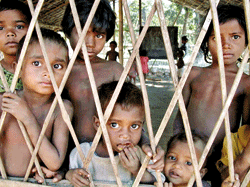 Three months after ethnic disturbances in Assam's Bodoland Territorial Area District (BTAD) claimed over 100 lives, the fires of hate have barely burnt themselves out.
In July this year, ethnic clashes between Bodos and alleged illegal migrants in the Bodoland Territorial Area District (BTAD) had claimed over 100 lives.
In the frenzied settlement that followed the violence, the Assam government had set up 213 relief camps for victims in Kokrajhar, Chirang, Bangaigaon and Dhubri districts. According to officials, these camps housed nearly 4.85 lakh inmates, including more than 1.33 lakh Bengali-speaking Muslims.
In relief camps where the marooned destitutes face an uncertain future, old fears continue to haunt, coupled with new threats. As for rehabilitation, it is the familiar old cant: the government machinery is not up to the mark.
Hope for the victims of violence has diminished considerably after an August 15 deadline set by Chief Minister Tarun Gogoi to shift them out of the camps, expired many weeks ago.
One reason for this impasse has been the slow rehabilitation process, which actually saw the light of the day only as late as the third week of October. It also presents other complications. At a recent press conference, Gogoi claimed that 3,43,249 people had already been rehabilitated while 42,000 continued to live in the relief camps as they lacked appropriate land documents, adding that rehabilitation in these cases was being worked out as well.
In Assam, implementing any policy is tough, and if it is related to ethnicity, the problem is accentuated. On the face of it, both the state government and the BTAD administration are joint partners in the rehabilitation process. But BTAD chief Hagrama Mahiliary has bluntly told the state government not "to rehabilitate doubtful people without proper land documents". He says, "No Bangladeshis will be allowed to settle in BTAD."
Such well-stated positions have seeds of discord sown into them. It flies in the face of Gogoi's assertion that those who have ration or PAN cards will be rehabilitated . Many victims in the camp say they took the government's August 15 deadline seriously and vacated their temporary accommodations in Panbari, Titaguri, Balajan, Bhotgaon, Kachipara, Matiapara, Bilasipara and the Indra Narayan Academy.
Nazrul Islam of Duramari village told TSI, "We have nothing to do in our village. Our houses were burnt down. We have been unable to cultivate paddy and I have no idea how I will run my family." Rahmat Ali of Hekiapara village has a similar tale. Miscreants burnt down his house and the administration "forced" his family to leave the relief camps. "We were informed that we would get cash assistance to rebuild homes. But so far, there is no news," he points out.
With the state government unable to meet its deadline, academic sessions in schools and colleges have been delayed, or worse, disrupted.
Prabin Bodo, spokesman of the Bodo Peoples Force (BPF), is hopeful that the situation will normalise. The situation went out of hands because "in this clash between indigenous people and illegal migrants, some third forces instigated common villagers into believing that it was a religious clash. But people have become wiser to the situation and will not be manipulated again," he avers.
But just how tenuous this peace in the fight for space is, is echoed in Prabin Bodo's next statement. "It is also certain that no illegal migrants will be allowed in BTAD because they are trying to occupy land meant for common people and have penetrated every sphere of life. As daily wage earners, they have snatched local jobs. Genuine victims have shifted back to their homes but those at the relief camps must submit authentic documents before they leave the camps."
Opposition is also mounting from other ethnic organisations. The Tribal Sangha had protested against the state's rehabilitation policy, saying that without verifying land documents, any rehabilitation will lead to violence.
Explains Sulekha Basumatary of Grahampur village under the Gossaigaon police station, "Though we have returned home, we are not safe. I have lost my brother in this clash. We are getting some relief from the state government but it is not enough.’’ There are many like her.
If the July clashes were meant to sort out ethnic difficulties, it has probably ended up aggravating the problem of migration. Already, 27 organisations in the BTAD have expressed unity on anti-migration issues. They have demanded that migrants – irrespective of religion – who entered the state after March 25, 1971, must leave at any cost.
Such cut-off dates have special significance in the state. The six-year-long Assam movement spearheaded by the All Assam Students Union (AASU) between 1979 and 1985, began on the subject of fixing this date. After coming to power, the Assam Gana Parishad government, led by AASU leaders, lost track of their main agenda and since then, the ethnic wound has festered. The demand to deport illegal migrants is clearly audible in the state with matching posters and graffiti adding to the crescendo.
The Congress-led UPA government too is watching. Union Home Minister Sushil Kumar Shinde has expressed the Union government's rising concerns on illegal migration. He said flood lights would be increased along the borders to identify those crossing over. Clearly, while some temporary peace has been restored, the state continues to sit on a politico-ethnic tinderbox.
(With inputs from Dulal Misra)


 Issue Dated: Feb 5, 2017

