


- Article
- Comments (0)
Disadvantage Akhilesh
UP, which elected a 'secular' SP earlier this year, has witnessed a series of communal flareups. Puja Awasthi looks at a number of unanswered questions
Tags : akhilesh |
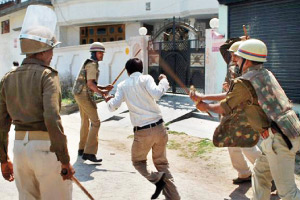 A riot has many versions. In curfew-bound Faizabad, all those versions grow from the same source – the molestation of a woman during the procession to immerse the idols of Goddess Durga after a nine-day period of prayer that set off a sequence of variously recounted events that culminated in looting, arson and mayhem.
The answers to other questions – How did one incident grow to such monstrous proportions? Why was the police unable to quell the violence? Why was there not enough force to manage the large crowds for an event that is a yearly occurrence? Were there triggers that went unnoticed by intelligence agencies? Why were liquor shops open on the day of a festival? Why was there no pressure in the water sprayed by the fire ambulances? Why was there a fresh bout of violence after the curfew was imposed? – are still being guessed.
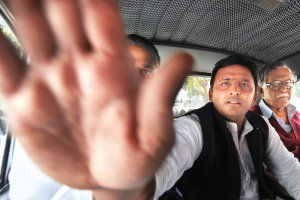 The state’s Chief Minister Akhilesh Yadav has voiced his oft repeated excuse of a conspiracy against his government. His police chief AC Sharma has admitted that his men did not react in time. And the opposition has played its role by slamming both for inaction. While the answers are yet to emerge, a deep sense of shock runs through the minds of Faizabad’s peace-loving citizens who had desisted from rioting even at the peak of the Ram Janmbhoomi movement which had its epicentre just seven kilometres away in Ayodhya. Mahant Jugal Kishore Sharan Shastri of Ram Janki Mandir in Ayodhya, says the episode was “not a riot but an attack on Faizabad’s secular fabric and its shared legacy”.
“The previous government was not more secular than this government, but the administration was firm. The lack of experience of the chief minister is showing. It is all very well to attribute the violence to a conspiracy, but that does not cover the inaction of the police. The communalisation of the force is complete,” says Shastri.
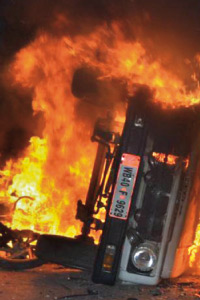
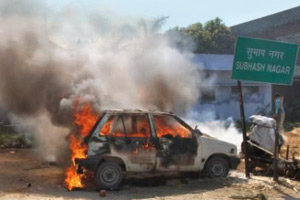 According to the accounts of several eyewitnesses from Faizabad, the arsonists were allowed a free hand for over two hours. The outnumbered policemen either looked on or disappeared as rioters torched over 40 shops, and police and private vehicles in the Chowk area which lies at the heart of the city. Local MLA Tej Narayan Pandey made a fleeting appearance but was frightened away. Next morning (October 25), as the toxic swirl of rumours grew (for example, kerosene oil was being distributed freely by a kotedar for use in petrol bombs) the violence travelled to Bhadarsa – a town on the outskirts of Faizabad, where more than a dozen shops were torched.
Lallu Singh, five-time BJP MLA from Ayodhya, says police laxity gave impetus to the initial rioting. “Whenever the Samajwadi Party (SP) comes to power, people of one community feel emboldened. They get the licence to do anything as the police and administration are under instructions to look away. The procession was heckled, pelted with stones and devotees prevented from throwing gulal. The retaliation was bound to be big.”
Housed above the Ghantagar Masjid, the office of Aap Ki Taqat, a Hindi Urdu weekly, was also ransacked in the first bout of violence in Faizabad. Manzhar Mehndi, founding editor of the newspaper, says, “There was a clear conspiracy to provoke the minority community to retaliate. That would have caused the police to fire. The procession was run over by drunken, belligerent men singing obscene songs. Things could have turned far worse had the minority community struck back.”
Faizabad is the ninth scene in a series of big communal clashes that have rocked the state since Akhilesh Yadav became the chief minister on March 15 (see box). If other incidents of communal violence (there was one in Faizabad on July 24 when a small argument led to stone pelting and the torching of roadways buses) are added, that number rises to 50. In all cases, petty arguments have flared and armed mobs have run amok.
Senior BJP leader and Lucknow MP Lalji Tandon says, “The government is working for one community. It is giving rise to differences among people and this is being manifested in anger. This is a government of many leaders who are at war with each other. There is no control”.
Ironically, that view of a lack of command was strengthened by the state’s top cop, DGP AC Sharma who said, “I asked an officer (present at the scene in Faizabad) why are you not using force…it did not happen and the violence ensued,” giving weight to the theory that police inaction contributed to the scale of the violence.
Sharma himself is not the best officer to inspire confidence in a communally disturbed situation. His role as SSP Kanpur Nagar in 1992, when more than 200 people were killed in rioting that broke out post the Babri Masjid demolition, is believed to have been put under a cloud by a never made public report of the Justice Mathur Commission submitted to the state government in 1998.
 Police inactivity in the state is an extension of government apathy. In many incidents of violence that have erupted recently, the roles of powerful political leaders, some ministers in the ruling party, have been hinted at but no action has been initiated. In Bareilley, for instance, a cache of arms was recovered from the home of a SP corporator. Similarly a report by the People’s Union of Civil Liberties (PUCL), UP, on the violence in Asthan village (Pratapgarh) notes, “The roles of local MP Shailendra (Kumar), Kunda MLA Raghuraj Pratap Singh (Minister of Food and Jails) and another MLA, Vinod Saroj, were anti-Muslim and the attackers had their support”.
These faultlines in the administration and the police are being grimly exploited. According to the above mentioned PUCL report, the second spurt of violence in Pratapgarh was stoked by the visit of international working president of Vishwa Hindu Parishad (VHP) Praveen Togadia on July 24. The report says that “inflammatory slogans” were raised during the visit leading to fresh attacks.
Similarly, Faizabad, which was reeling under a sense of outrage after idols from the Devkali temple were stolen in September, was paid a visit by the fiery Yogi Adityanath, MP from Gorakhpur who had threatened to launch an agitation if the asthadhatu idols were not recovered. (Four members of an international smuggling gang were rounded up with the idols on October 23, a day before the violence erupted).
Sharad Sharma, Ayodhya-based VHP spokesperson, says that statements such as those coming from senior SP leader Shivpal Yadav that the BJP and RSS are instigating communal hatred are baseless. “It was natural for people to be agitated by the theft of the idols. But the protests were peaceful. There was nothing premeditated about the violence. There was instigation and its reaction. Police inaction emboldened the agitated crowd.”
Maulana Amir Rashad Madni, president of the Rashtriya Ulema Council, counters that both the SP and the BJP are polarising the state to reap electoral benefits in 2014. “Despite coming to power because of Muslim support, the SP has created deep fear among the community. By allowing a free run to communal forces the party hopes to deepen religious divides for vote bank politics. The SP and the BJP are helping each other.”
While this might run contrary to the charge of minority appeasement being hurled at the ruling party, within the community there is a growing sense of dismay at half promises. The poll pledge to give Rs 30,000 to Muslim girls who pass class X, for instance, has been tweaked to apply only to girls from BPL families. There is no movement on other assurances like the 18 per cent reservation in jobs and the release of innocent Muslim youths framed on terrorism charges. Meanwhile, the CM has erred in not visiting any of the riot-hit areas to offer solace to the affected.
The government is burdened by its own existence. In addition to openly resentful senior leaders like Azam Khan who often stay away from functions chaired by the CM, there are elements disgruntled at not having gotten their dues post the party’s stunning victory. The much coveted chairmanships of corporations that come with ministerial status are yet to be doled out to party loyalists.
A senior party leader says, “There is a strong sense of identification with netaji. One feels proud to be associated with him. That is not the case with Akhilesh. How can he hope to earn our loyalty if we derive no benefits from being in the government? Even low-level officials are refusing to listen to us.” If despite a dismal law and order report card and growing dismay within party ranks the government does not give the appearance of complete breakdown, it has only the opposition to thank. Thus, while the SP slams the UPA government it supports for giving space to the corrupt in its ministries, not a squeak emanates from the Congress leadership on the alarming state of communal relations in the state. So long as Mulayam Singh Yadav is seen as a pivot in the post-2014 election scenario, parties that aspire to be part of the Third Front are silent.
Javed Abdul Wajid, a retired professor of Physics in Bareilley, says, “The government is fomenting situations where it can be seen as the protector of the Muslims. It is creating the illusion of preferential treatment without actually doing anything while encouraging fanaticism of every kind. Growing economic deprivation is leading to mutual hatred and small issues are becoming huge. There is a real possibility of a very big clash before the elections.”
Clearly something rotten is brewing in the state. A concoction of shrewd political ambition and subtle incitement is being infused with generous doses of duplicity. A dreadful template is being set for the next general elections. Unlike the many versions of a riot, this is an ugly truth which can be read just one way.
puja.awasthi@planmanmedia.com


 Issue Dated: Feb 5, 2017

