



- Article
- Comments (0)
Nielsen back on the receiving end, again
NDTV’s strong lawsuit against TAM and the people who control it (Nielsen and Kantar) exposes manipulations that are calamitous for the entire market research fraternity. And it also begs a question oft repeated by us – why does Nielsen, in particular, find itself in the ignominious limelight so consistently? By Virat Bahri
Tags : Tam ratings | David Calhoun | Nielsen Media | Prannoy Roy | NDTV | |
 David Ogilvy gifted us with many gems of advice, and one of them went thus: “Advertising people who ignore research are as dangerous as generals who ignore decodes of enemy signals.” Such is the importance of research in the marketing world, since it is the starting point of the marketing philosophy of ‘sense and respond’. While timely and accurate research is essential to effective advertising, it is also extremely important for media planners to ensure that a communication reaches the target audience and makes the desired impact. Conversely, incompetent market research (MR) is equally dangerous, and MR companies have to stay on their toes to keep their research results in tune with reality. But what about MR that is manipulated, and that too, by the best in the business?
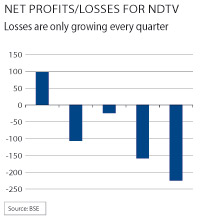
The latter is the basic context of NDTV’s recent lawsuit filed in the Supreme Court of the State of New York. The news channel has alleged that Television Audience Measurement (TAM) ratings have been deliberately manipulated in India over the years to report a lower market share for NDTV. This, in turn, has led to losses, which are “not less than $ 810 million” over the past eight years. Matters have worsened to the extent that NDTV is now seeking at least $ 1 billion in damages from Nielsen and Kantar, which jointly operate TAM ratings in India.
.jpg) Nielsen is certainly no stranger to criticism over its research practices. The data released by the company for the FMCG sector is a case in point. For the quarter ending June 2012, seven of the listed FMCG giants reported an average value sales growth of 19.28 per cent as compared to Nielsen’s estimate of 17.6 per cent. Even more significant discrepancies were found in the data across categories and companies (as reported in a leading national daily). Nielsen has maintained that it brings out a retail audit and it is technically wrong to compare it to actual quarterly results, but FMCG players have been critical of Nielsen’s research reports over time. Unilever CEO Paul Polman has claimed to the media that Nielsen is not very accurate with their numbers.
Nielsen is certainly no stranger to criticism over its research practices. The data released by the company for the FMCG sector is a case in point. For the quarter ending June 2012, seven of the listed FMCG giants reported an average value sales growth of 19.28 per cent as compared to Nielsen’s estimate of 17.6 per cent. Even more significant discrepancies were found in the data across categories and companies (as reported in a leading national daily). Nielsen has maintained that it brings out a retail audit and it is technically wrong to compare it to actual quarterly results, but FMCG players have been critical of Nielsen’s research reports over time. Unilever CEO Paul Polman has claimed to the media that Nielsen is not very accurate with their numbers.
It is not restricted to FMCG players. A spokesperson with a consumer durables firm speaks on condition of anonymity, “We had problems with Nielsen data on our market share since they had largely ignored the regions where major infrastructure development is happening.” Once Nielsen addressed these issues, the particular player’s market share more than tripled. A radio industry official also admitted that he was unhappy with Television Audience Measurement (RAM) readings. He cites the example of Radio One, which turned from Hindi to English in January this year. But its market share (as per RAM) remained just about the same, which is quite improbable with such a shift in audiences.
TAM ratings themselves have largely failed to find favour with the TV industry. But the case document filed by NDTV is a Pandora’s box of sorts, which goes beyond research competence to make shocking allegations of deliberate manipulation of TAM data for commercial gains and steadfast resistance by the ratings agency to make amends. At the very outset, the case document alleges that the core reason why Nielsen is neglecting customers is the fact that it is now controlled by private equity (PE) players like KKR and The Blackstone Group. Since these groups have short term gains in mind, Nielsen is allegedly looking at cost control and cost avoidance measures; the most common being “refusal to increase sample sizes” and not adapting to local conditions. A committee report in 2010 indicated that the sample size of 8150 for TAM and 6000 for aMap was grossly inadequate for a market with 129 million TV watching households. An e-mail request for interaction sent to the Nielsen India office for this story went unanswered.
NDTV documents that it first raised the issue way back in 2004.On November 9, 2004, NDTV officials noticed how viewership for English news channels went up from 50,000 to 200,000 in a span of two hours, despite the fact that there was no significant breaking news/change in programming. Also, viewership of a competing channel went up to 70 per cent from 20 per cent in that time span and dropped back to 20 per cent afterwards.
 The channel also saw strange variations in its market share data. In May 2009, GfK Mode showed that NDTV 24x7 had a viewership share of 60 per cent among the leading English news channels while Nielsen showed it to be 61 per cent. However, while GfK Mode showed that NDTV 24x7 had a viewership share of 56 per cent in August 2011 and 51 per cent in March 2012, TAM figures pegged the share in these periods as significantly lower, which is statistically impossible and hence indicates manipulation. Interestingly, when Dr Prannoy Roy, Founder and Executive Co-Chairman, NDTV, asked Nielsen officials whether such differences in statistical data and PeopleMeter data were possible, they replied in the negative and promised to look into it. Other instances were observed with NDTV group channels; like for NDTV Profit in June 2010, GfK Mode reported a share of 34 per cent while TAM reported 23 per cent. For channels like NDTV, where advertising accounts for 70-80 per cent of revenues, such manipulation can be extremely costly. In another case, the plaintiff observed that “the average viewing time in the panel of “Madhya Pradesh” rocketed by 700 per cent in one day, while the average time spent per viewer amongst SEC B witnessed a 5500 per cent increase from 2 minutes to 111 minutes for just 1 particular day, before falling back to normal”.
| Some glaring allegations by NDTV on TAM Ratings |
|
NDTV has lost “not less than $ 800 million” on account of “the false, fabricated and manipulated data released to the public by Nielsen, Kantar and TAM over the past eight (8) years” Serious manipulations could be inferred from TAM data over time, which were communicated to TAM officials. For instance, in an e-mail dated November 9, 2004, NDTV pointed out discrepancies in “the Sunday Viewership of English news channels during 12:30 hours to 14:30 hours, as the same went up from 50,000 to 200,000, despite no change in programming and no special event or breaking news occurring”. As per a communication to the board of the News Broadcasters Association last year, Rao, Executive Vice Chairperson, NDTV, expressed his concerns “relating to the reports of fiddling of PeopleMeters installed by TAM. Rao informed the Board that some broadcasters were indulging in undesirable activity, giving a bad name to the rest. Rao further mentioned that he had been made aware of how the tampering was being done and cited some of the unethical practices in this regard such as subverting the ratings system by “discovering” the panel homes that have PeopleMeters installed in them, doctoring data emerging from “parallel homes”, providing a separate TV in select panel homes for viewing while the TV linked to the meter was tuned to specified channels, misuse of the guest button where up to 10 guests can be shown watching even when there is no one there, specified marketing in localities that have panel homes, subverting the technician and using him to “fix” the PeopleMeter while tuning and skipping channels in the process”. NDTV’s representation states that despite senior officials at Nielsen and Kantar having admitted to “the existence of rampant corruption and manipulation in the collection and dissemination of TAM viewership data, which consistently and wrongfully showed a very low viewership figure for the news channels of NDTV, they recklessly and in pursuit of profits continue to release tainted data every week up to the date of filing this Complaint”. Source: Case document filed by NDTV on July 26, 2012, Deadline.com |
Numerous communications were sent to TAM officials. Face to face meetings also took place, but NDTV was not satisfied with Nielsen’s approach. Meanwhile, NDTV even ran an advertisement with the tagline, “You can fiddle data, you can’t fiddle truth”, which TAM and Nielsen officials strongly objected to. In a meeting with the Board of Directors of the News Broadcasters Association in November 2011, Narayan Rao, Vice Chairperson, NDTV, expressed concern over fiddling of TAM meters by some broadcasters. The means he cited included “subverting the ratings system by 'discovering' panel homes with PeopleMeters installed in them, doctoring data emerging from 'parallel homes', providing a separate TV in select panel homes for viewing while the TV linked to the meter was tuned to specified channels, misuse of the guest button where up to 10 guests can be shown watching even when there is no one there, specified marketing in localities that have panel homes, subverting the technician and using him to 'fix' the PeopleMeter while tuning and skipping channels in the process”.
At the JW Marriott in December last year, two TAM consultants met with NDTV officials Rohit Lamba and Mohan Shankar and “explained, inter alia, their modus operandi to ensure enhanced ratings and staying clear of TAM’s Outlier detection techniques”. On January 20 this year, top NDTV officials (Dr Roy, Vikram Chandra, et al) met with top officials of Nielsen and explained their entire stand on TAM data manipulations. A whistleblower, who provided services “to, inter alia, track happenings on the ground with TAM panel and panel homes”, explained how the entire process went and how TAM officials were also involved. Even Nielsen and Kantar affirmed that the information provided by the consultant was correct. In a subsequent meeting with NDTV, Nielsen US officials and Kantar officials (represented by global CEO Eric Salama) Bob Messemer, Chief Security Officer, The Nielsen Company, admitted in the presence of about 15 people, that “right through his professional career, he has been called in to put out many 'fires' across the world for Nielsen, but so far he had never seen anything like this 'absolutely shocking and unf…g believable' corruption at Nielsen and TAM in India”. However, till the date of filing, NDTV maintains that Nielsen and Kantar have not really addressed their core concerns, prompting the legal action. The network alleges that despite the trust established in the meeting on January 20, Nielsen misused the trust by “(a) continuing to allow TAM to publish weekly TPR reports after January 20, 2012; and (b) failing and/or refusing to take reasonable and appropriate remedial measures to cure the defective Nielsen Process, in India”.
Undercurrents of discontent with TAM ratings were there in the past, but the NDTV case certainly brings a lot of skeletons out into the open. While the TV broadcasting industry and the market research community will view developments in this case with mixed emotions, there are definite positives too. NDTV’s aggressive posturing could lead the way for other broadcasters facing the heat from TAM ratings. In a related development, Prasar Bharti has decided to approach the Competition Commission of India (CCI) and file a case against TAM for monopolising TV ratings and providing wrong information about Doordarshan’s coverage. Talks of bringing out the Broadcast Audience Measurement Council (BARC), an alternative audience measuring mechanism at the earliest are already going strong. For Nielsen and Kantar (more so for the former), this confluence of trends sends out a very stern message – they need to either shape up or ship out, and in quick time.
virat.bahri@planmanmedia.com


 Issue Dated: Feb 5, 2017

