

Friday, October 23, 2026


- Article
- Comments (0)
Is it really the right time for off-roading?
DEEPANSHU TAUMAR | Issue Dated: April 29, 2012, New Delhi
Tags : Indian auto component manufacturers | drop in vehicle sales | slowing economy |
Tags : Indian auto component manufacturers | drop in vehicle sales | slowing economy |
 Of late, several Indian auto component manufacturers have begun to diversify into sectors such as defence, aerospace and railways to hedge against the drop in vehicle sales and a slowing economy. But is it the best solution for them? By Deepanshu Taumar
It didn’t seem like a typical day at the Sona Koyo Steering Systems’ manufacturing plant located on the Delhi-Jaipur highway, approximately 38 kms from New Delhi. When we entered the facility (spread across 14,125 square metres), we could see only a few workers fixing accessories at each of the assembly lines meant to roll out a different steering wheel for vehicles ranging from cars to trucks and MUVs to SUVs. Although the place was brimming with activity, it didn’t look like a production unit, which employs over 5,000 workers and is the prime facility of a company that claims to be the largest manufacturer of steering systems for the passenger car and utility vehicle market
in India.
in India.
 As we walked through the departments, it looked as if the workers had already met their daily targets. But outside the main plant, we saw heaps of finished products lying, waiting for their turn to be shipped. We were told by the company officials that these products would soon be dispatched. As we were not convinced, we pried further. The administrative head confirmed that the company is diversifying into supply of parts for off-road vehicles and is currently testing its products with a US-based firm with a view to start exports from early next fiscal. We had hit the bull’s eye!
Due to inflation, rising cost of raw materials, interest rate and fuel price hike, several Indian auto components manufacturers, including Sona Koyo, can be seen diversifying into sectors such as off-roaders, farm equipment, defence, aerospace and railways. While Delhi-based Anand Automotive is looking forward to venture into defence equipment and is scouting for a potential partner, the $1.3 billion integrated components manufacturer Amtek Auto plans to increase its sales contribution from defence and railways to 30% (from 6-7% at present) in the next three-four years. Furthermore, the industry body ACMA (Automotive Component Manufacturers Association of India) recently set up a committee, which encourages auto-component manufacturers to diversify into other sectors. So, what calls for this tough decision?
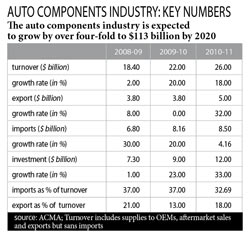
According to the Society of Indian Automobile Manufacturers (SIAM), after growing at a spectacular pace of 30% in the last fiscal, car sales in India have dropped by 1.5% in the first 10 months to January this fiscal. In fact, the gloomy economic environment has forced SIAM to once again lower the sales forecast for this fiscal – third time in a row – to 0-2% in January 2012 from 2-4% in October 2011. This is creating problems for an industry, which is already up against challenges such as lack of good infrastructure and increasing input costs and could further slow down their growth. ACMA estimates that an investment of $35 billion must be made over the next decade to help car makers realise their targets. But the industry invested a measly $1.7 billion in 2010-11, half of the required rate.
In fact, the symptoms are clearly visible. For instance, while Sona Koyo has reported a 32.84% fall in consolidated profit after tax for Q3 FY2012 (from Rs.204 million in Q3 FY 2011 to Rs.137 million in Q3 FY 2012), net profit of Amtek Auto has fallen by 7.23%, from Rs.582.50 million in Q3 FY 2011 to Rs.540 million in Q3 FY 2012. Even big players like Sundram Fasteners (from Rs 280.10 million in Q3 FY 2011 to Rs.248.40 million in Q3 FY 2012) and Rico Auto (from Rs 75.90 million in Q3 FY2011 to Rs 18.50 million in Q3 FY2012) have seen a massive decline in their profitability over the last one year.
Motherson Sumi, one of the largest manufacturers of automotive rear view mirrors, reported a net loss of Rs.247.20 million in Q3 FY 2012 against a net profit of Rs.1,063.7 million in Q3 FY 2011.
The only way out for them at the moment is to hedge themselves against the drop in vehicle sales and a slowing economy (at 6.1%, India’s economic growth slowed to its weakest annual pace in almost three years in the three months to December 2011). And how? By diversifying into non-auto components. Since the margins in the non-auto component sectors, such as power, oil and gas, aerospace and railways are higher at least by 200-300 basis points, it makes sense for companies to diversify to improve their profitability. Agrees Rohit Saboo, President and CEO, National Engineering Industries (NEI), “The biggest challenge of the market we are present in lies in its uncertainty. In fact, seeing last year’s drop in sales of passenger vehicles, we are now planning to diversify into new segments to hedge against the cyclical nature of the industry in which we operate.” According to a recent report from the credit rating agency ICRA, “Companies that have been able to diversify into multiple automotive segments have benefited by remaining relatively immune from periods of weakness observed in a particular segment.” A case in point is Bharat Forge, which has hedged itself against the industry’s cyclical slowdowns by getting into heavy forgings, aerospace and other critical parts for nuclear power plants, among others. Result: The profitability of the company has been increasing steadily over the last few years – from Rs.1.03 billion in FY 2009 to Rs.3.1 billion in FY 2011.
Having said that, such initiatives don't pay off immediately and the gestation period could be as long as five years. But it hardly matters to players in the industry, which is also beset by rising raw material costs. A report by securities firm Anand Rathi says that the cost of raw material has risen by 40-50% over the past year and has taken away India’s low-cost manufacturing advantage. It adds that the price difference for steel works out to 18% in favour of China and on an average, Chinese products are at least 13-15% cheaper than products offered by Indian auto components makers.
Counterfeit components, mostly from China, pose another big problem. According to ACMA, the auto-component replacement market in India is infested with Rs.87 billion worth of counterfeit parts. The components aftermarket forms around 25% of the total auto-component market, which is valued at Rs.247.5 billion ($5.5 billion), as per ACMA data. Thus, the only way out for auto components manufacturers is to diversify. Exposure to different segments of the domestic automotive industry will give them enough leverage to withstand the shocks coming their way. Off-roading is not a bad option when all the major highways are jammed!


 Issue Dated: Feb 5, 2017

