



- Article
- Comments (0)
From bat to verse
Tags : Lords | Windies victory over England | England Cricket Team |
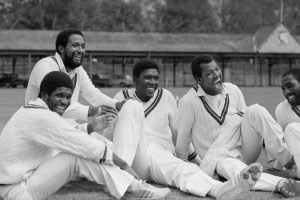 In 1950, Lord’s witnessed one of the craziest scenes ever in post-war cricket. Suddenly, it wasn’t a cricket ground anymore; it was a mela! The occasion was the historic Windies victory over England. The year, along with those euphoric moments, has disappeared but the wanton ecstasy of those unforgettable moments has been etched timelessly into one of the game’s most memorable calypsos:
West Indies first innings total
Was three twenty-six, as usual;
When Bedser bowler Christiani
The whole thing collapsed quite easily;
England then went on
And made fifty-one
West Indies then had two-twenty lead
And skipper Goddard said “That’s nice indeed”,
Chorus: With those two little pals of mine,
Ramadhin and Valentine.
Celebrating their 1983 demolition of England in England (5-0), Windies song writer Lance Percival had given old favourites (Jamaican Farewell and Banana Boat Song) a whole new twist. Belted out by (former) opener Gordon Greenidge, it went:
Down the way, where the skies are grey
And rain falls daily on the umpires’ head
We’ve arrived, with Captain Clive
The cricket team Englishmen fear and dread.
Chorus: Glad to say we’re in the UK
Where West Indian batsmen can bat all day.
 This little calypso number, however, is only one of thousands that rhapsodize the true joy and spirit of the game, inspiring some of the greatest writers to compose odes to the willow.
The “Golden Age” of narrative cricket poetry undoubtedly belonged to the 18th and 19th century. Poems of that era tossed out imaginary tales and historical ballads which at once enhanced elements of romance. All the traditional forms of poetry came into play. Interestingly, many eminent writers of “prose” paid glowing tributes to this great game – almost poetically.
In 1776, Irish-born playwright Richard Sheridan, with typical perception, referred in his celebrated School for Scandal to...
“The chimneys of Knightsbridge and footmen at cricket…”
British humorist and poet Thomas Hood described his young cricketers as “sportive deer”. Even the great Alfred Tennyson, for one profound moment, put aside the heavies to write:
A herd of boys with clamour bowled and stamped the wicket …
The 14th century English poet Geoffrey Chaucer mentions cricket in his immortal Canterbury Tales and in the 2oth century, Rudyard Kipling, too briefly, chips in with: "Flannelled fools" (The Islanders)
James Love, a fine poet of his day who is best known in sporting circles for his Cricket: A Heroic Poem (1744), eulogised the great game with:
Hail Cricket – a glorious manly British game
First of all sports, be first alike in fame.
It was James Love, himself no mean cricketer, who wrote that immortal line that has influenced writers and commentators ever since: “The strokes re-echo o’er the spacious ground”.
Even Lord Byron sang the game’s praise:
Together we impelled the flying ball
Together waited in our Tutor’s hall
Together joined in cricket’s manly toil
Or shared the produce of a river’s spoil.
Thomas Moult was one of the few who elevated cricket verse into romantic poetry. The 20th century journalist and poet had to his cricket anthologies like Willow Pattern and Bat and Ball to his credit. His memorable Close of Play remains a classic of cricket verse:
For the last time a batsman is out,
The day like the drained glass and
The dear sundown field is empty;
What instead of Summer’s play
Can occupy these darkling months
Ere spring hails willows once again
The crowned king?
How shall we live so life may not be chilled?
GD Martineau, Moult’s contemporary, is another great poet of the game. His The Crown is vigorous evidence:
Let cheers resound
For cricket-folk whose love’s a steady flame
Their fervour crowned
With deeds of derring-do and fairest game
And glad remembrance of a glorious game.
Martineau, whose principal claim to fame are two books titled Bat, Ball, Wicket and All and They Made Cricket, also wrote the poem Six and Out, which went: “The pitch was only smooth in parts/it sank at either crease/and motor vans and baker’s carts/at times disturbed the peace…”
John Arlott, the (late) great cricket writer and commentator, was yet another rare gem who dazzled with his evocative and charming verse. His ‘ode’ to the late Sir Jack Hobbs on the latter’s 80th birthday remains a gem:
No yeomen ever walked his household land,
More sure of step or more secure of lease
Than you, accustomed and unhurried
Trod, your small yet mightily manor of the crease…
World War I poet and literary critic Sir George Hamilton wrote, with pride and jubilation:
Where else, you ask, can England’s game be seen,
Rooted so deep, as on the village green.
H Villin’s Test Match was no less poetic:
Watch the blade thrust
The beautiful sword, the turn ‘o wrist
And the sudden streak to the distant rail.
Sir Francis Meynell, son of poet Alice Meynell, contributed his mite to the mighty tradition. Vaguely reminiscent of Walter De La Mare’s The Listeners, Meynell’s poem presents a whole new dimension with striking effect:
Dazzled by dappled land and light
And scarce-transparent shadow
I thought I saw the quickening sight –
The field close-set the men in white,
A host of cricketers in the meadow …
 Lewis Caroll, GK Chesterton, Sir Arthur Quiller-Couch, Conan Doyle, Thomas Green and even John Keats constitute only a small fraction of the “celebrity circuit” that went lyrical about the game.
What can be the reason for the muse to be clean bowled over? The lagato-limbed charm of a leaping bowler? The fantastic magic of lightning catch? The silken elegance of fluid strokes, the serenity of the traditional pastoral setting, the high drama of a nail-biting finish or the ultimate dignity of a game we played?
Who knows… and in today’s Twenty20 world, who cares? However, for true lovers of the game and devotees of English poetry – cricket and verse are undeniably made for each other!
monojitlahiri@gmail.com


 Issue Dated: Feb 5, 2017

