


- Article
- Comments (0)
Book Review: The Meadow
West's Selective Ire
Tags : Saurabh Kumar Shahi | The Meadow |
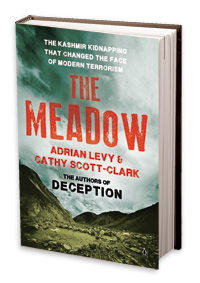
Adrian Levy & Cathy Scott-Clark
Penguin
Edition: Paperback
ISBN: 978-0-143-41875-7
Pages: 536
Price: Rs 499
Somewhere in the middle of this 510 page saga on the abduction and killing of foreign tourists, the readers come across an incident that is not merely chilling but raises a few question of its own. A woman tourist, a foreigner, voluntarily approached the Indian Army to report the abduction of Norwegian tourist Dirk Hasert. Instead of acting on her complaint, a Major of the Rashtriya Rifles corners her and rapes her. Naturally, no one in India got outraged then. Almost 17 years later, as the truth came out, the situation remains shamefully unchanged. Not a word of protest, not a whiff of shame. Welcome to the biggest democracy of the world.
On July 4, 1995 during a trekking expedition at Pahalgam, four foreigners – Don Hutchings and John Childs of USA, and Keith Mangan and Paul Wells of England were abducted by the then unknown militant group Al-Faran, generally thought to be an offshoot of Harkat-ul-Ansar. Four days later, in a show of impunity, two more trekkers Dirk Hasert and Hans Christian Ostro of Norway were abducted from the same locality. Childs made a daredevil escape on the same night and Ostro’s beheaded body was found on August 13 in the Shael Dar forest of Anantnag. However, the fate of others remained a mystery. The Meadow focuses on that one defining moment, the moment when Al-Faran tried to use them as bargaining chips for securing the release of a few Pakistani militants who were held as Indian prisoners, including Masood Azhar, who was released with two other militants in lieu of passengers of the hijacked Indian Airlines plane IC 814, years later.
The Meadow includes blow-by-blow account of the negotiations for the hostages’ release between an inspector and the militants, which appears to be on the verge of completion on more than one occasion. However, mysteriously, every time the release appears imminent, the terms of the negotiations were leaked to some newspaper, negating the negotiations. Surprisingly, on occasions when the authorities claimed the hostages were untraceable, the book reveals, they were being closely watched, followed and photographed by an Army helicopter.
It is also revealed through a thorough investigation by authors Adrian Levy and Cathy Scott-Clark, who specialise in investigative journalism and have worked for UK’s The Sunday Times and The Guardian for nearly 18 years, that instead of working to secure the foreigners’ release, the authorities, Indian intelligence agencies and Army protracted their detainment and sabotaged parleys with the militants. It further reveals that these actions by the Indian authorities were part of a bigger, well laid out plan to present Pakistan, and the Pakistan-supported insurgency in Kashmir, in a callous and ruthless light to the international community. The book also suggest that after rounds of failed and sabotaged negotiations, the foreigners were gunned down and buried in deep snow by a second group that was being partly funded and controlled by the Indian intelligence, in collaboration with a rogue local police unit.
“All the time New Delhi said it was trying to crack Al Faran, a group within the intelligence and the STF was letting them dangle, happy to let the militants portray themselves as savage criminals,” a police detective working on the case told the authors.
“So far none of these efforts have come close to ending the drama, whose ambiguities and illusions and hopes deceived have baffled a succession of anti-terrorism experts sent by the FBI and by Scotland Yard,” John F. Burns, another reporter, wrote from Kashmir in May of 1996. He further added, “Nobody can even be sure whether the kidnappers, who call themselves Al Faran, are real insurgents or, as many better known Kashmiri guerrillas assert, are Indian-backed renegades who have set out to discredit the entire movement.”
However, in its endeavor to become an all-encompassing account, the book delves a tad too deep on backgrounds of the tourists, militants and officials. It hampers the pace and adds little value to the saga. Also, its boasting that it has traced the beginnings of ‘modern terrorism’ to that event in Kashmir is misleading and plays to the gallery of paranoid Western readership. Those apart, the book remains a necessary read.
This incident, along with others like the assassination of the Mirwaiz of South Kashmir, Qazi Nissar, JKLF ideologue Abdul Ahad Guroo and the massacre of Sikhs in Chittisingpora and the involvement of Indian agencies in the same gives a new perspective to the events in Kashmir. That the revelation of such incidents along with the unearthing of mass graves does not so much as evoke concern from the world leaders, leave alone outrage, speaks of the travesty that world witnesses today. More than India’s failing; it exposes the duality of the Western leadership.


 Issue Dated: Feb 5, 2017

