



- Article
- Comments (0)
World's Lousiest Drivers
"Accidents, and particularly street and highway accidents, do not happen – they are caused,'' noted Ernest Greenwood, celebrated British painter in a rare moment of candour, away from his brushes and bristles.
Tags : road accidents | road deaths in india | rash criving | drunken driving |
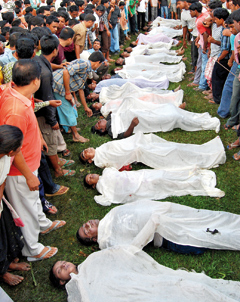 The iconic artist may have never visited India but his truism holds good in every sense of the word. According to a 2009 World Health Organisation (WHO) Global Status Report on Road Safety, more people die in road accidents in India than anywhere else in the world, including the more populous China.
Terming road accidents as among the three globally neglected 'epidemics' – it is expected to become the world's fifth biggest killer by 2030 – the WHO report said while rich nations had been able to lower their death rates, developing and Third World countries had not. It said 90 per cent of deaths on roads occur in low and middle-income countries though they have only 48 per cent of all registered vehicles.
Now look at the Indian government figures. According to the National Highways Authority of India (NHAI), a whopping 1,35,000 people perish in road accidents annually in India, about 70 per cent of these attributed to alcohol impaired or drunk driving. Drivers are considered alcohol impaired when their blood alcohol concentration is .08 gramme per decilitre or higher.
By standards in Delhi and National Capital Region (NCR) and other metros, the specification could be considered, at best, a 'chotta peg'.
Driving in India is then a double-edged sword. Good driving skills may not be enough; you also have to keep in mind that fellow navigators on the wheels could be callous, untrained and mostly holders of phoney licenses issued at road transport authorities not much better than public auction offices where the highest bidder earns his baptism, no matter what the collateral damage.
The numbers continue to boggle. During 2009, 4.9 lakh road accidents claimed 1,25,660 lives and five lakh injuries in the country. These numbers translate into one road accident every minute and one road death every four minutes, a status paper released in 2011 by the transport research wing of the Government of India said.
How else do you explain the recent death and mutilation of 27 members of a wedding party in one of the most bizarre accidents in recent memory that occurred on the Mumbai-Pune Highway on May 27, 2012?
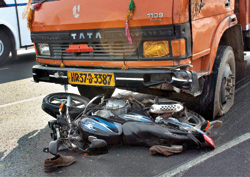
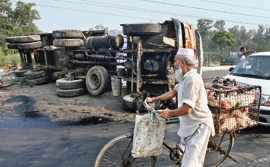
According to the police, baraat members had got off the two mini buses hired for the occasion, as one of them had a flat tyre and were safely parked in the service lane – or so they thought. Suddenly, a speeding truck in the third lane lost control, entered the service road and rammed into the mini buses. People sitting in between the two vehicles were crushed to death instantaneously.
The biggest irony: Bridegroom Eknath Bahule, who had exchanged garlands with 27-year-old Manisha Gaikwad just a few hours ago, was seen frantically identifying bodies of his relatives and friends – all in his wedding gown.
Consider some typical examples:
*** Deepak Yadav, 25, resident of the Nagli Parsapur village in Haryana worked in a company named M Tech. On July 8 this year, Deepak driving his motorcycle, rammed the divider. Apart from a leg fracture, there is a clot in his brain, leading to mental retardation. Doctors say a surgery could threaten the patient's voice.
*** In Baghpat, Uttar Pradesh, a 42-year-old mason Ashok was hit by a truck on the Meerut Road. Seriously injured, Ashok today lies at Delhi's GTB Hospital with rods inserted inside his legs. This daily wage earner and father of six could take several months before he can hit the road to recovery.
***Diwakar Sharma, a resident of Assam, was involved in a serious accident on July 8 this year and his family was informed two days later. Sharma has a clot in his brain and is unable to recognise anyone.
***Anil Kumar Srivastava, 42, a resident of Ashok Nagar in New Delhi, was hit by a motorcycle while crossing the road on July 12. He has an injury on his cervical point and his lower body has been paralysed. The cases are virtually endless, if looked at the length and breadth of the country.
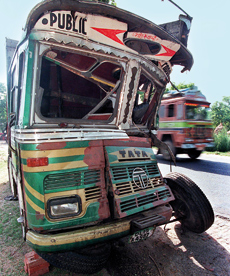
Just how serious is this threat? Says Chandmal Parmar, Chairman and Managing Trustee of the Rajshree Parmar Memorial Foundation, a trust he set up after the sudden death of his teenage daughter in a grisly mishap, "Road accidents cost the country Rs 100,000 crore annually which is equivalent to three per cent of the GDP spent annually for upgrading roads, vehicle repairs, road signs, medical assistance, police panchnama inquiry, judicial inquiry, insurance claims and the works.''
According to Parmar – now a passionate road safety activist – India loses 66 per cent bread earners in accidents every year and thousands of families have been utterly devastated.
In a country as big as India, what are the trouble spots? Road accidents due to drunken driving have nearly doubled in Uttar Pradesh, Andhra Pradesh and West Bengal between 2007 and 2009, while they have fallen in Maharashtra, Himachal and Rajasthan during the same period.
In 2011, Union Road Transport and Highways Minister C P Joshi told the Rajya Sabha that while in 2008, drunk driving was the cause for 20,150 accidents, that number rose to 27,152 in 2009.
Scarily, it is not just illiterates and idiots responsible for this upwardly spiral. There is equal threat from the rich and famous.
In January 1999, billionaire arms dealer Sanjeev Nanda, grandson of former Navy Chief SM Nanda, rammed into a police picket in Delhi in the dead of the night killing half-a-dozen people. He was sentenced to a five-year term but is now out on bail.
In September 2002, film star Salman Khan ran over a pedestrian while allegedly driving under the influence of alcohol. In 2009, an inebriated Karthik Somaiah dashed his vehicle into a group of morning walkers in Bangalore, killing five. Clearly, a problem like this has no easy solutions.
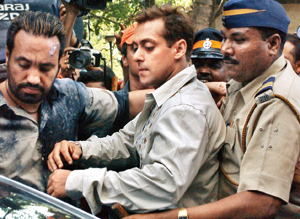
Prince Singhal, the founder of Campaign against Drunk Driving (CADD) and member of the National Road Safety Council, Ministry of Road Transport and Highways, told TSI: "Drunk driving is a serious problem. Offenders in this case are the rich and famous who understand that laws in India are lenient and hence have scant regard for them”.
What is surprising is that high accident rate is not just confined to the BIMARU (Bihar, Madhya Pradesh, Rajasthan and Uttar Pradesh) states where the literacy level is low. It is also very high in Kerala, which boasts of 94 per cent literacy.
Points out Mohammad Rafeeque, Assistant Commissioner of Police (Traffic), West Zone, Eranakulam, Kerala, "The main cause of accidents in Kerala is the utter lack of traffic discipline. Vehicle owners and drivers have scant respect for traffic laws as they believe that rules are not meant for them but for others.
Besides, the manner in which they overtake is so unscientific that it results in serious accidents. What is needed is not just rules and regulations, but systematic efforts have to be undertaken to change the attitudes of those on the wheel.''
In Kerala – as in most of the country – accident victims are aged between 20 and 55. Happily for the state, its high accident rate has shown signs of declining. In 2011, 35,216 people lost their lives in road mishaps in Kerala, down from 42,363 at its peak in 2005.
Rafeeque's prognosis of lethal and deadly accidents is not much different from the others – over consumption of liquor, speeding well beyond the prescribed limit and reckless driving.
According to him, Kerala's high accident rate is also because of bad roads. "As compared to Tamil Nadu and Karnataka, Kerala roads are inferior with little or no maintenance,'' he says.
|
Facts at your fingertips Every hour, 40 people under the age of 25 die in road accidents around the globe. In India, the accident death toll rose to 14 per hour in 2009 as opposed to 13 the previous year. The total number of deaths attritutable to road accidents has now passed the 1,35,000 mark, according to the latest report of National Crime Records Bureau (NCRB). While trucks and two-wheelers are responsible for over 40 per cent deaths, traffic during afternoon and evening rush hours are considered to be the most dangerous, with maximum fatalities. 48 per cent accidents are recorded as Hit and Run cases with the driver fleeing after the accident. |
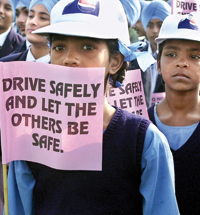
Increasingly, the focus on lethal accidents has narrowed down to atrocious driving skills and the flawed system of awarding licences in India. Says Prakash Mamadapure, Joint Secretary and Chief Engineer of Maharashtra's Public Works Department (PWD), "One of the main reasons for growing accidents is the inadequate training which Indian drivers have. We have to make the procedure of granting driving licenses so strict that only those who have adequate skills are given the permission to drive."
He should know. The celebrated 92-kilometre Mumbai-Pune expressway maintained by the Maharashtra State Road Development Corporation (MSRDC), has witnessed more than 1,800 accidents since it was opened 11 years ago. The casualties so far: 518 dead and 1,034 injured or maimed.
Many of these fatalities have been blamed on non–availability of emergency medical facilities during the crucial first hour, known as the golden hour, from the time of the mishap.
Outside of metros and some state capitals, there is little regard for traffic rules. In Noida, next to the national capital, it is common for the traffic policemen to sit idle while crowd and traffic mill around them. And Noida is respectable when compared to the country's hinterland where it may be difficult to even spot a traffic policeman manning the road.
Virtually no help can be expected on the national and state highways where chances of fatal or serious accidents is high. In the last few years, a few state governments have set up medical and trauma centres along the highways – the GT Road which passes through Punjab and Haryana is a good example – but most other highways are unattended.
Unlike the West and other advanced countries where technical facilities on freeways are advanced, Indian highways still belong to the medieval era. "We still do not have adequate lighting on our main traffic arteries and this leads to problems in the night. A large number of accidents occur after nightfall because visibility is poor and it becomes very easy for anyone to make a mistake,'' says Anand Raj, former DCP Traffic, Delhi.
Experts agree that human factor is singularly responsible for this high accident rate. States S R Tambe, former president of the Accident Prevention Committee of Maharashtra, "Most accidents occur because of the driver's fault. Their rash and negligent driving and the tendency to disregard traffic rules is one of the biggest contributors to accidents.'' There is general unanimity on the causes. Now only if we could find some remedies.
(With inputs from Sreekumar AT, Kerala, Pratham Dwivedi, Delhi)


 Issue Dated: Feb 5, 2017

