



- Article
- Comments (0)
Who is the smartest of them all?
There are a number of contenders for the 3rd position in the mobile handset market. And the key to success lies in winning in the smartphone space. By Anirudh Raheja
Tags : Smartphones | Nokia | Samsung | Micromax | CAGR |
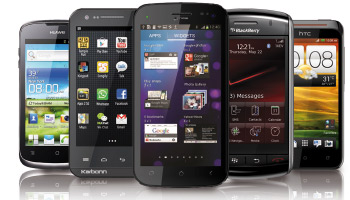 Numbers do not lie about the present; but they can, if viewed in isolation, be very misleading when you predict the future. It is a lesson that Nokia India learned the hard way, as it went from near domination of the Indian mobile handset market (80 per cent share) to a situation where it is desperately fighting to defend every inch of share. And apparently, it is fighting a losing battle. Samsung and Micromax have climbed up to the second and third spots in India with 25.3 per cent and 6.3 per cent respectively under their belly (Voice & Data, FY 2011-2012). Nokia, meanwhile, had a 38.2 per cent market share (a fall of 8 per cent yoy) in the same period. In fact, Gartner research reveals that Samsung's market share rose from 15 per cent in Q1, FY 2011 to 49.8 per cent in Q2, FY 2012. And at this rate of growth, it could reach a whopping 60 per cent by the end of 2012.
So the battle for the top two positions seems to be headed to a logical conclusion for now. But the real excitement is with respect to the number three spot, which has many contenders with single digit market shares. All of them are eagerly looking for every opportunity to outpace Micromax, as the latter looks to make a comeback after a slight drop in share to 6.3 per cent (from 6.9 per cent in FY 2010-11).
In a country where urban teledensity has already surpassed 160 per cent, the array of competing handset players in the market soliciting your attention certainly comes as a surprise (as per reports, there are over 150 handset players in the Indian market today!). The numbers, though, are still lucrative enough. Gartner projects that India is expected to see sales of 251 million handset units by 2013; a growth of 13.5 per cent yoy, and further to over 326 million units by 2016 (a CAGR of 9.1 per cent in that time frame).
However, the real potential now lies in the fact that 91 per cent of the market is still dominated by low cost feature phones (Gartner). The replacement opportunity for smartphones in the next few years will therefore be huge. Gartner projects sales of 821 million smart devices globally in 2012, which should grow to around 1.2 billion by 2013. According to a report by Research & Markets, smartphone sales are expected to grow at around 60 per cent to account for 25 per cent of mobile device sales in India by 2015.
Predictably, the contenders for the bronze are doing their best to ride the smartphone wave. At the moment, the ones that look to be up to the task are Micromax itself, with BlackBerry (4.7 per cent share), Karbonn (4.3 per cent share) and HTC (3 per cent share) close on its heels.
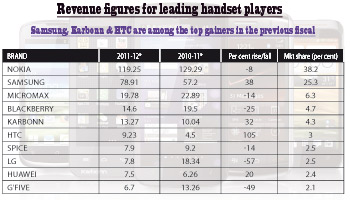 When it comes to the smartphone space, BlackBerry has the lead currently with 12.3 per cent share in Q1, 2012, beaten by Samsung (40.3 per cent) and Nokia (25.5 per cent, Cyber Media Research). However, the space is still wide open and ranks could switch places fairly quickly. In FY 2011-12, both Micromax and RIM registered a fall in revenues respectively by 14 per cent (to Rs 19.8 billion) and 25 per cent (to Rs 14.6 billion). Karbonn's revenues soared by nearly 32 per cent yoy to reach Rs 13.3 billion; while HTC uniquely saw triple digit growth of 105 per cent yoy to post revenues of Rs 9.23 billion.
Micromax and Karbonn are looking to make quick and deep inroads through aggressive pricing, while HTC and BlackBerry have the opposite approach. Micromax has launched a series of smartphones based on Android Ice Cream Sandwich 4.0, viz A90 and A100, for less than Rs 13,000. The latter's product range starts from Rs 3,999 for the A25. Karbonn too, has added the A1+ smartphone at around Rs 5,000.
HTC has stayed away from the league of ultra-low cost handsets; expressing confidence that their improved user experience will keep them going. Their entry level smartphone – the HTC Explorer – costs around Rs 8700 currently. And while RIM opened up the gates to premium BlackBerry Messenger services in 2009, the cheapest BlackBerry smartphone (Curve) still hovers at around Rs 8,600. Krishnadeep Baruah, Director-Marketing, RIM India, confirms, "We have not repositioned BlackBerry as a consumer product. We have been looking at the market very closely and our strategies are a response to changing market dynamics."
All four are extremely aggressive with respect to branding activities and some comparative advertising is gaining ground. Karbonn has signed on India's ex-Vice Captain Gautam Gambhir as its brand ambassador with an indicated budget of Rs1.2 billion. Micromax has been riding on the popularity of Bollywood star Akshay Kumar. In its quest for the second spot, it has recently targeted Samsung with its "Why Y" campaign (Samsung, on the other hand, has been targeting RIM with its modern "Uncle" campaign related to the "Galaxy Y" model). RIM has now caught up on celebrity endorsements with Katrina Kaif as its brand ambassador. However, HTC remains the odd one out in this regard; relying on its simplistic You campaign, which highlights the features of the products.
As far as distribution is concerned, Micromax today has nearly 1,00,000 retail outlets across 500 districts in India and expects to become a $ 1 billion revenue company by the end of 2014; riding on major expansion plans designed for FY '13 and beyond. Karbonn is also very bullish on the rural market's potential with 50,000 outlets to cover around 90 per cent of the districts in India. HTC wants to approach it step by step, since it does not see a huge market for smartphones in tier 2, 3 and rural India sans the benefits of connectivity enjoyed by urban markets. RIM, however, seems to believe that its entry level handsets will sell in tier 2 & 3 cities and is looking to go pan-India.
In a price sensitive market, Micromax and Karbonn look better placed, but there are umpteen examples of players that suffered since they had little to offer other than price. CyberMedia Research points out that most Indian handset players barring Karbonn and Lava suffered negative growth in the previous fiscal for that reason. To earn lasting market share, a superior user experience will be the key. RIM and HTC would fancy their chances with a relatively premium positioning. On the other hand, if Karbonn and/or HTC can create sufficient excitement and provide value for money at those price points, either of them could cement themselves in the coveted number three spot.
anirudh.raheja@planmanmedia.com


 Issue Dated: Feb 5, 2017

