



- Article
- Comments (0)
We as moral agents are no more at the mercy of NYT
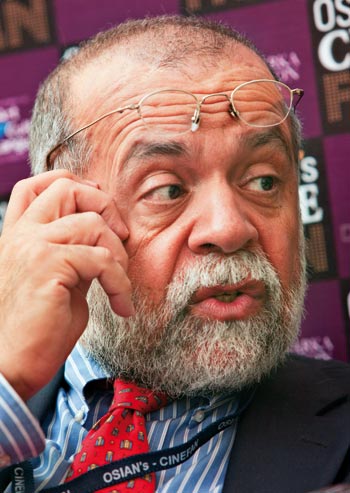
Author, academician and commentator Professor Hamid Dabashi needs no introduction. The Hagop Kevorkian Professor of Iranian Studies and Comparative Literature at Columbia University, the oldest and most prestigious Chair in his field, Dabashi has produced exemplary work in the field of Middle East politics and cinema. At the recently concluded Osian's Cinefan Festival, where he was part of the jury, Prof. Dabashi spoke to Saurabh Kumar Shahi on issues pertaining to cinema and politics in the region
Tags : Professor Hamid Dabashi | Arab and Asian Cinema | Cinema and literature | art and literature | poetry | film | drama |
We are celebrating the best of Arab and Asian Cinema here. What role do you see cinema and literature playing in what is now popularly known as the Arab Spring?
 There has always been a correlation between events such as the Arab Spring and its manifestation in art and literature including poetry, film and drama. So these dramatic events, this democratic uprising, which you have seen unfolding in the region from Tunisia to Morocco, from Yemen to Egypt, is basically a manifestation of hope and aspiration for democracy in the region. These aspirations are not new. Since the last, say, 200 years, people in this region have aspired for this change and these aspirations have been manifested through art and literature. So in a way, art and literature have been the harbingers. Now that we see a democratic uprising, it will be interesting to see how art and literature sustain this and carry it to the next generation.
But have not there been moments where fatigue has set in? Egyptian cinema had a reputation of its own from the 1940s to the end of the 1970s. Then the focus shifted. So now we either have films coming out of Israel and Occupied Palestine or from Iran. Barring a few exceptions, Arab cinema seems to have slipped away in the last two decades. Why?
I always say, two things destroyed Egyptian cinema, Saudi money and Saddam Hussein. Saddam Hussein hired some of the most talented, most brilliant hands in Egyptian cinema, including directors and actors, to make propaganda films during the Iran-Iraq war of 1980s. It also destroyed the Iraqi film industry. So the combination of these factors, namely the repressive regimes, propaganda films and the money that came from places like Saudi Arabia, preempted the fantastic cinematic tradition, particularly musicals. I always say that I grew up on three cinematic traditions particularly in musicals, the Indian musicals, the Egyptian musicals and the Hollywood musicals and Hollywood always lost. But also keep in mind that this is not generic. After all during this period, the magnificent work of Youssef Chahine emerged in Egypt. Then there was a period of slumber after which the third generation of cinema makers came into the picture. So, it is not that they stopped making cinema but its impact has shrunk.
How do you see the journey of cinema in the two regional cinema powerhouses, Israel and Iran?
The case of Israel is obvious. They have huge resources at their disposal and a number of quite talented directors who brought their films to the fore. However, more miraculous, in the absence of infrastructure, is the survival of Palestinian cinema. As you know Palestinian cinema has no infrastructure whatsoever. It is entirely dependent on foreign finance. But, it has managed to produce one of the most magnificent cinematic traditions generation after generation. From the generation of Ibrahim Hassan Sirhan to the generation of Elia Suleiman.
The case of Iranian cinema is different. You know that the origin of Iranian cinema goes before the revolution. The Iranian cinema post-revolution has much less to do with the politics of the Islamic Republic and more to do with what I call the national trauma; the national trauma of the revolution as well as the trauma of war. The revolution of 1979 and the war of 1980s gave rise to the magnificent Iranian cinema of today.
Israel is often lauded by the Western press as the only democracy in the Middle East. But we know better. We know how it has treated Ilan Pappé, Benny Morris and Avi Shlaim; people who have challenged the Zionist popular narrative. However, we also see accommodation of directors like Eran Kolirin whose The Band's Visit can truly be called a cinema of reconciliation. Do you see a change in offing?
Even in the case of Israeli cinema, the notion of democratic aspiration is entirely fabricated. The exquisite scholarship of Ella Shohat, a book called Israeli Cinema: East/West and the Politics of Representation explains this phenomenon. It says that Israeli cinema was part and parcel of the Zionist propaganda machinery. They wanted to project an European image. It is not just the question of Palestinians. Even the Mizrahim or Shepherdim Jews were not part of the Israeli imagination. So some of the best films and writings are those that question this narrative. So there is a reaction. A lot of these young Palestinian filmmakers were born inside the 1967 border of Israel. They have lots of Israeli filmmaker and writer comrades who collaborate with them and help them.
But do you see a crack appearing in an otherwise potent Hasbara machinery? I mean the advent of internet has created a situation where the control on information coming out of Occupied Palestine and Israel proper is no more a Hasbara monopoly. I mean we just saw a splendid production by CBS that established that Christians in the Holy Land had to migrate because of the repressive policies of the Israeli state and not because of Arabs as most Americans believed. This was impossible a few years ago. How do you see this situation turning out in the coming years?
I completely agree with you. There has been vast change in the media and that is for all to see. There are options other than the mainstream. Information is no more a monopoly of Western journalism, CNN, BBC, The New York Times, etc. Right here, sitting with you, I can read Al-Ahram. I can read Al-Jazeera. Also, through the mechanism of Facebook and Twitter, we now have a democratic level playing field. I mean in my own lifetime, I used to get up in the morning and the only option I had was the NYT. And that was the defining moment of what I knew about the world. So even if the NYT angered me or did something that opposed my sense of reason, my sensibilities or did not match with what I had learnt or what I knew about history or the region, there was nothing I could do about that other than throwing the paper away. Right now, the NYT is just a click away from Al-Ahram, or Al-Jazeera or The Daily Star or La Monde. That means I am no longer at the mercy of the NYT. We as citizens, as activists, as moral agents are far more potent today than we were a couple of decades back. And that gives us courage.


 Issue Dated: Feb 5, 2017

