


- Article
- Comments (0)
The simmering danger
The year 2012 saw an outbreak of something that was unimaginable even a few years ago. Mayank Singh examines how frequent and violent conflicts between jawans and officers is a danger signal.
Tags : Gen VK Singh | army jawan | fratricidal killing | Indian army |
.jpg) Three proud units –16 Cavalry, 226 Field Artillery and 45 Cavalry – have seen openly violent conflicts between soldiers or Jawans and officers in recent times. The incidents predictably sent shock waves in the upper echelons of Army. Lieutenant General Vijay General Oberoi says, "Three incidents of collective indiscipline by jawans in the last few months reflect a breakdown in the traditionally close officer-man relationship and is a growing cause for concern... especially as all three incidents are related to combat units."
Three proud units –16 Cavalry, 226 Field Artillery and 45 Cavalry – have seen openly violent conflicts between soldiers or Jawans and officers in recent times. The incidents predictably sent shock waves in the upper echelons of Army. Lieutenant General Vijay General Oberoi says, "Three incidents of collective indiscipline by jawans in the last few months reflect a breakdown in the traditionally close officer-man relationship and is a growing cause for concern... especially as all three incidents are related to combat units."
The rot runs deeper. Defence Minister A K Antony recently told Parliament that as many as 1,018 soldiers had committed suicide since 2003, with the yearly toll regularly climbing over 100. What adds to this problem is that incidents of fragging (to kill or wound a fellow soldier) have also become a regular phenomenon in the 1.13-million strong Indian Army.
Operating in a hostile counter-insurgency environment against a faceless enemy does lead to certain stress, but that is only one of the factors contributing to the growing disillusionment and disenchantment among jawans. Add to it the problems back home – land disputes, tensions within the family – rising aspirations, desire for better pay and allowances, falling standards of supervision from some officers, and a fatal concoction is ready. Stress levels are bound to zoom northwards. Company commanders who lead field units in counter-insurgency situations also believe that tensions at home become more immediate thanks to instant mobile communications.
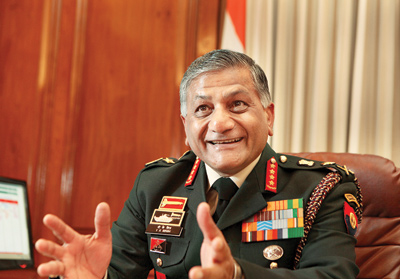 One more common thread among soldiers from Rajasthan to UP, from Tamil Nadu to Haryana was how little respect they seem to command today in a society which devalues their work. Soldiers these days are better educated and consequently better aware of their rights. This, coupled with falling standards of supervision and control among some of the undeserving officers who have risen to command units, is becoming a major cause for worry. A report by the Defence Institute of Psychological Research had earlier held that "perceived humiliation and harassment at the hands of their superiors" – over and above occupational and familial causes – often serves as the final "trigger" for jawans in stress-related cases in the armed forces.
.jpg) According to Antony, more than 25,000 soldiers have opted for voluntary retirement in the past three years (10,315 in 2011, 7,249 in 2010 and 7,499 in 2009). He added that during the same period, more than 1,600 officers have either sought voluntary retirement or have resigned (this when the army is already reeling under a massive shortage of close to 12,000 officers). Besides, more than 1,000 jawans have committed suicide since 2003.
According to Antony, more than 25,000 soldiers have opted for voluntary retirement in the past three years (10,315 in 2011, 7,249 in 2010 and 7,499 in 2009). He added that during the same period, more than 1,600 officers have either sought voluntary retirement or have resigned (this when the army is already reeling under a massive shortage of close to 12,000 officers). Besides, more than 1,000 jawans have committed suicide since 2003.
Colonel (retd) PK Gautam – who has been working on Composition and Regimental System of the Indian Army – asks for a rigorous and in-depth study on the issues involved. He believes that the solution to the shortage of officers in the Indian Army has to be out-of-the-box and that it is not difficult to find one. “We have remained fixated with the English speaking urban youth to join the Officers cadre, which is just 30 per cent of the total youth population and joining the Army is the last option for them. We have to open up to the remaining 70 per cent youth of the country. We can choose boys who can be trained (in language) with an extra year at National Defence Academy (NDA) and taught to match the rest in a year.” At present a recruit joins NDA for three years. With such increased direct entry one can hope to find more numbers to gradually fill the shortage of officers. Colonel (retd) Gautam also points to a bigger malaise that the Corps of Officers as a whole, has lost much of its self esteem, pride and élan and has become increasingly careerist, opportunist and sycophantic.
The acute shortage of officers at the cutting edge level is in fact a big reason for the increasing gap between soldiers and officers. While the authorised strength of a combat battalion is approximately 22 officers, many Commanding Officers have to make do with just 8 to 10 officers these days. One officer is burdened doing the job of three due to the shortfall. This compels the concerned officer to finish the tasks-on-hand leaving little or no time to interact with soldiers. In the old days, a game of football or hockey was considered the best way to get to know each other which is not possible in today’s condition. Brigadier (retd) Rumel Dahiya, Deputy Director, Institute for Defence Studies and Analyses says the shortage has started a vicious cycle. “Earlier we used to be trained by our seniors but due to shortage there is no time to groom the young officers who are unable to learn the skill of leadership and man management." It is ironic that while there is a shortage of over 12,000 officers in the Indian Army, a majority of staff postings (non combat) are fully subscribed. Meanwhile, combat units have to do with bare minimum strength! In simpler words, the Army Jawan is seeing too many things that outrage him. Perhaps it's time to deal with this simmering rage with renewed urgency.


 Issue Dated: Feb 5, 2017
