

Saturday, October 3, 2026


- Article
- Comments (0)
The Paradox of the Indian Media
Chandran Iyer takes a tumble down the rabbit hole into the topsy–turvy world of the Indian media – a world where the right is often left alone, unnoticed and all that is left is never really what it seems to be
CHANDRAN IYER | New Delhi, September 7, 2012 21:29
Tags : anna hazare | indian media | |
Tags : anna hazare | indian media | |
.jpg) When Aparna Malikar's husband Sanjay, a cotton farmer, committed suicide in Vidarbha in 2009 because he was unable to pay off mounting debts leaving her and their two daughters to fend for themselves, the media hardly noticed their woes. The news ofhis death was a “filler” at best. Barely two years later, the entire national media was chasing Aparna and her daughters to get their bites and interviews.Reason: the 29-year-old widow from Vara-Katha village in Yavatmal district had been featured in a special episode of Kaun Banega Crorepati and had won Rs 6,40,000. Bizarre as that sounds, that is the reality of the Indian media.
When Aparna Malikar's husband Sanjay, a cotton farmer, committed suicide in Vidarbha in 2009 because he was unable to pay off mounting debts leaving her and their two daughters to fend for themselves, the media hardly noticed their woes. The news ofhis death was a “filler” at best. Barely two years later, the entire national media was chasing Aparna and her daughters to get their bites and interviews.Reason: the 29-year-old widow from Vara-Katha village in Yavatmal district had been featured in a special episode of Kaun Banega Crorepati and had won Rs 6,40,000. Bizarre as that sounds, that is the reality of the Indian media.
Though it feels like something Alice might have read at the Mad Hatter’s tea party, Aparna’s story is not one of a kind. Indeed, it is quite the norm. Political rallies invariably draw more eyeballs than starving farmers an token fasts get much more representation, both on the pages of the newspapers or TV channels than imminent drought.
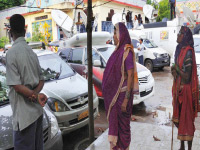 Take Kalavati for example. Nobody knew of this poor woman, living in a tiny mud house earning Rs 30 per day with her husband and three kids when Congress leader Rahul Gandhi made a visit to her house to enquire about her problemsin 2008. He also mentioned Kalavati’s name in his speech during the trust vote in Parliament on July 22. She shot to fame overnight with the editors of most newsrooms asking their reporters and photographers to feature her prominently.
Pradip Maitra, a senior journalist from Nagpur who has been covering the agrarian crisis in Vidarbhaextensively since the last few years says, “Mainstream mediais leastinterested in the actual problems of the farmers who are dying.They would rather cash in on the novelty value of celebrities like Amitabh Bachchan or Rahul Gandhi”.
He says what is surprising is not only the warped sense of news of the journalists but also their“stenogrpahic” regurgitation of whatever information the government officials planton them to escape their responsibility.
“How else do you explain the fact that when the government officialsconveniently say that most of the deaths in Wardha district of Vidarbha were becauseof liquor consumption and not due to starvation, the newspapers reproduce their quotes verbatim without questioning as to how the liquor is freely available in Wardha where liquor sale and consumptionis prohibited?” asks Pradip.
Sample this: when the anti-corruption crusader Anna Hazare, who was on a hunger strike in Ralegan Siddhi decided to call a meeting of editors of the electronic media in the midst of his hunger strike on September 13,pressing for Jan Lokpal bill, swarms of top notch journalists with their outdoor broadcasting (OB) vans descended like locusts hungry for Anna’s bites. This included most of the top news channels of the country, most represented by theirchiefs of seconds in command.
Nearly 17 television OB vans thronged Ralagan Siddhi and reporters, photographers and the whole television channel crew had practically laid a siege on the Padmavati temple – the venue of Anna’s media interaction with the editors. One channel had even brought its entire production team includingediting machinery like mixers to edit and transmit the news in the shortest possible time.
How many times do these editors set foot in the villages in Andhra Pradesh, Maharashtra and Odisha,where thousands of farmers have committed suicide? How many of them have toured the Yavatmal district of Vidarbha which is the epicentre of the crisis?
Shetkari Sangathana leader Sharad Joshi says, “Both the electronic as well as the print media has failed to understand the gravity of the farmers crisis. If the international price of cotton is Rs 100, the Maharashtra government pays hardly Rs 60. The Vidarbha farmer is bound to suffer. It is simple arithmetic.”
“When a handful of people committed suicide during the Mandal Commission agitation, it got massive coverage while lakhs of farmers committing suicide hardly draws interest. Paradoxical, isn’t it?” Joshi adds, underlining the lopsided nature of India’s media coverage.
Well, such is the structure of the fourth pillar of the Indian democracy.


 Issue Dated: Feb 5, 2017

