



- Article
- Comments (0)
The new sound of music
Spriha Srivastava in conversation with Pandit Vishwa Mohan Bhatt, the man credited with enriching the Indian classical music vocabulary with the creation of Mohan Veena.
Tags : Indian classical music | Mohan Veena | Pandit Vishwa Bhatt | Grammy Award winner | |
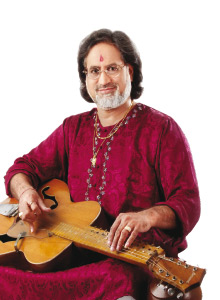 You come from a family of musicians. Had it not been for your background, would you have still been a musician?
I can not imagine myself without music. When there is heredity and environment both, you can not escape it. In my family, music has been transferred over generations for the past 300 years. Since childhood, I have been exposed to music from every room in my house. Till the age of 14, I played the Sitar, our traditional instrument. That age was my turning point. My father was a teacher and a girl from Germany had come to him to learn Indian music on the guitar. She was quite pretty and I was attracted to both, the girl and the guitar (laughs). In the first instance I thought I will Indianise this girl, but on second thoughts I took the guitar and Indianised that! I put new strings to it. A guitar has six strings, but I put 20 strings to it to play Indian classical music. I had certain sounds in my mind, which I necessarily wanted in my instrument. I wanted the sounds to be fragile sometimes, sometimes violent…all the ras and bhav to be there, all emotions to be incorporated. Thanks to good exposure to music owing to my family background, I was able to do this. However, if not a musician, I would have been at the front, defending our nation.
You won the Grammy Award – not the privilege of many Indians. Do you think there’s a bias that exists there?
Yes. And it is natural. We do not let foreigners have any Padma awards, so likewise. It is now that we have started to honour them. I would not really call them biased. The category in which I won was ‘World Music’, which is the most difficult category because they choose from all over the world. From about 10,000 CDs, they pick five which was a very big achievement for me.
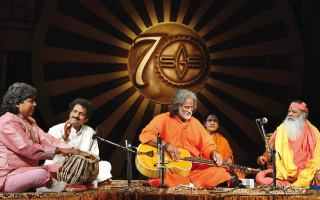 How well has the Mohan Veena been acknowledged?
I am very happy about its popularity and how people are adopting it, especially in countries like Canada, Japan, Australia, Singapore etc. These places have students regularly following me. In some countries, Mohan Veena schools are running in my name. I was once surprised to see about 100 students sitting and practising the Mohan Veena with my collection of work. They find videos of me and learn from those or from my CDs and DVDs.
In India too..?
It is a little slow here because our audience is not that mature or inclined. That is sad though…
How can we make Indian classical music popular among Indians?
Some glamour needs to be added. I would like to see, perhaps, Aishwarya Rai or Amitabh Bachchan promoting our music or being on a classical music TV show. Then everyone will be hooked to it. We are not exposed to our own culture, heritage, music, arts etc. It should be taught in schools as a compulsory subject. That will help a lot. Also, we lag behind because the marketing and packaging of our Indian music is not very good. If we talk about music companies, they do not promote us well. Why is it that Michael Jackson and Madonna were so popular and they charged so much? That is because their marketing was very well done. We need good promotion and publicity. Parents should also take the responsibility of teaching their children about all this. We have so many TV channels and out of these 200 odd channels, one should be dedicated to Indian music, culture or arts; at least one such channel running 24 hours so that when people are bored of Sheila or Munni, they will switch to this.
 Where from do you draw the inspiration for creating music?
For a musician, it is all imaginative. It is all in the mind. We can not see or touch the notes or tunes. What we do is keep improvising on the tunes and ragas and that makes it interesting for musicians also, otherwise we also get bored. Now ‘Sheila ki jawani’ is old. You want something new to hear. But classical music has newness to it every time. There is always a new raga or a new tune which keeps us interested. I usually get tunes in my mind. There is a Sanskrit Rachna called Meghadootam. It was very difficult to compose it. But I had the tune in my mind and so I composed it. Another time, when I was in the Andamans, sitting alone beside the ocean in the evening when the sun was setting, I composed an album there. So this is how it happens.
Are there any ragas that are impossible or difficult to play on the Mohan Veena?
Yes there are some. Some ragas really match the instrument and some become difficult.
How was your experience working with international artists?
They have a very different working style. They like to write their work and document it. And then they start playing by reading it. All of them, Beethoven, Mozart…all of them write their work. On the other hand, we keep the tune in our mind and play it out of our mind. Also, we like to improvise upon our tunes or music and not play the same thing.
Which has been your most memorable performance?
I have travelled 81 countries and have memories from many places like playing in the Royal Albert Hall in London, the Symphony Orchestra Hall in Chicago and many more. But my most memorable experience was playing with Eric Clapton who had invited me for the International Guitar Festival in front of about a lakh people.
spriha.srivastava@gmail.com


 Issue Dated: Feb 5, 2017

