


- Article
- Comments (0)
The more the merrier
Filmmakers on the fringes of mainstream Bollywood are beginning to unleash the power of crowd funding in a bid to get 'difficult' projects off the ground
Tags : movie | Onir | I AM | award |
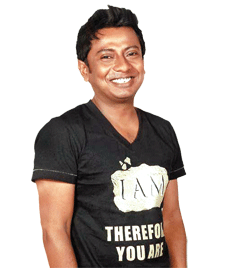 In 1976, Shyam Benegal, a leading light of the New Indian Cinema, made the National Award-winning Manthan, set against the backdrop of the White Revolution. The film was produced by the Gujarat Milk Cooperative Marketing Federation, a collective of five lakh dairy workers who contributed two rupees each. In 2011, in an experiment of a similar nature, filmmaker Onir received donations from 400 sources for I Am, an anthology of four short fiction films that addressed themes like child abuse and homosexuality. I Am went on to win two National Awards, giving crowd funding a fillip.
In his appeal to prospective donors, Onir had said: “We hope to bring another dimension into Indian independent cinema. We believe independent cinema exists to give a voice to those working against the tide and outside the system.” Not only did I Am get made, it also won accolades and made money in India and elsewhere. Says Onir: “It was impossible to get any conventional funding for the kind of stories I had. So I posted the project on my Facebook page." The shot in the dark worked and he raised Rs 1.5 crore.
In 2003, actor-director Rajat Kapoor had resorted to similar fund-raising methods for Raghu Romeo. But it was only after I Am that the movement gathered steam. Many others are following suit. Anurag Kashyap's assistant Vasan Bala has wrapped up the crowd-funded Peddlers, which made it to the Critics Week at the 2012 Cannes Film Festival. Partho Sengupta, maker of the 2005 Indo-French co-production Hawa Aaney De, is now sourcing funds for his next film Arunodoy. Similarly, RJ-turned-director Anirudh Chawla has roped in 600 co-producers for his Rs 20-lakh experimental Balls Hai Kya, which reportedly has ten real-life characters playing themselves on screen.
Documentary filmmaker Miriam Chandy Menacherry, who won the MIPDoc co-production challenge in Cannes in 2010 for The Rat Race, has also used crowd funding for the project.
To formalise the process, former McKinsey consultant Priyanka Agarwal has created a fund-raising platform Wishberry. In 2012, Wishberry began crowd funding of films when another research analyst with McKinsey, Anshulika Dubey, came on board. “Priyanka and I discussed the potential of crowd-funding for filmmakers in a Bollywood-dominated entertainment market. Having studied the Kickstarter model and Onir's crowd funding campaign, we felt this model could be scaled in India,” says Anshulika, vice president of Wishberry, which was awarded the ‘Most Promising Startup’ at the 16th Wharton India Economic Forum.
Wishberry is working for Onir’s upcoming project Chauranga, directed by debutant Bikas Mishra. Also in their kitty is Sridhar Rangayan’s documentary Breaking Free, which highlights the plight of the Indian LGBT community.
“Crowd funding is relatively new in India but it is here to stay,” says Raj Kumar Gupta, director of No One Killed Jessica. “It is the purest relationship a filmmaker can have with people that are equally passionate about a project,” he says. Crowd funding is still in its nascent stage in India. But actor Sanjay Suri, who co-produced I Am, says: “I feel it will be one way of promoting new talent."
Lack of clear legal guidelines on crowd funding is a stumbling block. “In India, independent filmmakers have to fend for themselves. People baulk because crowd funding is complicated. You need lawyers and tax consultants. You end up paying 40 to 45 per cent as tax,” says Onir.
Young casting director Anmol Ahuja says: “The only doubt I have about crowd funding is the possibility of it being misused for laundering money. I would like to see government involvement at some level so that a combination of state funding and crowd funding emerges.”
“I’m planning crowd funding for my next film too. But we’re consulting different people and finding way around these complex laws. We're trying to find out how we can tackle the tax implications in a legal way”, says Onir.
Long before crowd funding took to the internet, it had spread through word of mouth. John Abraham, the architect of the Odessa Collective, a people’s cinema movement that was behind India’s first fully crowd funded film, Amma Ariyan in 1986 raised money for his fourth film by travelling from village to village, playing a drum to attract attention, and sought donations from the general public. The drum is still being played as a growing tribe of filmmakers try to attract the government's attention to this unique method of funding quality films.


 Issue Dated: Feb 5, 2017

