


- Article
- Comments (0)
Swine flu scare haunts Pune again
Tags : Swine flue | H1N1 virus | cross- reactive immunity | Bharati Dhorepatil |
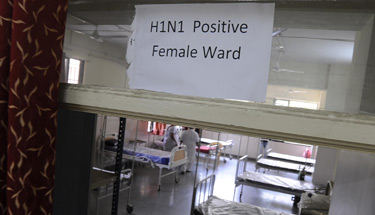 Three years ago if someone wanted to create panic in the city of Pune he never needed any gun. All he had to do was to cough or sneeze vigourously in a multiplex theatre or a mall and the result would have been more terrifying than the sound of a gunshot.
This was because the first swine flu death in India was reported from Pune and since then a number of people were infected with the disease and were dying every day in the hospitals of Pune in 2009.
This city which is known as the cultural capital of Maharashtra unfortunately came to be known as the “swine flu capital of India” with maximum number of people dying of this disease.
Now this disease has once again gripped Pune and other states of India and it could increase during the monsoon when the humidity is high and temperature is low as it augurs well for the growth of the H1N1 virus, according to doctors.
The disease is now prevalent in Maharasthra, Rajasthan, Tamil Nadu, Himachal Pradesh, Andhra Pradesh , Karnataka and Delhi. As of now more than 300 cases of swine flu, including 21 deaths, have been reported from across India this year, with the worst affected states being Maharasthra, Rajasthan and Andhra Pradesh.
An advisory, prepared by the ministry of health in view of the increasing number of cases, has been issued to all government hospitals in India as to how to tackle the disease.
Swine flu belongs to the same H1N1 group as the 1918 pandemic virus, which killed more than 50 million people world-wide. However the experts also feel that it may not be as serious as the first outbreak which occurred in 2009.
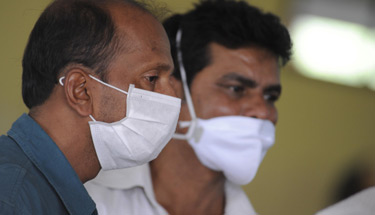 The severity of the disease is much less and the number of people dying due to this infection is much lower-thanks to the cross- reactive immunity which they have developed when the swine flu hit Pune for the first time.
When a large number of people in one area are subjected to the virus, they develop antibodies and develop “herd immunity” which itself protects the people from the virus. While it may not be sufficient to prevent illness, it may very well reduce the impact of the virus on mortality.
Besides availability of good vaccines and medicines has been a great help in tackling this disease.
According to Pune branch of Indian Medical Association, the best way to keep the disease at bay is vaccination especially the children.
Though this disease is not likely to spin out of control in the coming months as summer intensifies, there could be epidemic in July/August 2012 when the monsoon comes into effect in full force, according to IMA.
This year 13 people have died in Pune while a total of 300 people are infected by this disease which is considered to be one of the most infectious and at times deadly – if not treated on time.
Speaking to TSI, President of Indian Medical Association (Pune Branch) Dr Bharati Dhorepatil said, “Pune city is witnessing a spurt in the cases of swine flu. Normally the virus (H1N1) grows in optimal conditions of 24-26 degree C temperature and over 70-80 per cent humidity. With temperatures over 39 degree and dry climate we were not expecting cases of Swine flu. But over 150 samples being positive and a dozen deaths including one at Nashik has sent ripples around. Fortunately, the virus is still responding to Oseltamivir 75 mg twice daily.”
IMA officials suggest that though the situation is not alarming, people should take sufficient care. The high-risk patients -elderly, people with diabetes, kidney problems, cancer patients and pregnant women- should get themselves screened for the infection after symptoms like fever, cough, prolonged sore throat, chills and body ache.
Health officials say that timely medical help is crucial to reducing the risk of fatality. Medical experts feel that the current spurt in the swine flue may recur intermittently over the next two or three years and sporadic cases of H1N1 are likely to occur along with seasonal changes.
Considering the fact that Pune was the epicentre of swine flu in 2009 , a team of experts from New Delhi headed by Avdesh Kumar, assistant director general Union Ministry of health and family welfare arrived in the city recently to study the pattern of swine flu infections that are spreading in the city.
“The purpose of our visit is to study the pattern of H1N1 cases and and their management. It is a routine visit for collecting data. After visiting Pune we will visit other areas where this disease is being reported” said Kumar.
About the spurt in the cases of swine flu he said, “The virus is endemic and we do expect to see positive cases being reported. Environmental factors and conditions are also responsible for its resurgence.”
Dr Dilip Sarda, Secretary Indian Medical Association, Pune Branch said, “There is no need to panic even though there is definitely a need for people to be more cautious. We have advised the doctors to have high index of suspicion whenever people come to them with common flu type symptom. This is because the symptoms of common flu and swine flu are so similar that it is difficult to differentiate. In both the cases the patients experience generalised muscle aches and pains, headaches and fever along with a cough and runny nose. It is better to start taking Tamiflu tablets if the fever doesn’t come down after 48 hours”.
But isn't there a possibility of doctors prescribing Tamilfu tablets to even those who might just be suffering from common flu? Dr Sarda said, “Yes. There is definitely such a possibility. But the risk in not prescribing the tablets is much more than if prescribed”.
Dr Sharas Agarkhedkar, specialists in Paediatrics- Medicine suggest, “ It is very important to vaccinate all children at least as they are most vulnerable to this disease. Injectable vaccine is freely available and nasal vaccine will be available after six weeks.”
The IMA has specially asked the doctors to follow the guidelines issued during the pandemic of 2009. Cases should be identified for their severity,(Category A-mild, Category Moderate and Category C-severe) and treat accordingly.
The first swine flu in India was reported on May 13, 2009 when a man, who just boarded off the plane at the Hyderabad airport on its flight originating from the United States, manifested some signs of swine flu infections. Later on, the man was confirmed to be an H1N1 carrier. Thereafter, swine flu cases in India had increased fast in the month of August.
The first person to die of swine flu in India was a a 14-year-old-girl from Pune who succumbed to the influenza virus on Aug 3, 2009 .The girl, Reida Sheikh was a student of class IX from St Anne's High School in Pune.


 Issue Dated: Feb 5, 2017

