



- Article
- Comments (0)
Shoot to thrill
Tareque Laskar scouts around at the range as Indian shooting's Generation Next takes aim for Rio 2016
Tags : LONDON OLYMPICS | SHOOTING IN INDIA | VIJAY KUMAR | GAGAN NANRANG | ABHINAV BINDRA |
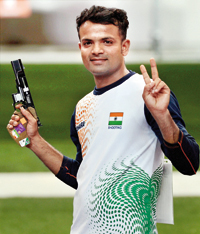 Of the 11 Olympic medals that India has won in the Games held in the new millennium, four have come in shooting. India's haul of 1-2-1 (gold-silver-bronze) clearly suggests potential but bogged down by logistical logjams and administrative apathy, the next generation of champion shooters seem to be struggling to spring up. But things might be looking up, if the vibes at the shooting range of the Karnataka State Rifle Association (KSRA) at the Sports Authority of India (SAI) premises in Bangalore are anything to go by. A quiet revolution seems to be taking shape as the administration readies to accommodate a surge in interest in the sport.
GM Krishna, the administrative officer of the range which was built during the National Games held in Karnataka in 1997, tells TSI, "Shooting has long confined to being a rich man's game but we want to ease it up.” As he speaks to this writer, a bunch of eager applicants to the KSRA wait for their interviews. Among them is a corporate honcho who's got his son along. Later, Krishna brings up the point that he also solicits sponsorships through connections cultivated at these meetings. The range, called the Jagdale Shooting Complex, was the result of a tripartite agreement among KSRA, the Karnataka Government and Jagdale Industries whose founder Nagaraj Rao Jagdale – himself a keen shooter – bankrolled the automated range.
.jpg)
Prakash PN, a pistol shooter who is part of India's world cup team and also an executive committee member of the KSRA, comes to the range regularly to practice and offers guidance to the young shooters being groomed here. The range doesn't have an appointed coach yet (Prakash himself was coached by his father P N Papanna) but that along with the fact that it remains open for only a limited time thus cutting down practice hours, are things that the association wants to change. Prakash recalls the days when the range was not automated and barely a shadow of its current self (he says it is currently 'one of the best in the world') but highlights that the association had always backed its shooters offering moral and psychological support that is just as critical for the success of a shooter as is the right equipment. The ecosystem of support is about to get more sophisticated for a sport that presents a lot of logistical complications.
Sample this: the government regulations make it pretty much impossible for a shooter to import rounds without the intervention of an association and only off late have they started allowing "shooters of repute" to do it by themselves. That still leaves the young guns out. Or take the case of Deepa MP, a promising young shooter who just switched over to pistol instead of her favoured rifle because she wasn't sure if she would still be allowed to shoot and carry around the paraphernalia required for a rifle if and when her parents get her married. Thus far, the story of India's shooters appears to be a work in progress because of these complications that the sport inherently has.
Buoyed by the success at the Olympics, however, and with a new set of heroes to look up to, talent only seems to have been emboldened. Rakesh Manpat, a young rifle shooter who is also being supported by Olympic Gold Quest, recalls how he picked up the sport after he visited the range with his brother. With rudimentary equipment early on, and without a rifle of his own, Rakesh honed his skills enough to impress Gagan Narang during one of the Olympic bronze medalists training visits to SAI. A potential Ekalavya Award recipient this year, Rakesh, who holds the national record in the 50- metre Rifle Three Position (Prone, Standing and Kneeling), even shifted residence to be closer to the range.
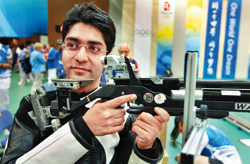
"I think if you're dedicated enough and quite good at your training, the infrastructure doesn't really matter and now that we have such a good facility here, it's possible that you can be a world-beater too," says Rakesh, hinting at his medal ambitions for Rio.
It is perfectly possible that the next Olympic medal winner in shooting comes out of the clique of shooters at the KSRA range. Rakesh and a set of other shooters that day are made to run through a 'champion of champions' training module (a format where shooters with the lowest total score are eliminated after each shot) with Prakash supervising them. As the last shooters stand ready to take the final shot, Prakash incites the sparse crowd to make some noise to simulate tournament conditions. Someone screams at Rakesh: "I dare you to hit the bull's eye." Another taunts "try to hit an 8… you haven't hit an 8 all day!" He takes aim. Bang! It's pretty much the highest possible score – a 10.9. That probably is as symbolic a moment as any that hints at Indian shooting's future being golden.


 Issue Dated: Feb 5, 2017

