

Saturday, October 3, 2026


- Article
- Comments (0)
Reserved Discrimination
While the Parliament recently debated the merits of promotions for Scheduled Caste officers, the Lok Sabha secretariat has emerged as a leading offender in this regard. Mayank Singh reports
MAYANK SINGH | Issue Dated: September 23, 2012, New Delhi
Tags : reservation | reservation on promotion | lok sabha | rajya sabha | |
Tags : reservation | reservation on promotion | lok sabha | rajya sabha | |
 While legislators in the Parliament are locked in a battle over time-bound promotions for Scheduled Castes (SC) and Scheduled Tribes (ST), the Lok Sabha Secretariat, the motor that runs India's lower house, stands accused of dilly dallying in a glaring case of
job reservations.
Even as the high voltage debate and an ugly fist fight between honourable members in the Rajya Sabha became the toast of the national media, the summons that the Secretary General of the Lok Sabha has received went unreported.
The National Commission for Scheduled Castes (NCSC) issued a hearing notice to Lok Sabha's top bureaucrat for personal appearance on July 30, 2012. Reason: Gross violations of the Constitution by Lok Sabha's recruitment board. Itis another matter that the official declined to attend the hearing citing parliamentary privileges.
The issue lies at the heart of what the Lok Sabha debated hotly in its concluding week – promotion for Dalit officers in government services. The facts of the case go back to the direct Class-I recruitment examinations held in 2008 for the posts of executive officers and research officers conducted by Joint Recruitment Cell of the Parliament.
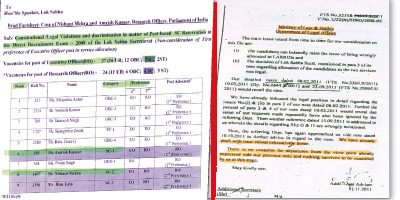 Of the 37 seats meant for the post of executive officers (EOs), seven were reserved for SC candidates, as were four out of 24 advertised posts for research officers (ROs). Despite the availability of eligible candidates, all seven seats for EOs were left vacant. Worse, at least three applicants, who had featured in the elite merit list for top ten candidates and had indicated EO as their first choice, were forced by the cell to take up the post of ROs, a lower grade.
The officers promptly wrote to the Secretary General of the Lok Sabha in February 2010, highlighting their case. To complicate matters, the Lok Sabha, unlike other ministries and government organisations, has no grievance redressal channel or mechanism for safeguarding the rights of Dalit employees. This is seen as a major institutional flaw. Had this mechanism been in place, the aggrieved officers would not have been forced to approach outside agencies and there was a good chance of the case being resolved internally.
Caught in a cleft stick, the Parliamentary Cell sent the representation to various ministries, putting it in a tighter spot than it could have visualised.
Strong opinions have been expressed by the Department of Personnel and Training (DoPT) and Union Public Service Commission (UPSC) in favour of the applicants. Said the DoPT: “The candidates had given their first preference for the post of EO and vacancies were also available. There was no mention in the advertisement about allotting the candidates based on functional requirement. Therefore, the Joint Recruitment Cell was bound to adhere to the first preference indicated by each candidate.”
The Department of Legal Affairs, when consulted, went to the extent of calling the actions of the Lok Sabha Secretariat a “departure from established procedure”, adding that the “Lok Sabha Secretariat has not followed the established procedure which is being followed by UPSC/SSC, ie merit-cum-option”.
.jpg) With things not going in their favour, the cell kept sending the representation back, hoping for different answers and buying time. But the concerned institutions were not to be outwitted. “We have already dealt with the issue raised exhaustively, thrice. There is no occasion for departures from the view point already expressed vide our previous note and nothing survives to be examined by us at this stage,” an exasperated Department of Legal Affairs wrote on November 1, 2011.
With things not going in their favour, the cell kept sending the representation back, hoping for different answers and buying time. But the concerned institutions were not to be outwitted. “We have already dealt with the issue raised exhaustively, thrice. There is no occasion for departures from the view point already expressed vide our previous note and nothing survives to be examined by us at this stage,” an exasperated Department of Legal Affairs wrote on November 1, 2011.
In the dark, the officers filed an RTI to obtain the various file notings pertaining to their issue. Information was still not forthcoming, which led to the filing of an appeal before the Central Public Information Officer, Lok Sabha Secretariat. The file notings, a copy of which is in the possession of TSI, reveal that all concerned authorities were unanimous in their support for the agitating officers.
So wherein lies the catch? As an explanation, the Joint Parliamentary Cell said that “allocation of cadres was decided keeping in view only administrative convenience” – a pretty lame excuse, if any.
The DoPT noting on the subject was categorical. “There was no mention in the advertisement about allotting the candidate based on functional requirements. Therefore, the Joint Recruitment Cell was bound to adhere to the first choice indicated by the candidate.” It further stated that since no undertaking had been signed by the applicants that they could be asked to serve in any post, their demand was justified.
Now utterly frustrated and disappointed, the aggrieved officers approached the highest constitutional body, the NCSC, for justice. Given the basis for the claims, the NCSC has issued two show cause notices and a summon for personal appearance to the Secretary General of Lok Sabha for not following the policy of reservation in recruitment in the Lok Sabha Secretariat since March this year.
No one from the secretariat had appeared before the commission following the summons on July 30. The next hearing was scheduled for September 11. The Secretary General or anyone from the secretariat once again failed to appear. The council has noted in a letter that this would be the last notice issued from it to the secretariat. This might mean stricter action in the near future.
According to sources in the NCSC, in a confidential letter sent to the chairman of NCSC, the Lok Sabha Secretariat claimed exemption from appearing before the commission on the grounds of parliamentary practices and privileges. This claim does not hold any legal and constitutional ground.
Article 338 of the Constitution of India grants the powers of a civil court in exercising its power of hearing, summon and evidence to the NCSC, which grants no exemption from appearing before the commission. The claims, sources say, are tantamount to willful misuse of autonomy to shy away from accountability and transparency.
The case, right in the heart of India's democratic system, has finally stirred the political class. Well placed sources reveal that Congress general secretary Oscar Fernandes and president of the Lok Janshakti Party Ramvilas Paswan have met Lok Sabha Speaker Meira Kumar, who had been previously notified, to discuss the issue. A case where the most powerful person in the lower house also happens to be a Dalit, is an abject demonstration of ultimately how fragile the system is.
mayank.singh@thesundayindian.com


 Issue Dated: Feb 5, 2017

