



- Article
- Comments (0)
No Rabindra Puraskar; artists prevented from paying homage to Tagore
Tags : rabidnra nath tagore birthday | rabindra puraskar | west bengal government | rabindra sadan | homage |
 Going against the tradition of decades, West Bengal government this year has decided not to award any author with the Rabindra Puraskar — the highest literary award of the state.
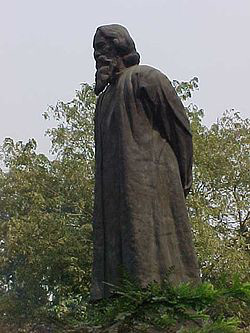
Also, Tagore’s 151st birth anniversary was not celebrated at Rabindra Sadan complex in the morning, but on the road at 2 pm under scorching sun of May. Even a group of noted singers and cultural activists, who went there, were prevented from placing floral wreath to Tagore’s statue.
Rabindra Puraskar is the highest honorary award for literary work in West Bengal. The award is being given since 1950. Satinath Bhaduri, Bibhuti Bhusan Bandopadhyay, Rani Chanda, Parashuram, Tarashankar Bandopadhyay, Historian R. C. Majumder, biographer of Tagore Prabhat Kumar Mukhopadhyay, Bimal Mitra, Sukumar Sen, Ashapurna Devi, Saradindu Bandopadhyay, Leela Majumder, Narayan Sanyal, Annada Shakar Roy, Shankha Ghosh, Tarun Sanyal, Kazuo Azuma, Nalini Patel are some of the recipients of the Award. Last year it was conferred to Amartya Sen. But, with utter dismay of the literary world, this year the state government announced no names for the coveted Rabindra Puraskar.
A group of singers and cultural activists led a procession towards Rabindra Sadan to pay homage to Tagore’s statue at Rabindra Sadan. They could not enter the Complex as huge police posse guarded the entrance of the complex. Eminent Rabindra Sangeet exponent Purabi Mukhopadhyay, veteran recitation artist Gouri Ghosh, Hiranmoy Ghosal was leading the song-chanting procession.
Later Mukhopadhyay told TSI, “We had police permission to go their and pay homage. When we went there police prevented us from entering and sought our permission. We showed the official permission paper. Then police said that this permission is to pay homage, but there is no mention of placing garlands. So you will not be allowed to enter.” Mukhopadhyay wonders, “Is placing floral tribute is not a way to pay homage? Does that require to be separately mentioned?”
Police officials present there said that the artists were followed by SFI and DYFI activists and so they were prevented to enter. Mukhopadhyay admits that activists of Ganatantrik Lekhak, Shilpi O Kalakushali Sangha (a pro-CPM forum for the writers, painters and cultural activists) were with them. “But this can not be a reason to prevent them to pay floral tribute to Tagore on the bard’s 151st birthday”, said Prof. Sunanda Sanyal. “If they had the permission to pay homage, they should have been allowed to do so. Tagore is not of the Government only, he is of the people. Supporters of any political party, accepted by the national democratic system, have democratic rights to do so. This is unwarranted.”
Singer Pratul Mukhopadhyay preferred to sit at home and read Tagore’s pieces in stead of attending the Government-sponsored programme outside Sadan complex under scorching Sun. He termed this as ‘unwarranted’. “To pay respect to Tagore, one does not require a statute or a photo. Tagore is in our heart. Even then, if some cultural activists pay tribute at the feet of the statue, what’s wrong! Political affiliation of the persons can not bar them to do so. It’s like two sets of political people are pulling Tagore hands on opposite direction!” Author and Drama director Chandan Sen said, “Bringing change does not mean the golden conventions are to be changed. It’s another form of politicizing culture.”
Dilip Chakraborty, Convener of the ‘Shilpi-Sahityik-Buddhijibi Mancha’, a common platform of the artists and cultural activists who were on the forefront to bring a change a political in Bengal, is unhappy with the decision to change time and venue of Tagore’s birthday celebration. He recollects, “In mid 60s, a group of writers and cultural activists, led by Premendra Mitra and Subhas Mukhopadhyay, defied government order and celebrated Tagore’s birthday at Rabindra Sadan’s gate. From the very next year, the then Congress-led government decided to observe the programme inside Sadan complex and at early morning. This is not a tradition made by the CPM government. The TMC government has killed the tradition of over four decades.”


 Issue Dated: Feb 5, 2017

