



- Article
- Comments (2)
Movie Review:Anhey Ghorhey Da Daan
Tags : movie review of Anhey Ghorhey Da Daan |
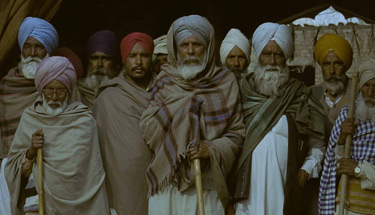 A Dalit village in Punjab wakes up to a pre-dawn demolition of a home on its outskirts. It has to make way for a factory. The owner of the house is powerless. The village elders, just out of their beds at the crack of a wintry, misty dawn, congregate and march towards the spot to sympathize with the victim and his wife. But that is all they can do.
These villagers have their backs to the wall in the face of a skewed paradigm of development and justice that has no room for the underdog. “We all have to take shelter in a desert like nomads,” says one villager.
The funereal air that hangs over this nondescript hamlet that is in danger of being wiped out completely is in sharp contrast to the robust, fun-loving and carefree spirit of singing and dancing Punjabis that commercial Hindi cinema projects on the big screen for popular consumption. This film, too, is unlike anything that has ever been made in the Punjabi language.
The austere, evocative cinematic idiom of Anhey Ghorhey Da Daan (Alms for the Blind Horse) taps into the entire range of visual and aural possibilities that the medium offers and delivers a film that is original and wonderfully organic in the way it uses craft to reflect mood and emotion.
Anhey Ghorhey… is an adaptation by first-time director Gurvinder Singh of a novel by Jnanpith Award-winning writer Gurdial Singh. It employs image, sound and expressions on the faces of non-actors to convey the deleterious impact that years of exploitation and suppression can have on men and women.
The film’s stark texture, strong visual style and unhurried pace add up to a cinematic approximation of the states of mind that the writer-director is looking to focus on. The camera lingers on wizened, emotionally scarred and bewildered faces of greying characters whose spirit has been battered into submission, if not entirely broken.
Produced by the National Film Development Corporation and released as part of PVR Cinemas’ Director’s Rare initiative, Anhey Ghorhey… was shot in and around Bhatinda. It tracks one day in the life of an impoverished family from dawn to midnight.
An old man, Mal Singh (played by Mal Singh, 60, a fertilizer factory-worker-turned-contract farmer), and his irritable wife (Dharminder Kaur) live in the village with their reticent but spirited daughter, Dayalo (Serbjeet Kaur).
The old man’s elder son, Melu (street theatre actor Samuel Sikandar John, the only member of the cast with prior acting experience), is a cycle rickshaw-puller in the city.
It is a winter morning. As the villagers get set for another listless day, we hear a voice ask: “Is anyone left alive here?” A little later, another voice laments: “They have hardly left us alive.”
Life seems to have ebbed out of this village. Words have lost their meaning. Only the weather-beaten faces of the men and women, grief writ large on them and all vestiges of hope drained out of their veins, reflect their depths of their despair.
It could actually be the story of many an Indian village: homes are being demolished to make way for industrial plots, young men are migrating to the city in quest of an uncertain future, and exploitation of farm hands by big agriculturists is getting worse with each passing year.
The novel on which the film is based was based in the 1970s. The village Gurvinder portrays is contemporary – nothing has changed in this space in the 30-odd intervening years.
This rigorous portrait of rural distress is aided significantly by the fine camerawork of debutant Satya Rai Nagpaul. The cinematographer controls both the movement of the camera and the lighting of his shots to convey the deathly stillness of the village and the clutter and chaos of the nearby town.
In the city, Melu roams the streets aimlessly after sustaining a head injury during a strike by his union and whiles away the evening with a couple of drinking mates.
Back in the village, as the day wears on and night falls two gunshots are heard. Commotion ensues. The old father leaves for the city to look for his son. The daughter wanders off into the night. Melu strays back into the village. But their static lives can go nowhere…
The power of Anhey Ghorhey Da Daan stems as much from the lack of artifice that the amateur actors bring to the screen as from the purity of the cinematic devices that the director brings into play to tell a Punjabi story that commercial movies usually sweep under the carpet. An outstanding film - a perfect blend of craft and heart.
Director: Gurvinder Singh
Cast: Samuel Sikandar John, Mal Singh, Sarbjeet Kaur, Dharminder Kaur
| Rating: | 4.5/10 |


 Post Comments Post Comments
|
Posted By: vipin | Noida | September 19th 2013 | 00:09 brilliant film
|
Posted By: jaspal | Amritsar | August 10th 2012 | 23:08 Nice movie.
|

 Issue Dated: Feb 5, 2017
