

Tuesday, October 20, 2026


- Article
- Comments (0)
Like lambs to slaughter
ADITI PRASAD | Issue Dated: May 20, 2012, New Delhi
Tags : sim terror in India | cell phone menace |
Tags : sim terror in India | cell phone menace |

Amidst dizzying telecom growth, unverified SIM cards are emerging as a potent threat to India's national security. The buck has to stop somewhere, says Aditi Prasad
Kochi police recently arrested two people for perpetuating an online robbery of Rs 13.4 lakhs from the bank account of one Dr Shabeer Khan. Rohit Bhoole and Ashish Salvi managed this feat by procuring a duplicate SIM card of the doctor using fake documents. They used the duplicate SIM to access his PIN number from the bank and transferred his money into several fake accounts. Activation of the duplicate SIM had already disconnected the original SIM of the doctor, so he also did not get the usual 'transaction alert' that banks send customers. The duo was eventually nabbed thanks to CCTV cameras installed in an ATM which caught them withdrawing their booty from one of their several fake accounts.
Unfortunately for security agencies, hardened criminals and terrorists are not swayed that easily by the charms of easy money. Normally they are even lucky enough to not have their images captured by CCTV cameras – unless they are Ajmal Kasab, wantonly indulging in terror acts on the roads of Mumbai. Instead, most of them have turned the manipulation of new age mobile and internet technologies into a fine art. The above incident may have been classified as cyber fraud – but the key role played by the illegal SIM card in the sequence of events simply cannot be ignored.
 Bhoole and Salvi went to some lengths of deception, complete with forged identities, to convince the concerned telecom service provider about their bogus claims. But as the TSI investigation shows, procuring pre-activated SIM cards on fake identities or in fact, no identity verification is a racket that is flooding India. Perpetuated by telecom service providers – eager to boost their subscriber additions – pre-activated and unverified SIM cards are not only giving a leg up to organised crime. They are also encouraging lesser evils such as pranksters making hoax emergency calls – and stalkers using them with impunity without fear of being traced – as also striking at the very heart of Indian democracy by providing terrorists a significant aid for masterminding lethal attacks.
“Unverified SIM cards have become a significant tool of the terrorist in the recent past. Not only for communicating with handlers but they are also being used as IED devices to set off blasts,” laments Ajai Sahni, Executive Director at the Institute for Conflict Management. He recounts a slew of recent instances where unverified SIMs played a vital role, including the 2007 Mecca Masjid blast, the Delhi High Court blast in 2011 and even the Israeli embassy blast earlier this year (See graphics on page 39).
 As India shines (or at least Indian telecom does) – and mobile service providers and industry czars rub their hands in glee at the rising subscriber figures which had crossed 950 million at last count – national security is in serious jeopardy. Projections by leading global consultancies indicate that the number of subscribers in India is likely to exceed that of China by 2013. The risk is particularly potent due to the illegal SIM racket consuming the pre-paid market, which constitutes roughly 95 per cent of India’s mobile subscriber base. Minus the usual requirements applicable for a regular, post paid connection, telecom service providers are perhaps not as enthused over the rigorous process of screening pre-paid subscribers. The problem is magnified as those in-charge of the verification process are themselves stakeholders in the subscriber additions race consuming the industry. It does not help that the actual points of sale of these SIM cards are mostly governed by profit-hungry franchises and vendors.
Worse, this is happening right under the noses of telecom regulatory authorities and the government. “We are aware that pre-paid SIMs are activated within a few hours of purchase, even before verification documents reach the company. The retailer tells the distributor, who in turn tells the licensee and the SIM card is activated. This is because there is a perpetual race among them for adding subscribers,” says a source in Telecom Regulatory Authority of India (TRAI).
The Department of Telecom (DoT) issued guidelines way back, making subscriber verification compulsory before activation of SIM cards. But cyber law expert Pavan Duggal argues for more stringent provisions in law that make issuance of pre-activated SIM cards a crime. “Right now there are only soft legislations (such as DoT guidelines) governing this practice. We need hard core legislation. As on date, if some vendor is caught selling pre-activated SIM cards without verification – there is no FIR, no arrest. We must make selling illegal SIMs a punishable offense,” he insists.
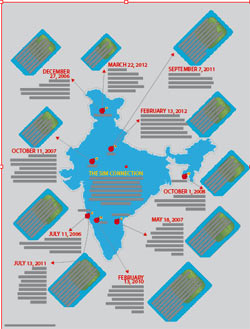 The problem is magnified by the fact that India lives in a difficult neighborhood – where border infiltration and terrorism is a daily occurrence. Defence analyst Maj. Gen. Afsar Karim encapsulates, “From the border areas, terrorists can only use unverified phone connections to liaise with their handlers in Delhi, Mumbai, Hyderabad or elsewhere. We have technology to intercept but detection is difficult because thousands of bogus SIM cards are floating around.” In Kashmir alone – a state which is plagued by infiltration and where border areas are a hub for terror training camps – there were reportedly over 10,000 unverified SIM cards in 2010.
Not that the government is apathetic to the problem. Growing recognition of the threat caused by mobile phones was the key reason behind the tussle between the Indian government and RIM (Research In Motion) over allowing security agencies to intercept Blackberry conversations. It is also the reason why the government banned the import of China-manufactured handsets in 2009. Apart from the fact that they were poor quality handsets, they did not have the crucial IMEI number, without which it is tough to track
wireless phones.
wireless phones.
But the problem is far from resolved. The omnipresence of unverified SIMs has offered new ways to terrorists to dodge detection. An inspector of the Delhi Police Special Cell – assigned to track terrorist activity in the national capital – explains how surveillance has become more complicated. “Now infiltrators from Kashmir leave their mobile and SIM card back there, travel to Delhi and get a new handset here with a pre-activated SIM card. Without an IMEI number or SIM card verification, it is difficult to intercept,” he points out.
If the TSI investigation makes you think that it is easy to purchase a pre-activated SIM card in Delhi or Mumbai, try going to small town India – where one can come away with pre-activated connections with the most rudimentary paperwork, if anything at all.
A recent PIL in the Supreme Court on how the flouting of guidelines in issuance of pre-paid SIM cards is posing a security risk to the nation, the petitioner alleged that around 80 per cent of the pre-paid SIM cards in the country may be purchased in pre-activated form which in itself is a violation of the 2006 and 2009 DoT notifications that bans sale of pre-activated SIM cards.
With the menace at its peak, the DoT framed stricter guidelines in March 2011 for ensuring subscriber verification. But these are yet to be enforced. The new DoT instructions also provide for filing a police complaint in instances of forged documents used for obtaining mobile connections. The FIRs can be lodged against a subscriber, point of sale franchisee or the service provider according to the gravity of the forgery.
It may however still be a long wait for the new guidelines to come into force – as the TRAI has differences on several aspects of the new verification processes (see table). TRAI Chairman JS Sarma told TSI that they are keen to come up with a suitable solution soon. "We have to see that everything is streamlined in such a way that people's security is assured and the availability of a SIM card is also not impossible," he says. For now, the penalty for unverified SIM cards – if and when detected in the sea of wireless connections – remains just a monetary fine with perhaps a rap on the back of the licensee’s hand. Issues of national security deserve stricter punishment.
But then, India has a reputation for being a soft state. Our politicians fight and debate over NCTC (set up to prevent terror) while simple basic things such as stopping misuse of SIM cards is ignored. That is why India is struck repeatedly by terrorists. And that is why almost no one is ever caught.


 Issue Dated: Feb 5, 2017

