

Wednesday, October 21, 2026


- Article
- Comments (0)
Fighting your demons
ANIL PANDEY | Issue Dated: May 27, 2012, New Delhi
Tags : Fighting your demons | Kuljeet Singh Chahal |
Tags : Fighting your demons | Kuljeet Singh Chahal |
 The BJP is in the throes of virulent factionalism with state satraps pitted against central leaders. Can they get their act together in time? Anil Pandey looks at the larger picture.
The story of little known Kuljeet Singh Chahal is symptomatic of how the Bharatiya Janata Party (BJP) continues to sideline potentially popular leaders in favour of its nominated oligarchs. It also provides an insight into the faction ridden ways of the saffron brotherhood and clues to why the party has not yet emerged as a serious contender for the 2014 sweepstakes. Chahal's entry into politics came through the Delhi university campus. His obvious talent was spotted early by party leaders and aged 27, he became BJP's youngest district president in Mayur Vihar. During the last Delhi assembly elections, he wanted to contest from Vishwasnagar and that is where his troubles began.
His claims were overlooked in favour of OP Sharma, political adviser to BJP Rajya Sabha MP and Leader of Opposition Arun Jaitley. Sharma ultimately ended up on the losing side. Keeping his undoubted talents in view, Chahal was nominated as secretary of Delhi BJP but was subsequently embroiled in a fake case after which he was sacked. End
of story.
of story.
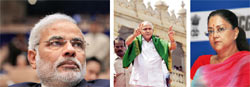
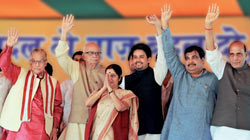 Chahal is by no means the lone example of BJP's arbitrary ways. Scores of young and upcoming leaders have been sacrificed at the altar of factional politics engineered by top leaders which, in turn, threatens to gnaw at the very vitals of the party. Most media discussions which focus on the roles of BJP state satraps, BS Yeddyurappa, BC Khanduri, Vasundharaje Scindia or Narendra Modi, miss the larger picture: the ongoing, no-holds barred tussle between the nominated BJP central leadership and its popular chief ministers who may lack the elan in stylish TV debates but more than make up for it with their mass support in the states.
Says APS Chauhan, professor and head of the department of political science at the Gwalior-based Jivaji University, "The battle of attrition between central leaders and popularly elected ones is three decades old. Popular leaders are being targeted because their emergence is a direct threat to the existence of central leaders who have no mass base to speak off. For the BJP, it means real trouble.''
Agrees Anurag Patoria, a Bhopal-based senior journalist who closely tracks the fortunes of the saffron party. "Leaders without any mass base in Delhi currently hold the upper hand in their equation with the party's popular chief ministers. Which is why after Atal Behari Vajpayee and LK Advani, BJP's central leaders have made no significant contributions.'' Top central leaders of the party are too squeamish about contesting elections and prefer safe passage into the Rajya Sabha. The ones who win can only do so if they have support of the state leaders. In fact,one of the frontrunners for the Prime Minister's chair, Arun Jaitley is also from the Rajya Sabha.
 Leader of opposition in the Lok Sabha, Sushma Swaraj, for instance, had to go as far as Vidisha in Madhya Pradesh to win an election with the support of chief minister Shivraj Singh Chauhan. LK Advani is dependent upon Gujarat chief minister Narendra Modi to pull his political chestnuts out of the Gandhinagar fire, while Murli Manohar Joshi and Rajnath Singh have had to change constituencies to avoid the ignominy of defeat. This tussle is now out in the open and public statements by Yeddyurappa, Vasundharaje and Gujarat veteran Keshubhai Patel make no bones about vicious infighting within the party rank and file. State-level leaders, often at the receiving end of central diktats, have had enough and what was earlier an internal tussle is now out on the roads. Top BJP leaders well ensconced in their air conditioned rooms in Delhi are hell bent on putting mass leaders in their place, no matter if it seriously damages the party's electoral prospects.
Says political analyst Subhrokamal Dutta, "The central leaders of the BJP are divided into camps. This is also reflected in the states. Central leaders who see popular state leaders as a threat are keen to neutralise them the best they can. Examples of this are Babulal Marandi, Yeddyurappa, Vasundhraje and Uma Bharti.
Yeddyurappa, former Karnataka chief minister who led the BJP onslaught south of the Vindhyas for the first time, said so in as many words. At a media briefing he told bemused journalists that former Union minister and powerful party general secretary Ananth Kumar was `feeding misinformation' to Advani and that "Anant Kumar had tried thrice with the help of the mining mafia to dislodge me from chief ministership.'' For a party that once prided itself on discipline, it is a long road travelled. In electoral terms, Yeddyurappa, who controls the powerful Lingayat vote bank, is leading a virtual fight-to-finish battle against Ananth Kumar and such is his clout that half-a-dozen ministers of the Karnataka cabinet offered to quit in his favour. Ananth Kumar, considered close to Advani is part of the D4 group in the party which has as its members Arun Jaitley, Venkiah Naidu and Sushma Swaraj. RSS chief Mohan Bhagwat had held D4 responsible for BJP's infighting and backed the appointment of Nitin Gadkari as BJP chief in an effort to offset the advantages that this quartlet enjoyed.
 Take Gujarat. The main threat to chief minister Narendra Modi comes not from a defunct Congress party but from within its own ranks. Senior central leaders and powerful state bosses, who see Modi as a potential threat to their prime ministerial and chief ministerial ambitions, are keen that the Hindutva strongman bites the dust when the state goes to polls later this year. If Modi wins a third term, it would buttress his claims for the country's top job; if he loses, then a heavyweight is knocked out of the race. Admits a Sangh insider: "Modi has more enemies at 11 Ashok Road (BJP headquarters) than at 10 Janpath.''
At the bidding of some central leaders, Modi's arch rival ex CM Keshubhai Patel, who was sitting dormant for some time, has suddenly taken the lead in fueling dissidence. He told a recent public meeting "Today, all of Gujarat is under fear, not just the Patels.'' The open secret in Ahmedabad is that most of those involved in the 2002 riots belonged to the Patel community. Political sources claim that some Delhi-based leaders are behind the creation of the Mahagujarat Janata Party headed by former Modi supporter Gordhan Jhadapia and any means is seen as fair game to upset the Gujarat strongman.
Little surprise that Modi is not likely to attend the BJP national executive on May 24-25 as a protest against these machinations as also against the re-induction of Sanjay Joshi into the party. In Rajasthan former chief minister Vasundharaje Scindia is considered close to Advani but conservative Sangh office bearers are not too fond of her. A blunt Scindia does not have too many friends and can expect little assistance from party chief Nitin Gadkari or other leaders like Rajnath Singh. So when Gadkari allowed a jan jagran agitation in the state to be led by her rival Gulab Chand Kataria, Scindia lost her cool and openly lodged a protest. She walked out of a party core committee meeting being held at the headquarters and the following day, 61 out of 79 BJP MLAs in Rajasthan put in their papers plunging the party into a crisis.
Similarly, naked dissidence in Uttarakhand led by ousted chief minister Ramesh Nishank Pokhriyal and efforts to undermine former chief minister BC Khanduri, which also led to the party's defeat in the recent assembly elections, has raised hackles all around. Says analyst Subhrokamal Dutta, "BJP defeated BJP in Uttarakhand, not the Congress.''
It is common knowledge in Dehradun that Pokhriyal had the blessings of central leaders like Sushma Swaraj and Rajnath Singh. Now there are genuine fears in Shimla that an Uttarakhand would be repeated in Himachal Pradesh as well.
Reason: central leader and BJP national vice presidentShanta Kumar and national general secretary JP Nadda are dead opposed to Himachal chief minister PK Dhumal, who is also close to Advani, Sushma and Jaitley. At the behest of BJP rebels, MP Rajan Sushant launched an open war against Dhumal but has been temporarily sidelined.
Shanta Kumar too has been urging the party high command to probe alleged corruption charges against Dhumal. Joining this campaign against the chief minister are former Sangh stalwarts from the state, ex-MP Maheshwar Singh, Mahendra Nath Sofat, Radha Raman Shastri and Shyama Sharma, who have set up the Himachal Lokhit party, which also has the indirect backing of some senior Delhi leaders. Needless to say, the prime aim of this new political formation is throw as many spanners in Dhumal's works as possible. So a stage has been reached when state satraps of the BJP have become independent entities in their own right and have decided to thumb their noses at the Delhi-based leaders - the political consequences of such actions be dammed.
Two powerful BJP chief ministers, Raman Singh in Chattisgarh and Sheoraj Singh Chauhan in Madhya Pradesh face similar deadly dilemmas. With the two firmly in their respective saddles, dissidents are lying low at the moment. But not for long. Both chief ministers with relatively clean records and a history of pursuing the development card are potential Prime Ministers if things go in BJP's favour in 2014. That is enough reason for insecure Delhi-based leaders to get into the act. For instance, despite vehement protests by Chauhan, Prabhat Jha has been sent to Bhopal as the the state BJP president. Jha, contrary to the stated party position, has one single agenda: to rally dissatisfied elements in the state against a perturbed Chauhan.
In neighbouring Chattisgarh, chief minister Raman Singh is feeling the combined heat of dissidence led by BJP parliamentary board member Nand Kumar Sai, former Union minister Dilip Singh Judeo and Karuna Shukla (niece of Atal Behari Vajpayee). All three, say party insiders, have the tacit go-ahead of central leaders who are loathe to seeing low-profile Singh emerging as the leader in 2014. Tiny Goa is no exception either. Here highly-rated Manohar Parikkar has to face constant hurdles created by Advani loyalist Sripad Naik. Parikkar who virtually led the BJP to a victory in the state – and who once famously described Advani as `old pickle' – managed to deny a ticket to Naik who would have become a force to reckon with had he won. Ditto in Jharkhand where Babu Lal Marandi, a leader with an acknowledged mass base, had to leave the party for reportedly opposing the theoretical diktats of BJP's central leadership. Now an important segment of the central leadership of the party is equally keen to destablise chief minister Arjun Munda.
The brunt of this infighting was taken by SS Ahluwalia, official BJP candidate for the recent Rajya Sabha elections from Jharkhand, who suffered an embarrassing defeat when chief minister Arjun Munda at the bidding of a Delhi-based leader, decided not to pull out all stops in Ahluwalia's favour. The RSS is naturally worried. According to those in the know, the Sangh's grip on the BJP has weakened considerably during the last ten years or so. Since the advent of Mohan Bhagawat, the RSS is being increasingly seen as a spitting image of 10 Janpath! A worried Bhagwat has prepared a blueprint called `Operation BJP'. In pursuance of this operation, many steps have been taken in the last couple of years. In 2009, the Advani camp was shafted to make way for Nitin Gadkari as party president.
Gadkari on his part has enforced the RSS line. Uma Bharti and Sanjay Joshi have been taken back into the party fold. Mandir-masjid disputes have given way to a positive development agenda and all out efforts are underway to give the BJP a moderate and young face. The party has worked on a concerted plan to increase its vote share by 10 per cent. For the first time, it has reached out to the working classes like weavers, labourers and others to get away from its image of an upper caste Hindu party and broad base its support. According to the party's calculations, weavers are the second largest vote bank in the country after farmers and the BJP is keen to take as many of them into its fold as possible.
But even Gadkari has not been able to stem the tide of dissidence. Even so, he has managed to inject some spirit into a party riven by factions and desperation. And the RSS is impressed because despite Advani's strong opposition, Bhagwat has extended Gadkari's term by another two years. When the national executive meetsthis position is likely to be ratified.
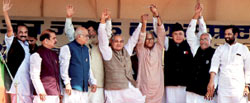 Reviving Vajpayee's spirit
The BJP has started making efforts to reach out to regional parties for a post-2014 scenario
The challenge before the BJP are two fold before the 2014 general elections. One, they have to get their act together. Two, and perhaps more significant, the party has to reunite and reignite the spirit of National Democratic Alliance (NDA) which had propelled Atal Behari Vajpayee's government to power and provided the country with the only non-Congress regime which completed its full tenure in 2004.
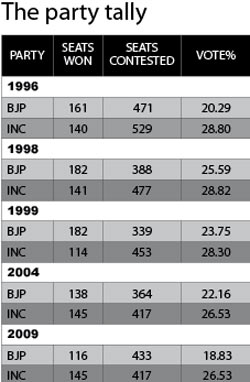
Sensing the urgency, the BJP is busy making its moves. Its allies and interlocutors are involved in making contacts with regional parties throughout the country, even though the results are not very encouraging so far. ``As long as we get 170 seats, we will be called communal. But the moment we cross that mark, we have the complete support of regional parties,'' BJP president Nitin Gadkari told this magazine. The BJP is aiming to first touch the 200 mark in the Lok Sabha. With the Congress under siege over a slew of corruption charges and spiraling inflation, the BJP believes its chances of emerging as the single-largest party are bright.
In an effort to cobble up an alliance which withered away after the NDA government lost the elections in 2004, the party led by Gadkari is keen to pick up new allies, including some constituents of the UPA which are unhappy with the current dispensation. And the party admits as much. BJP leader Rajnath Singh told TSI that ``the contradictions within the UPA are showing. Those who are not happy with the way this government is working will happily come with us when the time comes.'' Almost all BJP leaders who consider themselves to be frontrunners for prime ministership are meanwhile bidding individually with regional satraps to get their support when time comes.
Gujarat chief minister Narendra Modi is in constant touch with AIADMK chief Jayalalitha and Odisha chief minister and BJD boss Naveen Patnaik.
Central leaders Arun Jaitley and Rajnath Singh have a good equation with Mamata Banerjee. Rajnath is reportedly trying to bring in Mulayam Singh Yadav, even though an alliance with the SP chief looks uncertain, if not downright impossible. NDA chairman Sharad Yadav is in touch with Mulayam, Omprakash Chauthala in Haryana, Lok Janshakti leader Ram Vilas Paswan, HD Deve Gowda of JD (secular) and Telugu Desam's Chandrababu Naidu, working out modalities of a future alliance. Apart from these, Assam Gana Parishad leaders and YSR Congress leader Jagan Reddy are in regular touch with the BJP. With the BJP backing the demand for a separate Telengana, it is hopeful of getting the support of K Chandrashekar Rao, who is naturally miffed with the Congress.
Also buzzing the phone lines are leaders from all sides of the political spectrum which include MNS chief Raj Thakeray, Jharkhand Vikas leader Babulal Marandi, JMM's Shibhu Soren and others. Given the state of the Congress, everyone is suddenly hopeful, the most of them regional parties.


 Issue Dated: Feb 5, 2017

