



- Article
- Comments (0)
How Jaipur Literature Fest unfolded
Tags : jaipur literature festival |
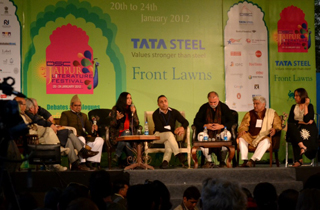 The festival of words mapping Jaipur as more than a destination for the play of oriental fancies inevitably gets mired in the very exoticism it seeks to cancel out.
For even as the speakers are handpicked from a sterling universe of conviction based authorship, the audience sadly is not of our choice.
The result a bevy of delegates who are marked by a bag which comes with the privileges they pay for.
This year the Jaipur Literature Festival was more organized what with the registration process outsourced to KYAZOONGA and streamlined beforehand. Further, the deployment of a comprehensive security check was a welcome development over the last year.
Yet what lacked was the presence of the very cannon which the festival fired the visitors’ imagination with: Salman Rushdie.
Michael Ondaatje in conversation with Amitava Kumar
Front Lawns, 11:15-12:15
Much like the anticipation of J.M. Coetzee “The man who brought us Disgrace” Michael Ondaatje‘s session received a packed front lawn response.
Ondaatje discussed the role of film making in his works. And even as he discussed the use of an incomplete narrative in the frames of the “The English Patient” which helped lead viewers on to the next frame, Ondaatje outlined the same to be a primary motivation to his writing as well. He desists from ‘knowing’ in the absolute sense. Surety then is not his style.
Harping upon The English Patient, Michael pointed out to the origins of the Novel as founded in the story of a particular individual. He of course developed the archive to map a tale of love defying geographies and problematising them.
Disagreeing with the excess of ‘reality’ in fiction, Ondaatje elaborated the same by quoting Kinky Friedman “There’s a thin line between fiction and non-fiction and I think I snorted it a long time ago…”(hinting at cocaine of course).
“Khili Battisi”
Ashok Chakradhar
In conversation with Lata Sharma
Front Lawns
Manouvering deftly the poor quality paper f the festival schedule I moved on to “Khili Battisi” Lata ji wasn’t very helpful with the anchoring until she insisted on lines from Ashok Ji’s ‘Jangal Gatha’
The poet regaled the audience with his much publicized (thanks to T.V.) performances of his poetry.
From Swiss Kalyani mocking flow of black money attempting to trace its origins to attempting the correct diminutive for Global Warming in Hindi in the process coming up with such over the top nomenclature as 'Dharti Dhadhak' and 'Sanasaar Sek'-Ashok was at his comic best.
Jangal Gatha marked an important body of work given the political meaning ascribed to conventional Indian Fables such as 'Bandar aur Magarmachh ki kahaani' and the king of the Jungle.
He followed it up with a dirge lamenting the loss of Adam Gondvi and Bharat Bhushan Aggarwal two prominent Hindi Poets.
To conclude, he exhorted the audience to action and fulfillment of their aspirations with the lines “…Jo kaam karne hain abhi poore karle, Tu kya sochta hai Hamesha rahega?”
Do Deewaane Shehar Mein
Pawan Varma and Gulzar
Introduced by Neeta Gupta
Mughal Tent
Next up we were late for Gulzar and Pawan Varma’s Jugalbandi at the Mughal Tent titled “Do deewaane Sheher Mein”.
Pawan, currently India’s Ambassador to Bhutan has Translated Gulzar for Penguin, a favor Gulzar returned equal vigor.
With regret in our hearts we nevertheless made sure to remain within earshot of the two.
Gulzar regaled the audience with his guttural voice infusing life into the Mughal Tent but Pawan spoiled it for us.
Somehow it was felt-at least by me-that some things needn’t be translated. Further, Pawan’s voice was only a dampener after Gulzar’s.
The jugalbandi was one sided as the sound of Gulzar’s deep breath on the mike reinvigorated the listener each time.
Nevertheless a prize discovery was Pawan’s perspective on the Mahabharata an operatic piece on the Yaksha Prashna written marvelously and translated with equal élan by Gulzar, to the enchantment of the listeners.
Stage by stage
Girish Karnad and David Hare
Introduced by Arshia Sattar
Front Lawns
The contemporaries discussed the history and scope of theatre and their own affinity to the form in this front lawn full house.
Girish Karnad reminisced about the constant adaptation of his play 'Hayawadane' among others in various languages across the country often without his knowledge. He discussed the slowdown of theatre owing to the onset of the Television in India charting a lamentable journey from the 60s for the two media.
David Hare opened the conversation with the mention of The Hours, the 2002 adaptation of Michael Cunningham’s novel which he wrote.
He pointed out that as far as writing was concerned he hasn’t had another passion much to the surprise of his compatriots.
He turned down offers for film scripts after The Hours to work on a play upon the privatization of British Transport to the shock of his acquaintances.
Karnad too mentioned that he pretty much couldn’t do much else but write.
The duo agreed upon the propagation of theatre as a matter of state policy, pointing out to infrastructural lacuna in the accessibility and presentation of theater.
At the end of this rather interesting discussion Karnad set another precedent, inaugurating a prudishness earlier unseen at the festival. He refused to sign autographs emphasizing he would only sign copies of his books. This was ominous in potential as future signings would see bouncers deployed in the author signing area and volunteers would outright ask those without a book to leave the cue.
The idea of a freely accessible literature festival somehow seems jeopardized this tie round. Book signing being a lucrative crowd puller, the festival might well turn into a closed affair open to only those as can afford to pay for an interaction with the authors.
Next we moved to Prison Diaries
Mediator-Siddhartha Varadarajan, Editor, The Hindu
Speakers: Iftikhar Gilani, Sahil Maqbool, Anjm Zamarud Habib.
Front Lawns
Siddhartha registered an opening protest against the censorship implied in Rushdie’s absence. He remarked upon the coincidence of the three authors hailing from Kashmir and the form of the prison narrative as increasingly affinitive to the predicament of the State’s populace.
Iftikhar was implicated under the official secrets act but never really tried in fact released after seven months in jail. Yet for this journalist those seven months left quite an impression what with the fabrication of evidence to show his presence in Pakistan. The security agencies obtained a copy of an interview of Imran Khan by Iftikhar (which he denied ever having done) to show as evidence of his presence across the border.
Sahil’s Memoir in translation 'The Darkness Inside' traces his journey from being a journalist of repute to being driven through much muck. He traces the pressure tactics of the security agencies such as solitary confinement further off from the detainees' hometown and third degree torture for several days.
Anjum recalls how she was among the founders of The Hurriyat party and how as was characteristic in the case of her fellow speakers people of influence and even her own party comrades distanced themselves from her in her hours of crises. Unlike the two men she refuses to talk about or even write of the atrocities of internment.
Rather she seeks 6to be a living testimony of survival for if she survived the torture then she can surely survive all odds.
The very act of diary writing is an outlet to the suppressed anger these protagonists suffer in jail. It shows their consciousness of their own innocence and the inescapability of their predicament. The very act of writing helps them create awareness of injustice among people lest they make peace with it and start believing in their framed culpability.
Iftikhar recounts that it was a guard at the jail who seeing him cry in helplessness suggested he become quiet and think about his situation with clarity and do something constructive with it.
Even as these narratives tell tales of personal suffering Iftikhar and the others emphasise authorial responsibility as reflected in Iftikhar’s statement with respect to news reporting “.there are many who treat whatever is written in black and white as gospel truth” implying the need for conviction in reportage and writing.
Jeet Thayil and Ruchir Joshi
Introduced by Samit Basu
Durbar Hall
The first day came to an end with Jeet Thayil’s immaculate pronunciation and Ruchir Joshi’s impeccable baritone. Jeet read out from Narcopolis his novel situated in the Bombay of 1992, tracing the arrival of new drugs of the scene and coinciding with the political tumult of the time. It gave him a vantage point to explore the city’s past present and future.
A particular chapter strewn with a particular Hindi expletive for female genital was read to much applause and laughter. Indeed Jeet kept up his reputation of dealing with the explicit to make his point. The chapter sought to caricature the mind of the aamchi Mumbai chauvinist in the process labeling the various communities in India, to show them as inferior.
Ruchir’s baritone tied the listeners into an incisive commentary on the “change/Pariborton” hullabaloo in Bengal. He doesn’t take sides rather depicts and points fun at the seriousness of the entire election process and rhetoric. He describes a particular debate where Suhel Seth and Mamata did among others field questions about the leaders and corruption and the ideal leader.
The questions put to them were equally humorous with a girl asking Jeet what was funny about the expletive ridden poem to which he replied he’d apologise if only he had written a poem.
Ruchir fielded questions on the state of Bengal under TMC to which he responded with the problematic singularity of Mamata in the government and poked fun at the need for Kolkata to fit itself into a metropolis paradigm namely Mumbai and now Delhi, at all times.
The duo ended with a reading of the Satanic Verses an act indulged in by Hari Kunzru and Amitava Kumar prior to these two at the same venue.
With this we ended an eclectic day looking forward to explore whatever little of the city was still buzzing outside the palace walls.
No concert for us as once again there were tickets which were sold once again, beforehand.


 Issue Dated: Feb 5, 2017

