


- Article
- Comments (0)
Guns for hire
The misuse of Punjab PSOs lies at the heart of the macabre murder of the Chadha brothers, reports Nirupama Dutt
Tags : Ponty Chadha | Hardeep Chadha | Chattarpur farm house | Crime in Delhi | |
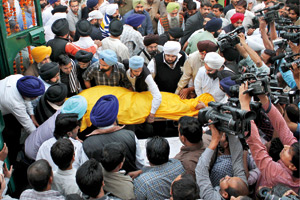 The gruesome double murder of the Chadha brothers, Ponty alias Gurdeep and Monty alias Hardeep, at the Chattarpur farmhouse gave a ghoulish turn to the famed rags-to-riches story on the fateful morning last Saturday.
Ponty Chadha’s rise to power, money and infamy could make any Bollywood plot on the theme look pale in comparison. His father, a migrant ravaged by the partition of the country in 1947, settled in Moradabad where Ponty was born in 1957. With little by way of education, he grew up selling snacks outside a liquor shop in the town. However, lying dormant was a sharp mind and the determination to make it big at all costs.
It is said that after dealing in as a legal contractor of opium and its byproducts, he used his political clout to become the undisputed liquor lord in Uttar Pradesh (UP), where his business interests included sugar mills, paper manufacturing, food processing, distilleries, power generation, bottling plants, real estate and film distribution extending to Delhi and Punjab. His combined business interests are reported to amount to several thousand crores.
.jpg) The spotlight fell on Ponty during the Punjab Congress Government led by the former Chief Minister, Captain Amarinder Singh. Although he was brought here with patronage from the Akali Dal in 1997 to break the monopoly of the Ludhiana-based Garcha group in liquor trade, yet it was Amarinder who gave the entire state contract to manage the liquor sale to this man with an innocent-sounding name of a Punjabi boy of some working class neighbourhood.
The spotlight fell on Ponty during the Punjab Congress Government led by the former Chief Minister, Captain Amarinder Singh. Although he was brought here with patronage from the Akali Dal in 1997 to break the monopoly of the Ludhiana-based Garcha group in liquor trade, yet it was Amarinder who gave the entire state contract to manage the liquor sale to this man with an innocent-sounding name of a Punjabi boy of some working class neighbourhood.
Then there was no looking back for Ponty. “Be it the Congress or the Akalis, Ponty’s of the world will always be close to the politicians because of their liberal money bags,” says a Punjab IAS officer. Ponty’s supremacy in the liquor business was further enhanced by the Mayawati regime in UP which saw him taking up the reins of the State Excise Department.
Pertinently, while he was the creation of the Congress in Punjab, he became equally close to the Badals so his Punjab connections remained really strong. He had close relations with politicians of all hues in Punjab as well as Haryana. During a Badal family wedding earlier this year, Ponty was a much coveted guest with both Sukhbir Singh Badal and Om Prakash Chautala keeping him company.
The Chadha family had police guards from UP as well as Punjab in plenty wielding powerful weapons and this was finally to be the cause of the bloody end of the two brothers. However, it has raised the question of misuse of PSOs and Punjab police has now sent a senior officer, alas too late, to probe into the role of its personnel in the shootout at the Chattarpur farm house.
Ironically, in recent times Sukhbir Badal via the present DGP Sumedh Saini had withdrawn police personnel from homes of senior retired police officers who were active even during the decade and a half of terrorism in Punjab, yet the Ponty's of the state had guards for the asking.
His Punjab interests included setting up two distilleries, in Gurdaspur and Hoshiarpur districts, in recent years. His company also bought a Coca Cola bottling plant near Amritsar. He invested heavily in malls and real estate in Ludhiana, Mohali, Jalandhar and other places. He had been a film distributor in the state earlier.
.jpg) However, what makes the shootout murkier is the recovery of an AK-47 belonging to a Punjab police officer recovered from the sight of the shootout and the Delhi police still probing how and why it was abandoned there. The horrendous acts of violence put a significant question mark on the misuse of PSOs recruited at the time of insurgency in Punjab and Kashmir, who were trained to combat violence and cannot come to terms with changed times and continue to be trigger-happy.
However, what makes the shootout murkier is the recovery of an AK-47 belonging to a Punjab police officer recovered from the sight of the shootout and the Delhi police still probing how and why it was abandoned there. The horrendous acts of violence put a significant question mark on the misuse of PSOs recruited at the time of insurgency in Punjab and Kashmir, who were trained to combat violence and cannot come to terms with changed times and continue to be trigger-happy.
Commenting on the Punjab experience, senior Punjabi journalist Daljit Singh says: “The PSOs and CAT commandos here were either kin of victims or informers. They were given unfettered power to combat terrorism and there was an element of revenge in their policing. There was a similar experience in Kashmir where the Ikhwanis started resorting to direct crime.”
It is a matter of having tasted blood and then not giving up the taste. In Punjab there was the infamous case of Inspector Gurmeet Singh alias 'Pinky' of the Punjab Police who was a terrorist-turned-cat-turned-cop. Enjoying proximity with a large section of terrorists in Punjab, Pinky, it has been learned, traded information with the Punjab Police then in the nineties he became a 'cat'. It is said that so true was the information passed on by Pinky, that he soon became an important tool for the police to fight terrorism.
.jpg) He became a core member of DGP SS Virk's team which was comprised of officers like Sumedh Saini and Shiv Kumar to name a few. Pinky's information led to some successful encounters and the arrest of some terrorists which earned him a permanent place in the police. In the mid nineties, Pinky was inducted in the police as a Havaldar from where he rose to the present post of Inspector and was, before this verdict, serving as Incharge, CIA staff, Fatehgarh Sahib. Pinky is reported to have killed several Sikh youths over the years.
He became a core member of DGP SS Virk's team which was comprised of officers like Sumedh Saini and Shiv Kumar to name a few. Pinky's information led to some successful encounters and the arrest of some terrorists which earned him a permanent place in the police. In the mid nineties, Pinky was inducted in the police as a Havaldar from where he rose to the present post of Inspector and was, before this verdict, serving as Incharge, CIA staff, Fatehgarh Sahib. Pinky is reported to have killed several Sikh youths over the years.
Former DGP of Punjab Sarabjit Singh points out that not only the recruits during the years of terror, but it had also become difficult to contain the regular police force when peace returned to the state. He adds: “OP Sharma, who took over from KPS Gill, started the reorientation programme for police officials to return to normal policing with return of peace. I carried it forward and a lot of effort was made to bring them to normal policing but the task was not easy.” The Chhatarpur shootout is an indication that a lot more still needs to be done.
nirupama.dutt@thesundayindian.com


 Issue Dated: Feb 5, 2017

