

Friday, October 23, 2026


- Article
- Comments (0)
Engineered implosion
SAURABH KUMAR SHAHI | Issue Dated: May 6, 2012, New Delhi
Tags : Syria crisis | Engineered implosion |
Tags : Syria crisis | Engineered implosion |
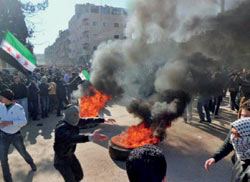 With the majority support that Assad has, it is impossible for the regime to implode without external intervention, and that is what the West and Gulf are precisely trying to do. Saurabh Kumar Shahi reports from inside the heart of Syria.
Sitting in one of the posh restaurants at Jebel Qassioun in Damascus, an Asian diplomat tells a story that pretty much sums up the farce the international community is playing in Syria. It was couple of weeks ago when Kofi Annan had first visited Damascus with his peace plan. After hours of deliberations over the nuances of the deal at the Syrian Ministry of Interior building, Kofi Annan and his entourage of observers retired to a nearby room to discuss the future course of action in private before again going back tothe deliberation table. As he started speaking, Annan suddenly remembered something and asked one of his officials to switch on the TV in the room. Apparently Annan, a veteran statesman, suspected that Syrians might have bugged the room and TV’s sound would muffle their discussion enough. It is an age old tactic. It was not surprising. What was surprising however was what was being showed on the television. Al Jazeera and France 24 were already playing it live that Annan’s mission has already failed. This, when the second round of deliberation was a good three hours away. Annan and his team were left stunned. Only if the world knew.
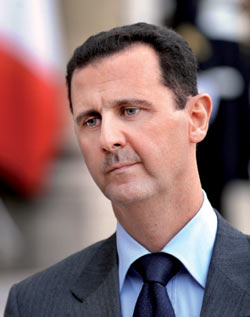 As the United Nations observers visit Syria to enforce and monitor Annan's six-point peace plan, it is very obvious by tone and tenor as to who does not want this deal to succeed.
Though the Syrian regime is extremely sceptical about the deal, it has left no stone unturned for its implementation. Even as this story goes to print, point one, two and six of the deal – that is establishing an interlocutor to facilitate a neutral dialogue for the political solution of the crisis; stopping the forward movement of the forces in the civilian areas followed by its withdrawal and that of heavy weapons; as well as the right for peaceful demonstration by the opposition – were already under progress. However, that has not stemmed the flow of body bags coming to the Military Hospitals in Damascus and Aleppo. In fact, Syrians appear to be pretty jittery when it comes to the implementation of the deal, and justifiably so.
Months ago when the Arab League Peace Mission had visited Syria, it had laid out a similar plan. In fact, Syrian officials often use the uncanny similarities in the detailing of the Arab League Mission and that of the Kofi Annan Mission to indicate that the same “outside forces” are behind these plans.
Then too, as it is now, Syrian forces had withdrawn from areas that were taken back from the rebels after months of fighting and bags of bodies, on the recomendations of the peace plan. However, as soon as the forces withdrew from the areas, the armed groups again controlled it and started the process of integrating it with civilian establishments. The second round of fighting cost Syria more soldiers and much more time. In fact, the report by the mission is quite telling in itself. The report was never properly publicised by the media. Only small sections of the report that were critical of the regime were released, out of context, in a bid to undermine it. However a complete view of the report spills quite a few beans.
 The report clearly and categorically suggests thatthe media has “vastly exaggerated” the situation in Syria and that while “the number of causalities remain high, it is nowhere near the figure suggested by activists and NGO groups”. The report was also adamant about the “active presence of armed gangs” who had “committed gross atrocities including abduction, manslaughter and targeting of civilians”.
Says Dr Fayssal Mekdad, vice minister of foreign affairs and the former Syrian representative to the United Nations while talking to TSI, “The system in Tunisia collapsed in 16 days while it took 18 days in Egypt. Isn’t it obvious why we have remained strong even after a year and four months of crisis? The people believe in the Syrian system and the majority of it rejects the external intervention. I agree that mistakes were made by us. We also have our own type of corruption. Our system lacked democracy. But when people first started making demands, President Assad was quick to introduce reforms. We are committed to implement the new constitution and we are sure we will overcome this crisis.”
In fact it is interesting to examin how this all started. It indeed started as a civilian protest that concerned civilian demands that were economic and social in nature. People were particularly upset by the delay in the distribution of land holding in some of the regions.
Years ago, a pattern emerged in the buying of land holding in Syria wherethe Kurds were seen as buying all the land on the either sides of the road from the Turkey border to the one with Iraq. It was suspected that if in future, a grand Kurdish state came into being, this corridor in Syria would be easily taken over and merged with it. The regime sensed the motive and put a moratorium on the sale. This moratorium lead to corruption and people were genuinely unhappy. It triggered the civilian protest. However merely three days after it started, the government agreed to the demands but
by that time, elements from outside Syria as well as others from within had already hijacked it.
In terms of its geographical expansion and demography, the rebellion is pretty contained. That not to say that is not deadly. The province that is majorly affected is Idlib. Experts suggest that as many as 32 to 34 villages of this province, especially in the Jabal al Zawia region. Apart from this, the Homs and Hama regions are also affected in parts and so are the coastal areas. In totality, it is estimated that somewhere between 10 to 12 percent of the Syrian population is directly affected by the revolution and is out of the control of the regime as of now. However, excluding these pockets of violence, most other parts of Syria remain as normal as they can be.
Broadly speaking, there are four sets of people in this opposition movement. The first, the smallest but the deadliest set are the elements of al Qaeda who have entered from mostly Lebanon and Iraq but also Jordan and Turkey. They are trained, motivated and coordinated. The second set is possibly the biggest and includes Sunni extremists of all stripes including Salafis. However, the biggest grouping in this set is that of the Muslim Brotherhood or Ikhwan al Muslimeen. They have mostly been pushed by Qatar and Saudi Arabia and get regular monetary and other support. The third group is that of bandits, criminals and convicts who have been released from jails or were fugitives and have accumulated in the restive provinces. They work as mercenaries and constitute almost entirely of locals. They are unorganised and lack training but have worked as frontliners for the armed gangs. The fourth set is that of Syrians who are genuinely unhappy with the regime and hence up in arms against it. It is this fourth group that this peace deal is going to address.
Diplomats in Syria suggest that the crisis will be over in a week if the armed gangs that have pushed through Turkey can be apprehended and stopped. Idlib, that shares its border with Turkey, has been restive primarily because of this. Secondly, experts and diplomats alike suggest that a large part of the problem is the exaggerated and often false account by both the Arabic and Western media of what is really happening. In fact, the fate of the French and Philippines ambassadors is a case in point. The Philippines government pressurised its ambassador to evacuate their citizens who are close to 30,000 in numbers here. A perplexed ambassador reported that situation was pretty normal in Syria apart from that very small section violent people. The ambassador was summarily replaced for revealing the truth.
The case of French is even more interesting. Paris was unhappy with the regular reports sent by the ambassador and asked him to send “useful” reports. When the ambassador’s report did not live up to Paris’s fancy, it formed a team of diplomat and asked them to pay a visit the country. The report by the team reflected what ambassador had said all along. The French Foreign Minister became furious. Finally, Paris shed off the mask and decided unilaterally.In fact, it becomes quite evident after talking to diplomats here that many of the Western and even Asian capitals overruled their respective embassies’ reports and went ahead with their vote. It is therefore not surprising that more than anyone else; it is the West that wants both Annan’s mission as well as the upcoming elections to fail.
Years of Baath Party domination has made Syria a staunchly secular and non-sectarian society. Now that fabric is under strain. Fearing the worse, the minorities of all denominations are standing steadfast with the regime. Among other sects too, apart from affected provinces, the pro-Assad rallies still draw an exponentially larger crowd than the anti-Assad rallies. This means that the regime is comfortable on the ground. Even the West knows this fact. And that explains the scale of external intervention.


 Issue Dated: Feb 5, 2017

