



- Article
- Comments (0)
Book Review: War Against The Taliban
Wages of a zero-sum war
Tags : Sandy Gall | Book review | Bloomsbury | War Against The Taliban |
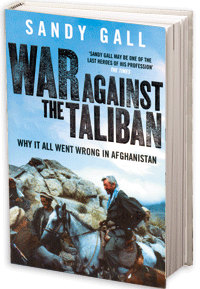 It is not always easy to review a book written by someone you partly idolize. The pressure is immense, and it is singularly difficult to figure out when your biases creep in. When I got hold of the review copy of Sandy Gall’s ‘War Against The Taliban: Why It All Went Wrong In Afghanistan’, I was doubtful whether or not I could do justice to the book considering Gall’s and my area of specialization is exactly the same and I had kind of grown up reading his fabulous accounts on Afghanistan—a total of 11 books.
Sandy Gall is the veteran in the region and started his stint even before the Soviet invasion of Afghanistan in 1979. During the invasion, he was embedded with the Mujahideen and stayed there even after the withdrawal of USSR when most of the other Western journalists had left for good. His staying back paid back as Afghanistan descended into civil war with troops loyal to Gulbudin Hekmatyar and Burhanuddin Rabbani fought out the road to road battles. And that is precisely why Gall has much more command over the intricacies of internal Afghan politics than any of his contemporaries or journalists who came later to the theatre.
Under the circumstances, I had pretty high hopes on ‘War Against The Taliban’, considering it was offering a simple answer to what in my mind is a very complex question. To be fair with the book, it does offer a couple of answers without oversimplifying the entire issue.
Of all the reasons attributed to the defeat in Afghanistan, Gall appears to put Bush’s fixation with Iraq as the topmost factor behind the failure. Gall insists that by late 2001 and early 2002, the invading army had a real chance of consolidating its gains and reconstructing Afghanistan as a modern nation. The locals were happy to see Taliban leave and there was no apparent hatred against the invading force. However, a series of mistakes squandered the gains in no time. Gall lists the faux pas at Tora Bora mountains as the first one in the series that was about to follow. He also lists the breaking of the “Musa Qala deal” in Helmand in 2006 as another possible reason. However, he puts the lion’s share of the blame on Bush’s folly of invading Iraq.
“I don’t think anyone expected the Taliban to offer such resistance. So in 2003 America apparently moved all of their intelligence and spy satellite resources out of Afghanistan and into Iraq. They obviously believed Afghanistan had been dealt with,” he writes.
This argument is debatable considering that when Obama went for a “surge” in Afghanistan, instead of stopping the Taliban onslaught, it only increased the violence. However, it can be granted here that the position of Taliban was weakened considerably in 2003 and had Iraq not happened, things could have turned out different.
Gall also analyzes in detail what he calls the duplicity of the Pakistani security establishment. However, while focusing on what he calls Pakistan’s Weltanschauung, he fails to give enough space to the sacrifice made by the Pakistani Army and the nation that has been left battered while fighting what was essentially America’s war. Gall does mention, however, that this duplicity arises from Pakistan’s desire to have Strategic Depth in the form of Afghanistan in its conflict with India. He further concedes, in a daring conclusion, that the “jihad mentality” of the Pakistani security establishment will continue until the international community starts to deal with the issue of Kashmir that has pitted the two nations against each other. In an era where mentioning Kashmir is considered sacrilege by western journalists eager to please New Delhi, Gall minces no words and calls a spade a spade.
Gall also takes to task politicos from United Kingdom who he believes remained clueless all along and never came up with the answer to ‘Why were the boys dying in the hellhole at the first place?” He is especially scathing on Tony Blair and Gordon Brown, who even refused to reply to his request for interviews as soon as they realised that the sub-text of the book was “Why It All Went Wrong in Afghanistan”. The Generals were more courteous and less cowardly. Some of the interviews give a detailed account of the initial years in Helmand and how difficult it was to focus on reconstruction when the majority of the resources were engages in repelling the Taliban.
Sandy Gall does come up with some answers at the end. But it cannot be called a definitive account of what actually went wrong. But much of it is to be blamed on the author himself who appears more eager to find out “how not to go to war” rather than “why not to go to war”.
Edition: Paperback
ISBN: 978-1-4088-2234-0
Pages: 400
Price: Rs. 399
Publisher: Bloomsbury


 Issue Dated: Feb 5, 2017

