



- Article
- Comments (0)
Book Review: The Second World War
Looking East
Tags : The Second World War book review | Antony Beevor |
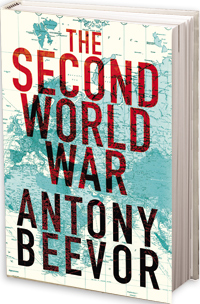 There has hardly been any war that has inspired as many books as World War II. From personal anecdotes to tactical moves, strategic blunders to diplomatic mind-games; there is little that has not been explored. Still, almost without fail, one sees another set of books on it. Only last year, readers were treated to In All Hell Let Loose, a refreshing work on the war that primarily focussed on the plights and otherwise of common people – farmers, housemaids, bootleggers and businessmen caught up in the whirlwind. British military historian Antony Beevor’s work is refreshing too, but in a different context.
Somewhere in his 900-odd-page saga of WWII, Beevor mentions a spirited speech that Joseph Goebbels gave at the Berlin Sportpalast in 1943. “Do you want total war?” he asks looking straight into the eyes of a frenzied mass. As the crowd shouts approval, an anti-Nazi journalist recalls how he barely stopped himself from saying “Ja!” although he too had leapt into frenzy. He later apparently told his aide that Goebbels was such a master of his craft that if on that day, even if he had shouted, “Do you all want to go to your deaths?”, the crowd would have roared in approval.
Or for that matter, the story of a teenaged Korean, Yang Kyoungjong, forcibly drafted into the Japanese Imperial Army in 1938 to fight the Soviet Red Army in Manchuria. He is arrested there and sent to a Soviet labour camp before being redrafted to take on the Germans at the Ukrainian front. Taken prisoner by the Nazis, he goes through a similar cycle of labour camp and redrafting before fighting for the Nazis in Normandy and is taken prisoner by the Allied Forces only to serve again in a British POW camp.
In many ways, these two anecdotes signify the overlaying motif that Beevor employs. First, the characters in the war were not merely mannequins and had their own set of human shortcomings and second, although the historians focused primarily on Europe, there was much more happening elsewhere too, notably in the Pacific and other parts of Asia, that affected the outcome.
Therefore, instead of beginning his book with Hitler’s invasion of Poland in September 1939, as is customary in the WWII narratives, Beevor goes back a month and starts in August 1939 on the Soviet-controlled Mongolian and Japanese-controlled Manchurian theatre, where in the Battle of Khalkhin Gol, Soviet General Georgi Zhukov, under Stalin’s command, routs the Japanese convincingly. But Beevor does not mention it merely for correction of narrative purposes. He provides solid reason why the battle remains one of the most important ones in the war, if not one of the biggest.
It was precisely because of the loss at Khalkhin Gol that Japan hastily dropped plans for further expansion into Soviet Union and started focusing its designs and logistics on the Pacific that eventually culminated in the attack on Pearl Harbour, drawing the US into the war.
On the other hand, the victory eased Stalin, for all practical purposes, out of the situation of fighting Germany and Japan simultaneously. It increased the space for maneuvering considerably and allowed him to transport the majority of troops to the Ukrainian hinterland to block the German invasion that began in mid-1941. And logically too, Beevor finishes his saga in August 1945 as the Soviet Red Army conquers Manchuria and North China.
Also, Beevor successfully manages to bring forth the disconnect that the process of strategy formulation of the top commanders had with the ground level tactical problems of unit commanders on both the sides. Through him, we now know how Hitler’s adoption of a stringent policy of not allowing tactical retreat or surrender cost him his 6th Army, the battle and the War itself at Stalingrad. We also come to know how Roosevelt’s rather embarrassingly exaggerated view of Chiang Kai-shek as an ally saw Mao routing the latter rather easily in China.
Other interesting tidbits, such as a Free French fighter group fighting besides the Soviets on the Eastern front, the disassembling of a prototype German V2 rocket by the Polish underground for British scientists to reverse engineer it or the hubris of German commanders on the Eastern Front in not ordering the winter dress for the troops thinking they will run over the Soviets before winter, let the reader peek inside an unexplored world.
The book is not without its shortcomings. Beevor’s rather laboured effort to discredit the Soviet Red Army and Stalin as well as the apparent lack of tactical details about the battles in the Pacific and Asia are two of them. Yet these accounts will remain an essential read in years to come, until someone else delves even deeper and unlock the mystery of what really happened in Asia and the Pacific.
Edition: Hardback
ISBN: 978-0-2978-4497-6
Pages: 885
Price: Rs. 1200
Publisher: Weidenfeld & Nicolson (A Hachette Imprint)


 Issue Dated: Feb 5, 2017

