



- Article
- Comments (0)
Book Review: Sky Train Tibetan Women on the Edge of History
Tags : Sky Train Tibetan Women on the Edge of History Book Review |
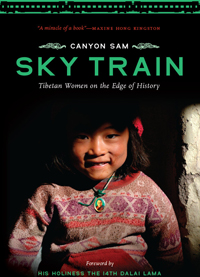 Human beings might be the only animals which, even faced with their own destruction, cannot look beyond petty distinctions of race, religion or, in the case of Tibet, sex. One would think that when faced with the onslaught of the Chinese and the very real risk of losing their own lives, the Tibetan people would be united in their bid for survival. The fact that even in suck dark times, the Tibetan people remained divided and the women folk were marginalised is the sad truth that is underlined by Canyon Sam’s Sky Train Tibetan Women on the Edge of History.
A third generation American Chinese, Sam returned to China to look for her roots in 1986. She found the land of her origin cold and not what she had expected. However, her trip exposed her to the land of Tibet. There, she became an activist and dedicated herself to tell the world the horrifying tales of torture and genocide perpetrated by the Chinese on the Tibetans through the occupasion and Mao's cultural Revolution.
Following the Chinese invasion, many Tibetans ran into India. However, the numbers were predominantly male. The reason behind this is that the Tibetan society, already staunchly patriarchal, did not want to take the risk of fleeing with the women folk. Buddhism already told them that Women were lesser beings. Even before the Chinese invaded, women in Tibet would pray to he gods to be born as men in their next birth. With the invasion, religious leaders decreed that the women were too much of a liability and did not want to take them along to safety. Sam weaves her book around four such women who were left behind – Paljorkhyimsar, Namseling, Taring and Sonam Choedron and their tales of survival.
As is brought out by the book, the exodus had an interesting effect on the women and the sociology of the land. It is undeniable that many women would face imprisonment and torture in the hands of the Chinese. However, for most women, this also meant a newfound freedom. For many, “every day was a Sunday”. They savoured their freedom – drinking tea and chang, meeting friends and holding raucous parties – things they could not do when their men folk were around.
However, the women were all that was left of the Tibetan culture. Therefore, even as most of Tibet gave in to the lucre of Chinese custom and the anti Dalai Lama propaganda took roots, most of the women remained devoted to the religious leader. Towards the end of the book, Sam tells us of the gift her Tibetan friend wanted her to give the Dalai Lama. The gift consisted of a robe left behind at the Norbulingka, the traditional summer residence of Dalai Lamas, in 1959 and saved by Tashi’s aunt for the last fifty odd years. Tashi’s folk thought the robe might have belonged to the 13th Dalai Lama. In addition to the robe, Tashi’s mother has sewn a shirt from some other cloth the aunt had saved.
Though, at times a little long winded and vague, the book is a rather interesting insight into the Tibetan women and the story of their survival.
Edition: Paperback
ISBN: 978-974-9511-83-1
Pages: 271
Price: Rs. 350
Publisher: University of Washington Press


 Issue Dated: Feb 5, 2017

