


- Article
- Comments (0)
Book Review: No One Had a Tongue to Speak:
Tags : No One Had a Tongue to Speak | gujarat |
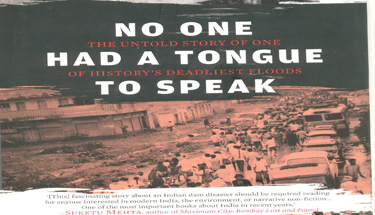 For a state that was witness to the communal carnage in 2002, few would have thought that Gujarat could have, in its history, an event so traumatic that it could dwarf even the horrors of Godhra. However, that is, indeed the case. Though it has faded from public consciousness long ago, two Harvard academics, Utpal Sandesara and Tom Wooten, tell the tortuous tale of Morbi, the erstwhile princely town in Gujarat that saw one of the worst natural calamities in modern India in their book No one had a tongue to speak.
On August 11, 1979, after the incessant rain over 11 days, the two mile long Machu dam broke. The resultant flood completely submerged Morbi, known as the Paris of Saurashtra in its heyday, completely demolishing the densely populated town in the river valley. Entire neighbourhoods were levelled and lives were torn apart. Though accounts greatly vary, estimates put the toll to as high as 25,000 lives lost. The book goes on to take a look at the standard Indian blame game that starts after any major disaster in the country, with politicians and bureaucrats busy to shift the blame onto someone else and the common man losing out. The book also shows the resilience with which the Morbi showed to slowly claw back into a semblance of normalcy.
What makes the book interesting is that instead of heavy prose and reams of news reports, the book takes a very humane tone. Instead, we have a few individuals. There is Pratapbhai Adroja, the owner of the Ghost Pan shop; Khatijaben, who married into the Valera clan of royal court singers; Bhagwanji Patel, owner of Sri Lilapar Potteries; Kanubhai Kubavat, a teacher, mayor of the city Ratilal Desai and Gangaram Tapu, in jail for perpetrating an act of communal violence. The authors take us into their lives, their every day joys and sorrows. They tell us why Pratapbhai's shop has such an unusual name, of the rivalries among Khatijaben's brothers in law and a possible conspiracy against her husband. And in all this, we see how their lives were intertwined with the river.
They steer clear of controversy. This is by no means a treatise on the political condition of India. It does not seek to question the wisdom of making dam after dam as a panacea to all of developing India's problems. Instead, the book concentrates on the people,on the lives that were lost and puts a human face to the dry statistics. When they talk of the grit and determination of then chief minister Babubhai Patel to bring Morbi back on its feet merely from the point of view of a man who loves his community, not as a politician doing, or not doing for that matter, his duty.
Overall, the book does a good job of shedding light upon one of the most horrific disasters in independent India from a very human perspective that is very easy to relate to.
Edition: Hardcover
ISBN: 978-81-291-1989-6
Pages: 411
Price: Rs. 799
Publisher: Rain Tree


 Issue Dated: Feb 5, 2017

