



- Article
- Comments (0)
Book Review- Everest: The First Ascent
High altitude amnesia
Tags : Edmund Hillary | Mount Everest | Everest: The First Ascent |
 It was in 1953, the year of the coronation of Queen Elizabeth II, that the fading glory of the British Empire got its final sheen. Or at least an achievement worth mentioning. The world had started to come out of World War II and was lunging into the Cold War with USA and Soviet Union cornering every glory in science, arts, militarism and what not. Britain, in contrast, was a glory of its former self. It needed a boost, a kick, in the year of the coronation of its new queen. And it was then that the news of the successful conquest of Mount Everest arrived.
Although the lead climber, Edmund Hillary, was from New Zealand and his porter and guide Tenzing Norgay from Nepal, the expedition was essentially British as pretty much everyone else was from there. It was Britain’s chance to savour the glory. But there was a twist. Applied Sciences was the buzz word of the era and Britain cut a sorry figure in front of the USA and the USSR when it came to it. After all, British glory was to be found in the pure primal of human instincts; the good ’ol heroism. The final moment of British glory was not to come from what was achieved in some dingy labs. Consequently, the role of science in the expedition was quietly relegated to subsidiary level whereas plain heroism was promoted as a Viagra to boost the failing confidence of an empire.
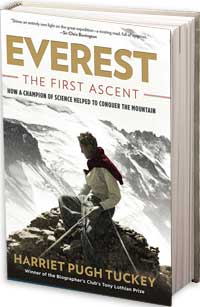
However, in doing so, one person was discriminated against, and how! Griffith Pugh was a physiologist and a key member of the 1953 Everest expedition. But chances are, if you are not an avid mountaineer yourself, you would not have heard of him. Griffith Pugh was the scientist who was sacrificed at the altar of heroism. In Everest: The First Ascent that record is put straight.
First the disclaimer. The author, Harriet Tuckey, is the daughter of the wronged physiologist. Understandably, one can question her integrity in this matter. But to put things in perspective, Harriet pretty much remained estranged from her father all her life. In fact, estranged might not be the right word to express that feeling. She abhorred him.
The author admits that it was only after sitting through one expedition commemoration ceremony after another and seeing her father’s contribution ignored that she decided to write the book. She talks about the 40th anniversary celebration at the Royal Geographical Society in the presence of the Queen where many members of that Everest expedition were in attendance. Griffith Pugh, by then in his advanced age, was also present and so was the author. She was left speechless when even after four decades of the achievement; her father’s contribution was conveniently ignored. It was as if everyone wanted to keep the myth of heroism alive. And then, a decade or so ago, in a lecture delivered by the Everest expedition’s doctor, Michael Ward; Pugh was described as “the unsung hero of Everest.” She got inkling that her father was much more than just a vile, selfish human being.
So what was Pugh’s contribution to the expedition in particular and in the field of advanced mountaineering in general? It was his ground-breaking research into human physiology that altered the perception of how the human body copes with oxygen deficiency at higher altitudes. It was he who charted out the acclimatisation regime used by climbers till day and also invented several specialised gears and apparatus, including high-altitude boots, camp-tents, stoves, apparels and several other equipments. And if that is not enough, it was Pugh who made all climbers adhere to the strict water drinking regime, with the hint of British efficiency and discipline, which helped them battle dehydration. Suffice to say, most of the previous expeditions were rendered unsuccessful because of the dehydration issues.
Writing about the evening prior to the triumph of Hillary and Norgay, Harriet says, “That evening sheltered by a tent made of the fabric chosen by Pugh, they started up their cooker (made to Pugh’s specifications) and, finding it ‘worked like a charm’, brewed ‘large amounts of lemon juice and sugar.’ … [then] they retired for the night using sleeping oxygen (courtesy of Pugh), resting on mattresses also developed by Pugh.”
The book takes readers through the entire process through which Pugh developed these revolutionary equipments and paraphernalia and how they proved key to the success of the 1953 expedition. The author also traces Pugh’s role in mountain warfare in WW II and how those experiences later helped him.
The author has not only salvaged the reputation of her father by giving him the due he long deserved, she has also given the Applied Sciences its deserved place in the story of one of humankind’s greatest triumphs. And that, without taking anything away from the old romantic idea of heroism.
Edition: Paperback
ISBN: 978-1-84604-349-9
Pages: 432
Price: Rs. 599
Publisher: Rider/Random House


 Issue Dated: Feb 5, 2017

