

Monday, October 26, 2026


- Article
- Comments (0)
An ear for an eye
ISHAN RAYCHAUDHURI | Issue Dated: May 6, 2012, New Delhi
Tags : Echolocation | blind people | |
Tags : Echolocation | blind people | |
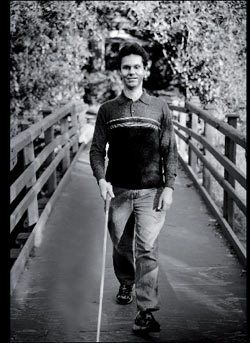 Congenitally blind, Daniel Kish taught himself to see using Echolocation, a la Batman meets Daredevil.Ishan Raychaudhuri chats up with a real life superhero who now helps impart ‘hearing aids’ for the blind…
There is much drama in all our lives and for some of us, perhaps more than our fair share. And yet, taking-for-granted remains a uniquely human trait. Overworked with channeling the information overdose that swamps our generation and time, we hardlypause over the many marvels that keep us going. Our senses, for instance. Amongst our faculties, the wonder that is our eyes – looked upon as the windows to our souls – and all that they make us privy to, can hardly be overstated. Possibly, the only times we see what it is like to be not able to see are when we lay our eyes on those without sight. Daniel Kish – blind since the age of thirteen months – however, would have your sympathy no more than he would have your reading glasses.
I had first seen him on TV when I was a kid and I was astounded. He seemed like the blind Marvel superhero Daredevil incarnate. Besides, he did stuff just like in the comic books: ride mountain-bikes and skateboard effortlessly. With “Running into a pole is a drag, but never being allowed to run into a pole is a disaster,” for a motto, Daniel managed to teach himself to never run into things ever again. So how does he actually work, I ask him. By making clicking noises with his mouth, he makes use of sound waves ricocheting off objects to visualise his surroundings. That’s right, just like a bat. Echolocation, thus helps Daniel navigate through his environment in much the same way it does for beluga whales and dolphins.
Daniel’s theory behind his proficiency: “The fact that light at night is a modern invention, and the fact that our ancestors used to routinely scavenge and move in the dark means that we might have a certain part of our brain primed to receive such training.” It is obviously in sync with his experiences of taking remarkably little time to share his skills with others. He warns that sufficient data has not been collected yet and we still have a lot to learn about the human brain.
Animals that echolocate as a principal form of interacting with and understanding their world are wired differently and they have special regions in the brain where the echoes are decoded and a map of their immediate environment prepared. In human echo locators, it is known through behavioural analysis that the auditory cortex is developed more highly. Also, in the MRI tests of experienced echo locators, the visual processing area of the brain has been found to light up even for those who never had any eyesight.
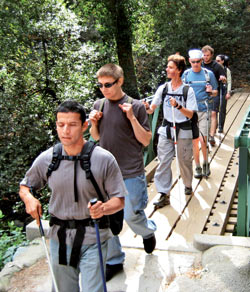 Imparting echolocation skills is not the end of his teaching repertoire. Like a concert pianist who is trained not just how to play the piano but also groomed to sit in front of it and maintain the right elbow angles, Daniel too provides a wholesome training program where the visually impaired learn to be more social and more open and circumvent the sympathy which may have kept them safe but robbed them of their independence.
Daniel doesn’t remember when he started echolocating. When talking about his childhood, he says, “I don’t consider what I do to be awesome. I always knew that I could navigate my surroundings and I was pretty well oriented spatially.” He particularly remembers a certain incident when he ran through his backyard and climbed over the neighbourhood fences, only to be brought back home by the neighbours. What struck him was the fact that there were so many things to be discovered and experienced. He enjoys hiking alone in the woods which, he says, is his favourite outdoor activity. He is also a trained vocalist and enjoys music a lot and not just because of that highly developed auditory cortex. He is also a certified Orientation and Mobility Specialist and holds degrees in psychology and human development.
In 2005, Daniel started the World Access for the Blind to teach his unique skills to other visually impaired folk, most of whom find their enhanced environment perception life changing in many ways. Even though the recessions had dried up his funds and made his work that much more difficult, his fierce self-reliance made sure that he came out victorious. On self-reliance, he says, “Society really doesn’t help, it doesn’t give support, and it doesn’t give sympathy. Society really has a lot of mixed up approaches to blindness. Much of what we consider to be help and support might just lead to exclusion and isolation in lots of different ways and in the end, you don’t see a lot of blind people contributing to the community at large.”
Daniel makes a resounding point there and it reminded me of my visit to the London Aquarium with a friend and his blind brother, who complained against being dragged to the aquarium and its supposed facilities for the blind. It has, in braille, the names of the exhibited fish in a neat metal placard. Even if a blind visitor were able to locate these signs, then all that they would be left with at the end of their visit would a list of fish. Hardly worth the £13.25 entrance fee.
For Daniel Kish and others like him, being blind is not a disability. And he urges others to stop thinking of it like that. “Blind people are people first and blind second. They have the same dreams and the same desires to realise their dreams as anyone else and blindness is no reason to change or stop any of that.” Now those are the words of a true warrior.


 Issue Dated: Feb 5, 2017

