



- Article
- Comments (0)
Accounting for intelligence
The November 2008 attacks in Mumbai have prompted an across-the-board intelligence revamp and parliamentary accountability. Mayank Singh examines a recent proposal which takes a clear eyed look at India's security imperatives
Tags : 26/11 mumbai terror attack | abu jundal |
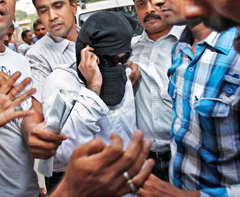
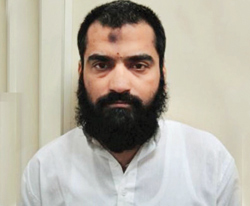 The recent deportation and arrest of Abu Jundal, the Indian hand directing operations in the deadly November 2008 attacks in Mumbai from a Karachi safe house, must go down as a significant intelligence scoop by government agencies, which for its sheer range and the quality of subterfuge would have done John le Carre proud. The Saudi Arabian government is not particularly keen to listen to India when it comes to bilateral issues vis–a–vis Pakistan. So when the Indian government presented evidence of Jundal's true identity, authorities in Riyadh, where the terror mastermind was held, would not bite.
Until the Intelligence Bureau (IB) in collaboration with the Maharashtra Police pulled a caper which involved a relative making inroads into the Jundal household in Maharashtra's Beed district where his parents lived. The family mole was specially tasked to get a swab of one of Jundal's parents to establish the terrorist's DNA.
The unnamed mole, under guidance of intelligence officials, adopted unconventional tactics, not unknown to those who specialise in fighting underground wars. He picked up repeated fights with Jundal's father and in the ensuing fisticuffs, literally scratched blood from his hands, which was soon dispatched to DNA laboratories around the country. When authorities in Riyadh saw the results, Jundal's deportation then became a question of time.
To be sure, agencies which have the mandate to gather intelligence, are on a dicey wicket. The amount of frivolous work they do – for instance protecting VIPs from headline grabbers wanting to get into news by slapping or throwing shoes at VIPs and ministers – leaves them with little time for serious collation of facts and the ability to foresee potentially dangerous situations. The politician with his myopic vision on the vote bank could not care less.
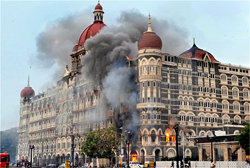
Yet, in a strange way and despite the odds, the November 11, 2008 attacks in Mumbai have changed things.
Acknowledgment of it has come in a recent Institute for Defence Studies and Analyses (IDSA) task force report, sponsored by the Ministry of Defence (MoD) which admits that "the unprecedented attack on Mumbai on 26.11.2008 focused attention on the complex security challenges facing India, which have the potential to derail its economic and social progress.''
While inquiry commissions and task forces on the state of intelligence have been set up before, notably after the 1999 Kargil intrusions where the issue of intelligence lapses had been examined in depth and several proposals made
by the Task Force set up by the Group of Ministers implemented, the IDSA report is in response to the new
challenges best epitomised in the 2008 Mumbai attacks.
"Several efforts have been made in the past to bring about reforms in the intelligence sector. Our contention in this report is that these efforts have been piecemeal and ad hoc. New organisations were created but no thought was given to prevent overlaps of jurisdiction or turf wars on the creation or sharing of expensive new technical assets or know how,'' the three-member Task Force has said in its conclusion.
R Banerji, PK Upadhyaya and Harinder Singh, authors of the report had top professional help from India's strategic supernovas – late S Subrahmanyam, former National Security Adviser Brajesh Mishra, intelligence aces Girish 'Gary' Saxena, AK Verma, Ajit Doval, Ved Marwah, B Raman and Lt Gen (Retd) R Sawhney, to name just a few.
Calling for introducing greater transparency and professionalism, the Task Force believes that despite the sensitivities involved, greater accountability and parliamentary oversight is the need of the day. "We are mindful of reservations within the intelligence community, especially among police officers in the profession, that excessive harping on accountability could damage operational efficiency and jeopardise secrecy. Yet, it has been felt, on balance, that there can be no getting away from introducing some sort of external supervision and control, including legislative oversight to improve efficiency and to build in self-correcting mechanisms."
The authors believe that "to tackle the widely perceived incompetence and malfunctioning of intelligence agencies, it will be necessary to implement a wide range of reforms to improve and empower the intelligence agencies.''
Ushering in reforms is tough because "even the smallest of reforms can become hostage to divisions, rancour or the monumental shortsightedness prevailing within the intelligence community,'' the report says.
Most experts believe that coordination between a plethora of agencies is the key. There is the IB which reports to the Home Minister; the Research and Analysis Wing (RAW) which reports to the Prime Minister; there are organisations such as Joint Intelligence Committee (JIC), Aviation Research Bureau (ARC) and the National Technical Research Organisation (NTRO) which report to the National Security Council. The armed forces have their own intelligence agencies, one each under the Army, Navy and Air Force and an umbrella body called the National Intelligence Agency. There are other agencies which specialise in financial intelligence. These are the directorates in the Income Tax, Customs and Central Excise departments. In addition, there are a number of state intelligence agencies and special cells, all devoted to the same cause.
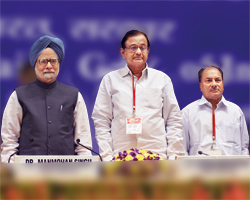
Home Minister P Chidambaram admitted as much when he delivered the Intelligence Bureau Centenary Endowment Lecture in 2009. "There is a need to network all data bases that contain vital information and intelligence. Today each data base stands alone. It does not talk to another data base. Nor can the 'owner' of one data base access another data base. As a result, crucial information that rests in one data base is not available to another agency,'' he said.
There are other bugbears as well, the foremost of them being the wall of mistrust between civil and military intelligence. Traditionally, Secretary RAW briefs the Prime Minister as per need and requirement and the Director IB to the Home Minister, leaving no forum for Military Intelligence (MI) to present its findings and assessment to the country’s decision makers except during times of crisis. Confirmation of this has come in the Task Force report as well.
A senior MI officer, on conditions of anonymity, attributes turf battles, lack of strategic vision and inbreeding as the main causes behind the poor performance of India's intelligence agencies. "Duplication is the result of this guard-my-turf attitude which is all pervading. Civil intelligence agencies have become parking places for officers who seek to remain away from their cadre states,” he avers.
Says former Defence Intelligence Agency (DIA) boss Tejinder Singh, "There has to be a perpetual focus on intelligence. You cannot focus one day because there is a problem there and then next moment you leave it. It requires perpetuity. The problem comes because of competition and the number scoring attitude. Organisations will have to appreciate that time is critical when it comes to intelligence input, not who reports.''
Most experts and analysts, however, believe that the time has come for not just a total intelligence revamp but also bringing it under appropriate scrutiny, whether an oversight committee like the various parliamentary panels or a special committee formed with the Defence Minister, Foreign Minister, Home Minister and Finance Minister under the chairmanship of Prime Minister. Of course, all this needs to be done under the oath of secrecy so that sensitivity is not compromised.
A critical part of this revamp is the inclusion of manpower with varied experience and exposure. Pointing to this lacunae of not having the benefit of specialists from streams like financial services, people with understanding of business issues and the media, Rana Banerji, former Special Secretary RAW, says experts from different fields need to be roped in so that perspective and planning at the agency is enriched by multiple inputs. "We should appreciate the importance of people from the financial world when identifying support to terrorist organisations, drug cartels and hawala dealers,'' he points out.
According to former RAW chief, AK Verma, recruits must be members of in-house services. No outsiders, including IPS officers, should be allowed to dominate though there can be a revolving door policy to admit anyone suitable, he adds.
The creation of an elite cadre within civilian intelligence organisations cannot be over emphasised. BN Mullick, the country's second Director IB (DIB), had set up an earmarking scheme which became operational in 1954. According to the plan, four or five top candidates of the Indian Police Service (IPS) were selected by the Union Public Services Commission (UPSC) and they spent a life-time in IB after initial training. With extended rigorous training within the IB, they evolved into an elite core, extremely efficient, committed, and masters of operations and analysis. They employed caution but were not risk averse.
All DIBs subsequently have come from this corps.
But with years, the scheme was wound up due to intra-bureaucratic pressures, particularly against the prolonged stay of IPS officers in Delhi, which meant that they would not spend time in their state cadres, a cause for heartburn among the ir cadre mates. Sadly, political controllers of the day could not prevent the demise of this scheme and it remains a telling commentary on their vision, understanding and management of intelligence.
Says Verma, "RAW, which functions outside India, is essentially asking officers to break the law. In the US, intelligence officers have the backing of their country's laws which authorises them to function 'legally' outside US shores. Here, none of us is protected. We should have a law to protect our intelligence officers." Fair point.
The IDSA Task Force has advocated providing a legal framework for their existence and functioning. The report suggests a single authority for supervisory control. He could be the National Security Adviser in a modified role, DIB or even a Minister for National Intelligence, answerable to the Parliament.
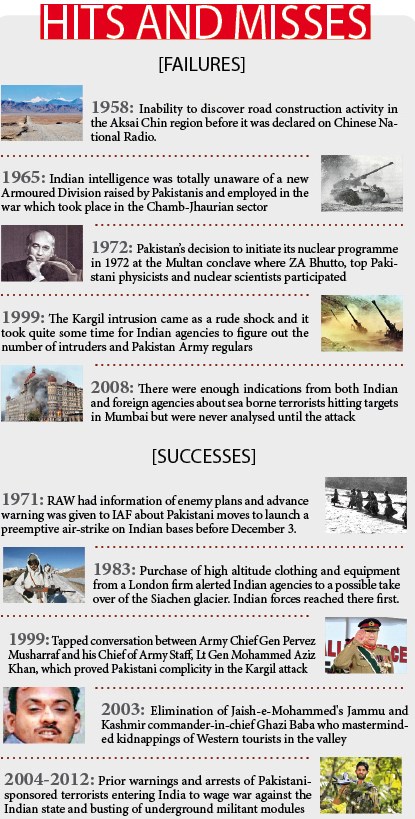 Points out NTRO's first chief RS Bedi, "Unfortunately reforms are put on the agenda only after the damage is done, as an after thought. Therefore, it is always a question of trying to catch-up. We have not been able to put any serious effort to have a system in place which an aspiring, emerging power needs to have. The Subrahmanyam Committee report, I think, was well thought at the macro level. But, then, implementing is where we can never be successful. The bigger issue is the opposition from agencies which are already established and do not want to lose their pre-eminent position. In addition, there is no political will.
Pointing out that modernisation of the intelligence machinery is a prerequisite for security, the IDSA has recommended extensive reforms in the recruitment and training processes of personnel, their pay structures and career progression, to attract the best talent. It has also suggested that recruitment to various agencies be widened so as to have experts from myriad fields, such as science and technology, information technology and communications, rather than making them exclusive reserves of the police sector.
Referring to the vexed issue of coordination between civilian agencies like the IB and RAW and those of the armed forces like MI, the report advocates putting them on an even keel, so that there is greater interaction.
Vice-President M Hamid Ansari during the course of a recent lecture, talked of the need of intelligence agencies being made accountable and made to function under some sort of legal cover.
Last year, Congress MP Manish Tewari had introduced a Private Member's Bill in the Lok Sabha, seeking to regulate the functioning and power of the intelligence agencies. What were his motivations? "Organisations which are tasked with the responsibility of preserving and protecting national security certainly need to be put on a proper legal footing. In India, the Central Bureau of Investigation (CBI) is still governed by the archaic Delhi Police Special Establishment (DPSE) Act, 1946. If my research on the subject is correct, probably, the notification constituting DPSE Act was itself not issued in the first place. Further, the culture prevailing across administrations and governments prevents the meeting of the need to set these organisations on a proper legal footing,'' says Tiwari.
The move to make intelligence agencies more accountable is gathering momentum. In a letter to Prime Minister Manmohan Singh this May, lawyer activist Prashant Bhushan has made a strong case for defining a legal status for the IB. "Though the IB is a critical instrument of state intelligence, its organisation and charter is not known to the public. For some inexplicable reason, Parliament has failed to legislate for the establishment, regulation, discipline, control and operations of the IB. There is no mention of the IB on the official website of the Ministry of Home Affairs.''
In the letter, Bhushan held similar views about RAW. "Like the IB, RAW is one of India's premier intelligence agencies. Before the creation of RAW in 1968, the IB was responsible for both internal and external intelligence. During the 1962 and 1965 conflicts with China and Pakistan, a number of shortcomings were noticed. Based on the concept paper submitted by the Army, the government approved the creation of an independent intelligence agency to gather external intelligence. However, instead of the Ministry of Defence, as recommended in the paper submitted by the Army, the new organisation was to function under the PMO,'' he said.
The first extensive attempt at revamping intelligence agencies and their functioning were enumerated in the Kargil Committee Report which talked quite candidly about the handicaps that bedevil Indian Intelligence, namely its ethos, culture, work styles and capabilities.
With its overweening emphasis on reforms, the lowest end of the intelligence spectrum, the beat constable or the policeman in the remotest village, can scarcely be ignored, says a senior officer who has wide experience of both state police and central police services. “We should start right at the grassroots when it comes to revamping the internal intelligence collection mechanism. Is it a secret that even a constable pays bribe to get recruited? What will be his focus except to eye opportunities to get returns on his investment,'' he queries.
There can be no doubt then that recruitment, even of the lowliest of police constable, has to be on merit.
The traditional beat system at police stations where a constable is assigned a particular area and he maintains a round- the-clock vigil which leads him to every information, movement or event, worked well but that too has come under severe stress with most police stations understaffed or too busy with law and order duties or protecting sundry VIPs.
Says a source, "When it comes to an Intelligence Bureau set-up at the district level, it is staffed by about four or five people. The police constable is mandated to meet people, reach the last man without raising eyebrows on what he is observing and collecting as feed back. But duties like bandobast, elections, political rallies and VIP duty have seriously compromised day-today work. State governments do have Special Branches with a mandate to look into intelligence gathering but has anyone bothered to see what kind of men are put there?" Good question.
The problem of manpower shortage has serious implications. Chidambaram informed Lok Sabha in April this year that the sanctioned and actual police personnel per 100,000 people (police-population ratio) at the all-India level were 145.25 and 117.09 respectively. The number of policemen per 100,000 people in India is 130 while the minimum prescribed United Nations norm is 220. At 220, India is approximately 600,000 policemen short or about 25 per cent less than the sanctioned strength.
Lieutenant General (Retd) RK Sawhney, former Director General of Military Intelligence (DGMI) says India's intelligence focus is all wonky. "If we aspire to be amongst the league of the nations who have a say in global matters, we require eyes and ears at all places that matter. There can be no substitute to hard human intelligence,” he says.
Sawhney concedes the job is tricky, saying: "It is a game of high risk and at times the dangers involved are higher than even military risks. We should learn to respect these men and keep them motivated in every way so that they never think twice before taking a risk, but the reality, at times, is different.”
B Raman, leading anti-terrorist expert and former RAW official points out, perhaps rightly, that Indian intelligence agencies are good in crisis management after a threat to national security has materialised. What needs to be done is to prevent an impending crisis.
Others like AK Verma have reiterated their concern over issues of manpower and technological backwardness. The failure to prevent a national security crisis can be attributed to a lack of quality control in their internal management. This poor quality control is evident in their outdated recruitment procedures, which tend to presume mistakenly that police officers make for good intelligence officers. Their poor man management often leads to internal frictions.
Shoddy team work which affects their ability to co-ordinate and the tendency to treat intelligence services like any other government department where seniority prevails over merit, are also an unhealthy outcome. So is their failure to keep pace with developments in science and technology which are adding to the threats. The over-focus on short-term tactics and the under-focus on a long-term strategy to foresee, forestall and control a national emergency stares in the face. Former Special Director IB, DC Nath suggests that a few dedicated officers interact with the media and public as a sound PR excercise. It could well be a good beginning.
Anything but intelligent
The NTRO, set up to upgrade India’s technical intelligence capabilities, now faces charges of corruption, nepotism and sleaze
During its eight-year existence, the National Technical Research Organisation (NTRO) has grappled with every posible allegation. Not only is its reputation in tatters, but legitimate questions are now being raised about about its very existence.
After the Kargil Review Committee had recommended reforms, the NTRO was raised as a premier technical agency with capabilities of remote sensing, data gathering and processing, strategic hardware and software developments and crypto systems to break secret codes and messages. In other words, truly high tech.
The core body was handpicked with RS Bedi, old RAW hand, who became its first chief and who in turn selected his own team on the lines of Britain’s Government Communications Headquarters (GCHQ) and America’s National Security Agency (NSA) which are indispensable arms of the country when it comes to technical intelligence.
But trust the Indian version to be different. In recent times, NTRO has been involved in couple of scandals which are not remotely connected to intelligence.
These include misuse of assets in hand and massive corruption in the use of funds and discretionary powers. The use of sensitive spycams to catch terrorists was used to snoop on lady colleagues in toilets at the NTRO headquarters in New Delhi and the misuse of agency money in sponsoring personal purposes, are just two aberrations.
In the highest Indian traditions, nepotism and cronyism have come to dominate the entire recent selection process, highlighted by the Comptroller and Auditor General (CAG) when it was given permission from the Prime Minister’s Office (PMO) to conduct a special audit.
In a scathing indictment, the CAG noted the selection of ‘ineligible candidates’ and ‘lack of transparency’.
The organisation’s top brass has not just hurt the organisation by bringing in ineligible people, they have also compromised the system by tossing aside rules with complete disregard to transparency when it came to procuring assets.
The impact has been two-pronged, both with devastating side effects. On one hand, it is staffed by ineligible people without professional excellence; on the other, highly specialised equipments meant to provide the cutting edge were bought from blacklisted companies with highly questionable efficacies.
The Supreme Court had to intervene after CAG exposed the alleged irregularities involving top NTRO bosses in a special audit report tagged “top secret”.
India is one of the few democracies where Parliament has no supervisory control over intelligence agencies and the NTRO is a burning example of this flawed procedure.


 Issue Dated: Feb 5, 2017

