


- Article
- Comments (0)
A tale of practical virtues
Tags : Arthashastra The Science of Wealth | Thomas R. Trautmann |
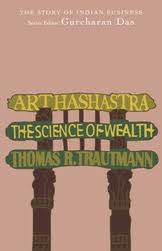
Arthashastra - The Science of Wealth
Author: Thomas R. Trautmann
Publisher: (Penguin Books)
Edition: Hardcover
ISBN: 9780670085279
Pages: 180
Price: Rs 399
India's intellectual contribution to the world knowledge-pool may be limited but its consequences have been far-reaching and widespread. The decimal system, Yoga, Ayurveda, Panchatantra, Kamasutra and Arthashastra are the timeless jewels which have been read, followed and interpreted through the prism of each generation over the centuries. Another such attempt has been made by Thomas R. Trautmann in his recently published book, Arthashastra – The Science of Wealth. It's a part of a trilogy on the Story of Indian Business with the famed historian Gurcharan Das as its series editor. What makes this book relevant in this age of economic globalisation is its emphasis on trade and business practices in ancient India when kingship was ideological tool of governance.
History is often a continuous flow of events with each incident having its precedence and a cause of its occurrence. Today's representative democracy has its precedence in ancient Roman Republic and democracy of Athens. Likewise, the republics of Ancient India were the precursors of deliberative and collective governance, although at a nascent stage of evolution. The same is true with the Arthashastra of Chanakya a.k.a. Kautilya. Arthashastra is a tradition of polity and economics laced with practical wisdom that found its final authority in Chanakya's version. It's an anthology of various schools of thought to which several eminent scholars and teachers contributed to its making, much before Chanakya.
Most of us have grown up with the popular folklore that one has to follow either of the means (upayas) in order to succeed in life, namely conciliation (sama), gifts (dana), sowing dissension (bheda) or force (danda) within the enemy camp or against a person whose favour we earnestly look forward to winning. The credit for the above doctrine is often given to Chanakya. But he was not the original propagator of the theory and it finds mention in the earlier tradition of Arthashastra. There are other anachronisms, especially about the period and the kingship that Arthashastra refers to. It's a book offering practical advice to a hypothetical king ruling a hypothetical kingdom and not to Chandragupta Maurya, the ruler of Magadh, as commonly understood. While referring to trade and commerce, the book also has a reference to China silk. In fact, the word China came into being only after the Chin Dynasty came to power during 221 BCE, long after Chanakya had left for his heavenly abode. This proves that the text was either altered or added after its author had compiled it.
The Western scholars have often compared Chanakya's Arthashastra with Sun Tzu's Art of War and Machiavelli's The Prince. The comparison is not only far-fetched and far-removed from the reality but inappropriate. While Sun Tzu was a military strategist and confined his theories to warfare, Chanakya expanded it to polity and economic governance and made it practically feasible for kingship to either practice or discard it. Machiavelli, a political philosopher of Renaissance Italy on the other hand had no scruple in resorting to moral corruption to rule a state. It's here that we find an ideological divergence between the two schools of thought propounded by Chanakya and Machiavelli. In Indian tradition, artha (Artha-Shastra) or material well-being is always subordinate to dharma, the moral well-being, and is a mean to achieve higher goal in life. Although Chanakya does not mention this categorically, the preeminence of dharma over artha is central to Indian philosophy.
Written in a simple and easily-understood narrative style, the book is devoid of scholarly or erudite prepositions. It takes you to the time when kingship was not only a gateway to luxurious living but also a responsibility to be discharged with utmost care and justice. A king's daily routine was divided into rigorous working hours which he had to adhere to, to keep his kingdom intact and subjects satisfied.
Arthashastra explains in detail the threats faced by a king from the young princes including the queen, his ministers and counsellors and the neighbouring enemy kingdom. Arthashastra is essentially a guiding principle for head of the state – which may be a king, a dictator or a democratically elected ruler, cutting across the boundaries of time and space.
Trautmann however, warns its readers not to read between the lines and draw too many parallels in the modern context. Undoubtably, Arthashastra is a masterpiece on Ancient Indian polity and economy and remains confined to a particular set of hypothetical situations. But one cannot fail to notice the propensity with which certain events have taken place in the Indian history post-Maurya period. The possible explanation for this deja vu experience is – human beings are essentially the same, the way they were in Mauryan period and the way they are today, having the same lust for power, dominance and greed.
Corruption was widespread during Chandragupta Maurya's period as it's today. Kautilya suggests various harsh measures to keep it under check, even pressing espionage services to keep it under control. The king had greater and munificent control over inflation and often levied taxes to keep it under hte permissible limits. The king was also an entrepreneur who ran his enterprises both in trade and production like the modern-day state does in the form of Public Sector Undertakings. Like the various economic scams in recent times like 2G, the king faced similar graft cases of his ministers and councillors. The king also maintained mines and minerals as a strategic tool for the production of weapons and ammunition. The present day mining scams could be a fitting expression of a similar kind of greed by private enterprises in the modern context. How much has India changed from the time to Maurya to Manmohan Singh is anybody's guess.


 Issue Dated: Feb 5, 2017

