

Tuesday, October 20, 2026


- Article
- Comments (0)
Indo-Pak Relations
A nation at war with itself
REEM WASAY | Issue Dated: April 22, 2012, New Delhi
Tags : Pakistan is in a state of flux | Pakistan at war with itself |
Tags : Pakistan is in a state of flux | Pakistan at war with itself |
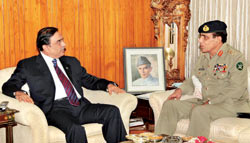 Pakistan faces a slew of grave challenges – a breakdown of governance, a floundering economy, a severe energy crisis and sectarian violence – as it wages a desperate battle to protect its democratic processes.
Pakistan is in a state of flux, one in which it is trying to establish a new beginning from wearied ends. It has waged a battle between civil rule and military dictatorship amid the sporadic clamouring of the extreme right, a bedraggled partnership with the US especially since the ‘war on terror’ began during the military rule of Pervez Musharraf, and a populace that has now come to see fit a life of less than ordinary virtue.
There is crisis upon crisis; a critical near-breakdown of governance what with colossal mismanagement in the energy sector, a complete disengagement from the law and order situation, especially during cycles of sectarian violence and gang warfare in the port city of Karachi, a separatist movement in the province of Balochistan, and increasingly projected anti-American sentiment fulminating on the streets and boardrooms of the rich and powerful, drawing rooms of the middle class and slums of the impoverished – more than so than before 2011.
 The events of 2011 flung Pakistan into the embarrassingly bright spotlight of diplomatic discrepancies, religious intolerance and ugly politics that can either be described as sheer incompetence or double games. These events brought into the open what may have been festering behind the scenes since the war on terror began: two allies that have a hard time getting along. Starting with the Raymond Davis fiasco in January last year where the CIA contractor shot dead two allegedly armed Pakistani youths and was subsequently whisked away after the US stepped in and had him released on the basis of the country’s diyat (blood money) laws, and culminating in the May 2 American raid on Osama bin Laden’s Abbottabad compound within a stone’s throw of the Pakistan Military Academy, Pakistan has come out on this side of 2012 as incapable of keeping its promises as an ally in this war and the US being seen as an arrogant bully. Zulfiqar Ali Khosa, a senior leader of the PML-N, a centre-right political party that represents the Punjab government, vents, “The sacrifices made and the lives lost have all been taken for granted by the US in a war we should never have been fighting. We should have our own interests at heart. It is time to bring our national integrity and sovereignty back into focus.”
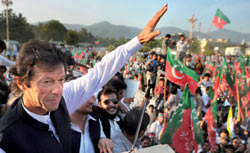
Such sentiments are gaining momentum, so much so that a new political entity has emerged much to the chagrin of the country’s sparse liberal voices. The Difa-e-Pakistan Council, a coalition of some 40 political/religious parties, has taken as its raison d’etre the mission of whipping up mass anti-Americanism by advocating that NATO supply lines not be re-opened after the Salala incident in which some 26 Pakistani FC troops were killed by NATO forces in an attack on a checkpost on the Afghanistan-Pakistan border in November, and also trumping up an anti-India agenda by rejecting Pakistan’s decision to grant it MFN status.
Although the reopening of the NATO supply routes is a dilatory debate that is still being debated by parliament, military to military contact has been re-established between the two allies and the Pentagon is making enough hopeful noises to make it seem as if the two countries are on their way along the beaten track once again.
According to Rashed Rahman, editor-in-chief of Daily Times, “Beyond a point Pakistan can just not afford to needle the Americans. It is the sole superpower. A country so dependent on aid can’t be seen standing in opposition for too long. The political and military establishments know this but they just don’t have the courage to say it out loud in the face of popular anti-US sentiment. We hear the same loud noises every time an incident occurs but we go back to the way things were.”
While Pakistan-US relations might be inching forward, not all is well on the home front. Balochistan is once again caught in probably the most volatile insurgency in its history. A separatist movement that is being likened to 1971 (the breakup of East and West Pakistan) has cast a dubious light over the country’s intelligence and security agencies that stand accused by the Baloch people of atrocities inflicted as an occupying force. The now infamous case of ‘missing persons’ (those allegedly whisked away by the security forces) and the subsequent bullet-riddled bodies found dumped in different places, have fuelled the insurgency.
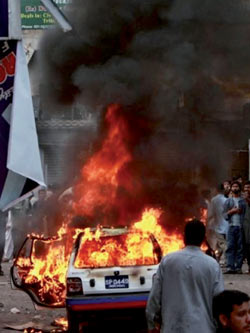 The Balochistan Liberation Army is a prominent participant in the armed struggle against the government and the armed forces over the above-mentioned human rights abuses, the issue of royalties that the Baloch claim are not being paid in full by the government for the resources generated from the province and the struggle for more autonomy. “There will never be progress on Balochistan until the grievances of the people are addressed in full. From the first conflict in 1948 to the loud and violent uprising we are seeing today, due redress needs to be given the Baloch, the most impoverished people in Pakistan. They have been oppressed and have been given only half-promises by political dialogues that never gained momentum,” says Mir Talpur, a writer who has had a long-standing association with the Baloch movement since the 1970s.
With the war being waged against the Taliban in both Pakistan and Afghanistan one tends to forget how fragile Pakistan and its existing territories really are. If Balochistan really does get out of hand, 1971 could follow the country through into the coming years.
Punjab meanwhile is in the grip of the worst energy crisis in its history, with some 9,000MW shortfall and an angry populace frothing on the streets after massive job cuts and the shutting down of businesses. The electricity crisis is at the helm of public outcry and unrest - the perfect illustration of the discord the democratic coalition is facing, and also the ineptness with which the entire admi istration has handled public welfare in the four years it has been in power.
The facts and figures reek of incompetence and mismanagement. Circular debt, to the tune of Rs 400 billion, in which the government is the biggest debtor to fuel suppliers, has crippled the economy in ways unimaginable. Riots have raged in Punjab with protestors killed and property damaged.
The Supreme Court, on March 30, declared that all rental power projects were unlawful. No less than 19 names of those associated with the RPPs have been placed on the ECL, of which three are ministers. And this is just one example of the coalition’s ineptitude. It is also the harshest.
The economy is in tatters. It has robbed Pakistan’s youth (75% of the population is under 26) of a reasonable future and has made it vulnerable to radicalising forces. That Pakistan is leaning towards orthodox conservatism is no secret but the fact that a mismanaged economy has the potential of lending such views the strength of Pakistan’s youth is frightening.
Raza Rumi, a columnist for Pakistan’s Express Tribune newspaper and a development professional, says, “The best counter to the growing fundamentalism is gainfully employing the disillusioned youth who see fuel, electricity and even safe drinking water as beyond their means. If they have a stake in the country they will be less tempted to be taken in by rejectionist ideologies. Three things need to be done immediately to reverse the tide on radicalisation: we have to revise the curricula and textbooks being taught in government-run educational institutes, we must monitor and regulate the madrasa system so that a check can be kept on what is being taught and we must make sure the electronic media, which caters to over 100 million viewers, takes on a more accountable and responsible role.”
Moderate voices are increasingly becoming sparse especially after debate on the country’s blasphemy laws ended in the assassination of governor of Punjab Salmaan Taseer and Christian minorities minister Shahbaz Bhatti last year.
The economic stalemate has given Pakistan other very real fears. “You can put your money on a direct military intervention in the next three to five years. The next government will be an even weaker coalition than the present one and will not endure for long. My fear is that if it’s a general, a la Zia, then the country is done for,” says Savail Meekal Hussain, an economist and column writer.
Pakistan has hardly ever seen a democratic government drudge through a full term. It has attracted military intervention and dictatorships that have lasted for years. This is the first time that the political process seems to be gaining a foothold in the very shaky foundations of this country’s concept of democracy. And that is no small feat. No matter how corrupt the PPP government, it has persevered. The people have renewed hope in the fact that democracy has arrived, albeit some 60 years too late. “We aren’t out of the water yet. It is vital for this weak coalition to gain strength, to earn its decision-making power. Only then will the political process be able to wrench away foreign policy decision-making and unquestionable authority from the military to bring it to the floor of Parliament,” says Rahman.
From the inclusion of the monumental 18th amendment to the country’s constitution in April 2010 which reversed many of the infringements made by several military dictators in the constitution to the passing of bills aimed at increasing women’s rights such as the anti-harassment in the workplace bill, democracy is waging its own mini war in a country marked by fanatical pursuits of power. And, for now, that’s good enough.
The writer is an editor and analyst based in Lahore


 Issue Dated: Feb 5, 2017

