


- Article
- Comments (0)
Coming of Age
The Indian Navy has quietly upgraded its modernisation and indigenous production programme. Mayank Singh reports
Tags : Coming of Age | INS Arihant |Navy Chief Admiral Arun Prakash |
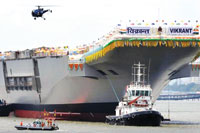 While the country’s defence modernisation plan is going on in fits and starts, real gains have accrued to the Indian Navy, which has been silently but steadily build up on its formidable operational strength and revealed visions of indigenisation, helping it to become a network centric warfare enabled force.
Mention war and the image which flashes immediately are foot soldiers with their arms and ammunition – rarely does the navy come on the radar. But navy’s operational assignments range from high intensity war at one end to humanitarian assistance and disaster relief operations at the other. The navy’s military role is characterised by the threat or use of force at and from the sea.
After the terrorist attacks on Mumbai on November 26, 2008, the overall responsibility for coastal security has been mandated to the Indian Navy, in close coordination with the ICG, state marine police and other central and state agencies, including port authorities.
In the modern world though, any role or task assigned to navy cannot be successful without the platforms, arms and equipments under the disposal of a competent and trained manpower.
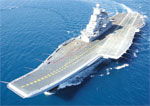
Of the all three sword arms of India, navy has been on a modernisation spree, adding capacity and capability in every dimension. Beginning with training, it has HAWK AJT 4, offshore patrol Vessels P8I 3 and the Indian Aircraft carrier launched which will be fully fitted by 2018.
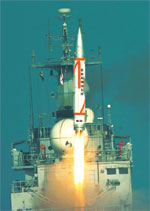 INS Arihant has got its critical nuclear reactor thus moving in the right direction to complete the nuclear triad after the Indian Air Force and the army. Vikramaditya is sailing from Russia on her homeward bound journey. But what will come as the force multiplier is the Rukmini Satellite which will give every platform, ship, submarine and aircraft a facility to see in real time what is happening in areas of Indian importance - and that includes the entire Indian Ocean.
Commanders on all sides are well networked. Earlier, in 2012, a Russian nuclear-powered attack submarine had been inducted on a 10-year lease. Over the next decade, the navy expects delivery of seven stealth frigates, six diesel submarines and 30 other warships, apart from over 150 fighters, maritime-patrol aircraft and helicopters.
Speaking on maritime security and navy’s rapid modernisation programme, Admiral (retd) Arun Prakash explains: ‘‘These acquisitions will cost the exchequer in the region of about $ 25-30 billion and we must note two important aspects in this context. Firstly, there are not many navies, world-wide, which have seen, in recent years, or are likely to see; in the midst of a global economic downturn, such significant accretions to their order-of-battle. Secondly, this force build-up, once complete, will not only enhance the navy’s combat capability by an order of magnitude, but would also alter the balance of power in the Indo-Pacific region, provided necessary strategic guidance is forthcoming from government.”
Navy sources say that about 20 Fast Interceptor Crafts are to be inducted. In the pipeline is a formidable array of platforms; Offshore Patrol Vessels, a Request for Proposal for Medium Range Maritime Reconnaissance Aircraft is out and other acquisitions are on the way.
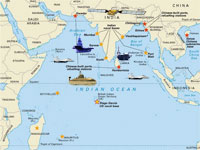
 For a nation preoccupied for decades with its vast land frontiers, India really turned to the seas in the early 1990s. The Indian Navy launched its naval diplomacy two decades ago. It is true for the navies of other countries as well, they are being increasingly used to build maritime bridges and Confidence Building Measures (CBMs) and in this context the exercises which the Indian navy is conducting with foreign navies is of significance.
The number of bilateral and multilateral exercises in which the Indian Navy is participating speaks about increasing engagements with foreign navies. An Exercise code named Milan, a confluence meeting of navies from Indian Ocean countries, warships and naval delegates from several countries, Australia, Indonesia, Malaysia, Myanmar, Thailand, Sri Lanka and Singapore, was held with great success.
Apart from its neighbourhood, it has exercised with the biggest navies of the world like France, Japan, UK and now an exercise has been scheduled with the Chinese Navy. The navy has held the Malabar series of joint naval exercises with the US Navy.
One of the traditional ways of making their naval presence felt is achieved through port calls to remind local inhabitants of the effectiveness of the navy and the state that owns it. These visits are not intended to represent threat of force; instead the ships act as goodwill ambassadors.
 The mention, therefore, of the department of naval design (DND) in pursuance of its indigenous programme, would be in order. Speaking on capability enhancement before Navy Day, 2012, Navy Chief Admiral DK Joshi had said, "We have 44 warships and submarines on order, 42 of them in Indian shipyards. Over the next five years, we expect to induct five to six warships/submarines per year”. It highlights that the shipbuilding in India has also picked up. With the support of DND, ships have reached nearly 80 percent indigenisation levels.
Post-Tsunami deployments have shown the preparedness and response time while fulfilling its benign duty of relief and rehabilitation. Indian naval ships, aircraft, helicopters, and personnel responded to Tsunami in the Indian Ocean promptly. It deployed 32 naval ships, seven aircraft and 20 helicopters. This was in support of five rescue, relief and reconstruction missions along the scene of destruction on the Indian side as well as with neighbouring countries’ shores.
They were aptly codenamed ‘Operation Madad’ (Andhra Pradesh and Tamil Nadu coast), ‘Operation Sea Waves’ (Andaman and Nicobar Islands), ‘Operation Castor’ (Maldives), ‘Operation Rainbow’ (Sri Lanka) and ‘Operation Gambhir'’(Indonesia).
On December 26, 2004, when Tsunami hit the subcontinent, the Indian Navy had deployed 19 ships, four aircraft, and 11 helicopters which were rushed to Maldives, Sri Lanka and Tamil Nadu and Andaman and Nicobar Islands. Says an officer: ‘‘This was hailed internationally and speaks volumes of the efficiency and the operational readiness of the Indian Navy.’’
Indian Navy’s record of cooperation with regional navies on issues of common security concerns such as terrorism, piracy, gun running, marine pollution, search and rescue have been admired and publicly acknowledged.
Any Indian aspirations to emerge as an independent regional power, among other initiatives, would have to be achieved through strength at sea.
Author Robert Kaplan characterizes the area between the Gulf of Aden in the west and Malacca in the east as the centre stage of the 21st century. Indian Ocean will be important and if India is to graduate from being a regional power in South Asia to a great power in the Asia Pacific, it will have to be prepared to play its role — whether directly through hard power, or indirectly, with a soft power approach. But either way, modernisation is a must.
India's main strategic threat comes from China
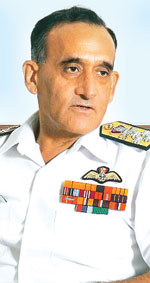 How do you define Maritime security?
This is a term which connotes different things to different navies. While some perceive maritime security in a narrow sense as measures for force-protection and defence against sabotage, others include actions to combat terrorism and illegal activities like piracy and trafficking; still others expand it to embrace the protection of territorial waters and sea lanes. Adopting an inclusive approach, we in India define maritime security as comprising a collection of all issues that pertain to the seas and have a bearing on national security. These include, inter-alia, seaborne trade and infrastructure for its pursuit, management of sea resources, environmental issues and employment of naval forces.
What is your take on indigenisation and the role of the department of naval design?
It is a quirk of fate that India has become a significant military and economic entity with great-power aspirations before it has become a significant industrial power. Thus India finds itself in an anomalous situation wherein it possess nuclear weapons and boasts of the world’s fifth or sixth largest armed forces, but is forced to support their operational requirements through massive imports. There is inadequate realization of two facts; one, that every piece of hardware that the Indian armed forces acquire from abroad places them at the mercy of the seller nation for the lifetime of the equipment; and two, that if our peacetime arsenals remain half-empty –whatever the reason - how will we ever fight a war? India is fortunate in having a vast defence technology and industrial base (DTIB) which could be the envy of developed nations. This base comprises thousands of talented scientists working in a network of sophisticated DRDO laboratories backed by advanced production facilities of the ordinance factories and defence production units. And yet, India’s DTIB has rendered our armed forces hollow, by failing to deliver, for six decades, capabilities they direly need. A willing and capable private sector has been kept out of defence production while many PSUs have hoodwinked the nation with spurious claims of ‘transfer of technology’ and ‘indigenisation’. Consequently, the navy’s operational readiness remains hostage, on one hand to the inefficient and complacent public sector, and on the other, to unreliable foreign suppliers.
How much has Indian Navy grown in last few years?
The dramatic growth of India’s economy has been stimulated by the powerful phenomenon of globalization, leading to not just large foreign direct investment in India, but also heavy Indian investment abroad. Thus, along with an Indian diaspora of over 20 million, we also have growing economic interests world-wide. India’s economy as well as progress and prosperity depend on international trade, which is carried overwhelmingly by sea, as is energy, the lifeblood of our industry. These factors, coupled with the prospects of harvesting oceanic resources and India’s growing international profile, have helped awaken an overdue realization of our dependence on the seas. As for international commitments we still have limitations.
What according to you is going to be India’s main strategic challenge?
India’s main strategic challenge comes from its prosperous northern neighbour, China. Without entering into a detailed discussion about respective capabilities and intentions, it can be said that China and India, are going to make uneasy neighbours. For the two nuclear-armed nations to rise, almost simultaneously, without conflict will require either adroit diplomacy or a miracle; possibly both. The all weather Sino-Pakistan alliance, with its strong anti-Indian slant, further complicates our security problems.


 Issue Dated: Feb 5, 2017

