



- Article
- Comments (0)
Book Review:Farishta
A fresh perspective
Tags : Farishta | Book review | Patricia McArdle | Riverhead Books |
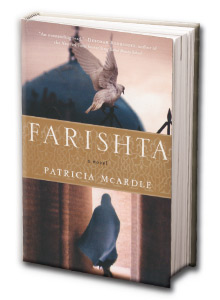 Patricia McArdle’s Farishta is an important book in more ways than one. Firstly, it is an account of the conditions that the NATO troops have to face in Afghanistan and other war zones in the Middle East and West Asia and how the interminable wars that the West has entangled itself in is affecting the morale and psyche of the young soldiers. Also, and perhaps more interestingly so, McArdle’s novel marks an interesting shift in focus in the socio-political strife that the world is facing today – both in terms of where the drama is being played out and which actors are in the lead roles.
While once, as in the novels of Fredrik Forsyth or the tongue in cheek Ian Fleming or popular films in the last decade of the previous century, the stage for all fictional international intrigue would be eastern Europe or even northern Ireland, now it is the Middle East. Afghanistan and Iraq are fast becoming the Vietnam of our times. Also, while the protagonist of a Forsyth would be a square jawed operative of the Company, the people in the spotlight today are from the Foreign Office, like McArdle’s heroine Angela. As she rightly says, “The Great Game is still alive”, just that the players have changed, as have the rules.
Diplomat Angela Morgan’s career is dying a slow death. Since she lost her husband and unborn child to a bombing in Beirut 21 years ago, she has never really recovered. After a debacle in Leningrad owing to a drinking problem that she had developed and treading the diplomatic backwaters of South and Central America for a while, the verdict for her was clear – get a meaningful posting and a promotion, or make way for fresh blood.
At this point in her life, she finally gets her posting – northern Afghanistan. She is forced to go not only because she put it on her list of preferred postings (albeit ninth in a list of nine), but also because of her way with foreign languages, fluency in Farsi, love for Rumi and the fact that no one else was willing to go. There she meets a litany of characters – the sniper Fuzzy, the interpreter Rahim, the rebel Nilofer, the slick Russian Stefan, the French archaeologist Jeef and the typical iron-jawed-blue-eyed soldier’s soldier Major Mark Davies. As she spends time with these people and becomes a part of their lives, she finds the purpose of life that she had once lost. She becomes, the eponymous Farishta – the angel.
As such, McArdle does a fine job. Having served in the US Foreign Office and having spent time in northern Afghanistan, she had a good deal of first-hand experience to fall back on and she does not disappoint. The characters are well crafted and believable. McArdle manages to create and hold the readers’ interest in the men and women who people the tale. One feels quite a kinship developing with them and when some of them take a bow, one actually misses them.
The interpersonal relationships are also very well played out. The powerplays and the sexist overtones of a male-dominated profession in a tremendously patriarchal society, the subtle insults and undermining of authority and finally, how the protagonist deals with it, make for a good read. Particularly touching is the bond that Angela develops for Rahim, her interpreter, who would have been around the same age as her son if he had survived. The stark landscape of Afghanistan gives McArdle a good backdrop to play her story out and she makes good use of the rocky ravines and electric blue skies.
Having said that, Farishta is not all that it could have been. For one, it seems to have the soul of a loosely connected anthology of short stories trapped in the form of a novel. The plot is a bit too scattered for a novel and almost loses itself at times. The climax and some stray narratives, embedded for the sake of the format, seem forced, and added almost as an afterthought. For example the romance that springs up between Angela and Mark Davies feels hurried, lacking in depth and anything but spontaneous. Also, one has the feeling that the novel could have been about a hundred pages shorter.
However, Farishta, despite its few failings, remains an interesting book. What it lacks in speed and dynamism, it makes up for with depth and human interest. Overall, Farishta is definitely an extremely readable book and highly recommended by this reviewer.
Author:Patricia McArdle
Publisher:Riverhead Books
Edition: Paperback
ISBN: 978-1-59448-578-7
Pages: 406
Price: Rs 499


 Issue Dated: Feb 5, 2017

