



- Article
- Comments (0)
Celebrating 100 years of Indian Cinema
Art, cinema aur Dibakar
Breaking new ground in each of his earlier films and meeting box-office success in the process, Dibakar Banerjee has his finger on the pulse of cinema vérité. After Shanghai – what is set to be one of the most outstanding films of the year – Dibakar ‘Oye Lucky’ Banerjee tells Aakriti Singh about his dream project: his next movie, of which he knows not yet.
Tags : dibakar banerjee | khosla ka ghosla | shanghai |
 Shanghai is your 4th film as director. How do you think you have evolved as a director since Khosla ka Ghosla?
Age (laughs). As a director, ummm… ummm… umm… I have no idea. It’s just that I am a little more confident about the craft. I have become much more instinctive, which means whatever runs in my heart, reaches the screen a little faster than it would have had in Khosla ka Ghosla. Having said that, the biggest issue with my films is that each time I do a film, like when after Khosla, I did Oye Lucky…, it’s a completely new venture. It was like a first film; it baffled many and slowly it got its audience. After Oye Lucky…, when I made LSD, it baffled the audience again; it also started making its way up over time. Now that I’ve made Shanghai, it has been hugely appreciated by a lot of people and it has hugely polarised a lot of people. So there’s a huge debate raging. This again feels like a first film for me. I have no idea what has changed. Every time I make a film, it’s like back to Khosla ka Ghosla.
What matters to you more, commercial success or critical acclaim?
Both are equally necessary.
Shanghai is adapted from the Greek novel Z. How did the idea occur to you?
I wanted to make a political thriller. I spoke to Urmi, my writer, and was giving her an example of films like All The President’s Men and Z the film. So she asked me if I've read Z the book. I said no and I didn’t even know that there is a book! So she gave me the book and I read it and I realised that I could really take it down into a very different and contemporary Indian political thriller.
Shanghai pulled off a casting coup of sorts. How did the actors approach their roles?
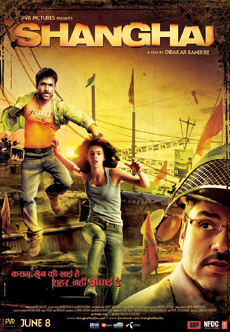
Prosenjit never let us feel that he was a star and he was all for the role. We had a definite idea of who to model the role around because we had spoken about some very prominent Indian social activists and politicians. We kind of did a combination of all those characters and it is a very intelligently done portrayal. Emraan Hashmi’s performance by now has become legendary and everybody is talking about that. I don’t know if he’s new to the genre, but he’s new to this kind of a film and this kind of a portrayal and this kind of a character where he steps out of his star persona and there is a completely earthy character. I'm being flooded by reviews about Emraan’s performance. Kalki bagged this role completely on the basis of a fantastic screen test. I make everybody do screen tests.
Even Abhay Deol?
Absolutely! We did workshops after workshops. Abhay himself wasn’t ready to do the role – it was understated, the Tamil accent, the language issue, everything… Abhay went through a lot of workshops and language-accent sessions before he could feel completely confident about the film.
An actor you’ve had most creative differences with..?
I don’t think I’ll be able to work with any actor with whom I have creative differences. Either he would have fired me or I would have fired him. The fact is that in none of my films I've had to fire any actor. And none of the actors have ever walked out of my films. So I've never
had any creative differences with any actor.
How much homework do you have to do before starting a film?
Your homework is your whole life actually. If you are not observing and noting, and if you are not filing things for future references, you are in the wrong business.
Is there a dream film that you would want to make?
My next one…
Out of all the movies you’ve made, which was the most challenging script to bring forth visually?
My next one (chuckles). Because the moment the film is over, the challenge disappears. So I would say that LSD demanded innovation most, and Shanghai taxed us physically the most; some of the most difficult shots, one-take shots and some of the longest shots – thousands of rioters bombing, burning, chasing on a moving truck… these kind of shots were from a moving truck throughout the film. These were the most technically and physically difficult shots I've ever taken.
Which directors do you take creative inspiration from? Which of their movies do you like the most?
Scorsese, Ray, Matteo Garrone; the director of Memories of Murder (Bong Joon-ho.)… I like most of their films.
Indian audiences are typically star struck, and your movies rarely have stars. Don’t you want to make a big star cast, larger-than-life movie?
I have no idea what larger than life is. But yes, the moment my script, the superstar and the dates coincide – the character in my script matches with the superstar, the superstar says yes to the script and the moment he says yes to the film and has dates for my film within my calendar, I’ll definitely shoot the film!

Many young guys and girls are getting into filmmaking. Any piece of advice for them?
All these guys getting into film making are getting into films against the advice of people who supposedly know better. So if you succeed it is totally on your own and if you fail you can’t blame anyone. The biggest challenge is that nobody believes in you. And they are right in not believing in you because you haven’t done anything. Somehow you have to create trust and that is the biggest challenge.
Have you ever had to contend with interference from your producers or actors in any project of yours?
Never. I'm one of those few lucky ones who, from the beginning have been completely backed by their producers.
Of all the actors you’ve worked with, who would you consider a director’s delight?
I'm not really looking for delights, you know. It’s not a one-way street. It’s a relationship between a director and an actor, which makes a film possible. It’s not about the actor becoming a willing puppet to the director’s commands. So I've never looked for a delight actually. I’m not sure if I’d like a delight, I’d rather like a challenge, I’d rather like somebody who is figuring out his own things, who is confronting me with bigger answers than I have myself.
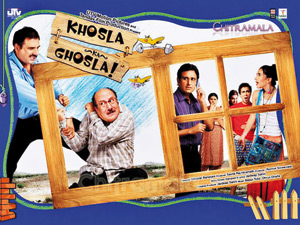
100 years of Indian cinema and only a handful of Khosla ka Ghoslas. Where do you think is the problem?
It’s because only very few people can afford the independence. To be independent you have to sacrifice a lot. I’m not saying it’s a crusade to make films like Khosla ka Ghosla or Shanghai but still it’s a very, very tough fight and we are going to fight it all the way through. Nothing comes easy. So the reason why Shanghai is a profitable venture is because of the fact that it is made at such a cost with so many struggles and troubles. Freedom is not cheap and not everybody wants to pay the price.
Do you think independent filmmaking has become easier now?
Of course, slightly easier. But what has also happened is that the audience that used to exist for films like these (Shanghai) in the 70s and 80s does not exist today because our lives are so much more difficult and tension-ridden and fast that everybody wants escapist stuff.
What challenges do independent film makers face today?
Money. Trying to do a film cheap enough which is also interesting enough to make a studio go ahead with it. Everybody has their own difficulties. In the years that have gone by, nobody expected a film like Ardh Satya or a Manthan or Kalyug (1981) to compete with Coolie. Can you find any article from '84 or '83 that compares Coolie and Ardh Satya? Today what happens is that every time a Shanghai comes out, it is compared with a Rowdy Rathore which is an insult to Rowdy Rathore and also an injustice to Shanghai. The director of Rowdy Rathore must be feeling bad that the biggest summer blockbuster is being compared to a film which is just a fraction of its budget! That is a huge impediment faced by all independent films because everybody wants to know how the film has opened and what are the box office collections?


 Issue Dated: Feb 5, 2017

