


- Article
- Comments (0)
A ride through history
A recent exhibition in New Delhi on the eventful journey of the Indian Railways revealed the organisation’s contribution to the task of holding this vast nation together, writes KS Narayanan. Photos by Mukunda De
Tags : Indian Railways | Railway bribery scam | Railway photos exhibition |
.jpg) Of late the Indian Railways has hit the news for all the wrong reasons. First it was a hike in passenger fares. After an interval of eight years, railway minister Pawan Kumar Bansal, in January this year, announced an across-the-board hike in passenger fares less than two months before he presented the railway budget.
Of late the Indian Railways has hit the news for all the wrong reasons. First it was a hike in passenger fares. After an interval of eight years, railway minister Pawan Kumar Bansal, in January this year, announced an across-the-board hike in passenger fares less than two months before he presented the railway budget.
Later, Bansal came under the scanner after his nephew Vijay Singla's alleged role in a cash-for-promotion scam in the Railways. As newshounds chased Bansal and the scam- ridden government 24X7, the issues of safety, security and history took a backseat.
In such a scenario a photo exhibition of 160 years of Indian Railways was held without much fanfare. The exhibition ran for ten days from June 7 to 16 but failed to evoke much response from the general public.
Despite lucrative offers from low-cost airlines, Indian Railways remains the principal mode of transport for large swathes of people in this country, from Kashmir to Kanyakumari. On the Indian railway network, 2.3 crore passengers and over 1 billion tonnes of goods are transported daily.
Employing 14 lakh people, the Indian Railways is a mammoth organisation, vibrant and pulsating with life. It is in every sense the ‘heart’ of India. It keeps the nation alive by linking its remotest corners to each other.
The photo exhibition did more than just trace the history of the Indian Railways sequentially from 1853 to the present. It was a thematic portrayal of the many facets of this organization. This was possible through many rare photographs sourced from the railway archives, the Press information Bureau and the railway museums. These photos helped highlight the importance of the railways in the lives of the people, its role as an integrating force, as a catalyst of history and as a mute spectator to the unfolding events.
Vinay Mittal, Chairman, Railways Board, in a souvenir published on the occasion, observed: “The railways, in their own powerful way have paved the way for the growth of the nation and thus are the lasting symbol and substance of its unity.”
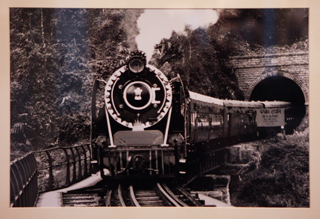 Mittal pointed out that the purpose of this exhibition was to take the narrative of the railways back in time from its current point and revisit memories in sepia and black and white tones to understand the transitional, exciting and tumultuous phases that this organisation has gone through.
Bringing the railways back into the forefront of the public consciousness, the photo exhibition was divided into several sections and began with prime movers for the Railways, beginning with Prince Dwarkanath Tagore, grandfather of Nobel laureate Rabindranath Tagore. An 0wner of collieries in eastern India, Tagore was denied permission for setting up a railway by the British Government.
However, it was on the survey report prepared by him that Rowland Stephenson was allowed to construct a railway link between Calcutta and Mirzapur on military and commercial consideration. The 121-mile-long section of the Howrah and Raniganj section was finally inaugurated in 1855. Indian Railways has not looked back since then. Today it has a network of 6400 kilometres of tracks.
Also the early development of the Railways goes to the credit of Lord Dalhousie, Governor General of India (1848-1856), who laid the foundation in his 216-page memo called a ‘minute’ in which he provided all the justifications and guidelines for the system of railways to be built.
By 1859 there were seven railway companies. Fifty years later, on a recommendation by Lord Curzon, a small railway board was set up to run the railways as a commercial enterprise. When India attained Independence in 1947 the railway network in the country was made up of about 42 separate railway systems, including the private companies. The first zonal railway to be formed was the Southern Railways on April 14, 1951.
Besides pictures of building railways, locomotives, and bridges, the pictures of railways’role during the bloody Partition and the subsequent communal conflicts were also displayed. ‘Partition - The Black and White Pictures’ reflected aspects of that cataclysmic event that shook and cleaved the subcontinent. Photographs showed a refugee special train standing at Ambala railway station overflowing with people who risked their lives sitting on the rooftop of coaches.
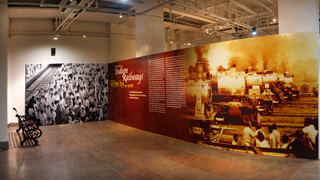 Another section portrayed the story of station architecture, reflecting the history of the period and the region. The exhibition observed how stations in India varied in size, design and comfort and showcased Victoria Terminus (formally opened on the Queen’s Golden Jubilee in 1887) whose exterior was fusion of English, Gothic, Venetian Gothic, Romanesque and Mughal while the Madras Central was built in the Romanesque revivalist style. Pictures of stations like Kanpur and Lucknow pointed out to domes and towers of Indo-Saracen designs while those in Rajasthan displayed distinctly Rajput motifs. Hill railways such as Ooty, Simla, and Solan with their sloping roofs look like cottages transplanted from the Alpine regions.
Besides feeding English cotton mills with raw cotton from different nooks and corners of India like Dharwar, Salem and Coimbatore and Punjab in the North, the Railways also emerged as a centre of town and economic activity like building of roads, ancillary industry, etc.
Though the Railways played an important role in quelling riots and maintaining the British Empire, it equally aided and abetted the Indian freedom movement with leaders like Mahatma Gandhi, Jawaharlal Nehru and Netaji Bose travelling across the country to mobilise people against alien rule.
An interesting section was 'Railways under the Princely States'. Many of them initially opposed the proposal of building the railways. Other sections exhibited pictures of locomotives, carriages and wagons and bridges and tunnels.
One picture showed the first transcontinental train from Peshawar (currently in Pakistan) to Mangalore
at Old Delhi Railway Station in 1929.
With the Indian Railways being treated as the personal fiefdom of the ruling class often announcing more trains for their constituencies, general commuters often feel that passenger amenities have been given the short shrift by the authorities. A litany of complaints on fare hikes and lack of basic amenities has co-existed ever since the railways came into being. Things have no doubt improved since the first passengers were transported in 1853. Still, many railway stations and trains could do with better upkeep.
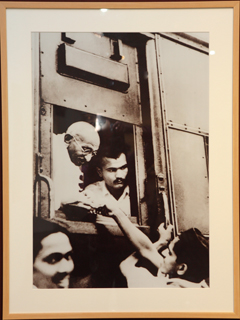 In the past, long distance trains had restaurant cars, but for shorter journeys and for local lines, passengers had to dine at refreshment rooms at various stations. Trains halted at certain stations three times a day for half an hour each to allow passengers to eat.
What the exhibition also pointed out was that, until the first half of the 20th century, a communal divide and social stratification was the norm at the with restaurants, tea stalls and drinking water utilities, which were divided on religious lines for Hindus and Muslims. There were separate ‘pani pades’for Hindus and Muslims bearing ‘hindu pani’ and ‘muslim pani’ respectively. Their robes would distinguish the ‘religion’ of the water they were serving. There were rumours that the same person would serve the same water to both Hindus and Muslims, only changing his robe!
To enliven the journey of the first class traveller, AH Wheeler and Company launched their Indian Railway library in 1888. It was co-founded by Emile Moreau, a French author, TK Banerjee, an Indian businessman, and others in Allahabad. Today there are more than 250 AH Wheeler outlets active across the country.
In an age of digital cameras these black and white pictures constitute a crucial part of Indian history by highlighting an organisation that laid the foundations of modern Indian state.
Very few of the pictures had dates or years mentioned against them. Otherwise it looked like a collection of photographs, though a difficult task in itself, from various sources.
Last but not the least a section was dedicated to the workmen who were solely responsible for the running of the railways. The photographs reflect the hard labour which is put into transporting millions of people across thousands of kilometres, marking practices most of which are still fundamental to the railways working today.
The exhibition was an enjoyable ride through history, but the nagging feeling was that it provided nothing at all on technology, safety, security and passenger amenities. So there is scope for another full-fledged show – it might give us a better perspective on whether the Indian Railways is on the right track or not.


 Issue Dated: Feb 5, 2017

