

From the Editor
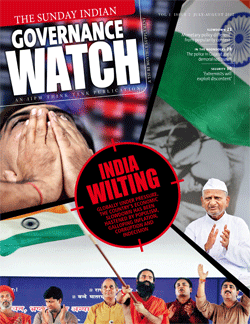
Chickens come to roost
Rarely has a country been at the economic crossroads as India is. In dictatorships, economic policy runs a course dictated strongly by political logic.
Importance of statistics in governance
A large part of governance is facilitating the work you may or may not be directly involved with.
Cover Story
Reforms to be communicated in a democracy: Shettigar
When the reforms agenda was prepared and presented to him, I G Patel told him this is what the economists feel for the good of the economy and country and corrective steps are required.
'This is an economic crisis'
There are two different things. One is reforms.Second part, even where the government need not go to Parliament and where decisions have to be taken by the executive, files are not moving at all.
'Monetary policy different from popularity contest'
The Reserve Bank of India (RBI) once again thumbed its nose at consensus street expectations by refusing to lower any of the benchmarks rates.
Reject neo-liberal economics
Recently there has been much noise about the sharp decline in the growth rate of Indian economy. It is being argued that we have a crisis now.
Column
New models needed for conflict resolution
Early last month, the Kosi Kalan town in Mathura district of Uttar Pradesh witnessed wide spread communal violence.
Interview
'Extremists will exploit discontent'
The Tarun Gogoi government has ruled the state for three consecutive terms and it should be taken as an index of the popularity of the government.
'Farmers neglect crops with lower MSP'
The idea of setting up this commission had three main objectives. One was that India was to go for Green Revolution adopting new production technologies in the mid-1960s preceded by food crisis, two, to incentivise farmers to grow rice and wheat and three, to give minimum support price (MSP) to be fixed by CACP.
Governance Watch: In the boondocks
The dusty road leading to the Naranpura police station in Ahmedabad seems strangely deserted at noon.