

From the Editor
Clear eyed look
The Union Budget is one of the most crucial days in the Indian calendar. On that one afternoon that heralds the advent of spring, the financial health of the country, its growth rate, future projections and investment climate is kept on the table, a copious piece of public document which concerns the economic well being not just of a group of people or a community but the country at large.
Cover Story
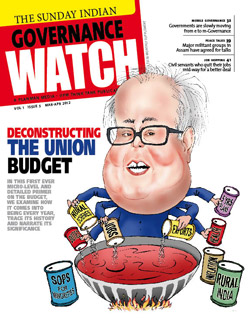
Deconstructing Union Budget
Like every family, or a business venture, governments need a budget. A budget for any country is a road map for meeting its security needs, fulfill welfare commitments and lay down infrastructure.
The men who shaped India's economy
An applied statistician, he is best remembered for the Mahalanobis distance, a statistical measure. He founded the Indian Statistical Institute, and contributed to the design of large scale sample surveys.
Lobbies as reality
There was a time when budgetary process was viewed as the exclusive preserve of policymakers and administrators and treated as a purely technical matter for expert consideration.
Budget's day out at the market
Traditionally the Union Budget is the most important period of every financial year, not just for the government, but also for everyone else at the market place – from the multi-billion dollar Foreign Institutional Investor to the smallest retail investors who park but a few thousand rupees a year in the market.
'Popular mood impacts budgets'
The Budget is an extremely important economic instrument. For one, the total expenditure is now about 15 per cent of the GDP. This is a huge portion. Whatever happens to the GDP also influences the budget. So that is one aspect of the totality of the budget.
Column
Budget a cosmetic exercise
Every year in the month of February we have this huge colossal exercise taken by the government of India to present the total outlay plan and the expenses of the Indian government in the Parliament of India which is known as the general budget and the rail budget.
Restructuring the answer to all problems
In order to understand the future needs and the linked restructuring of the Armed Forces, we have to analyse various security challenges that India is facing at present. India is in a two front situation with China to the north and Pakistan to the west.
Terrorists on the table
In the three-decade-long insurgency in north east India, many players have been coopted in the Indian system, yet the fact is that Assam has been at the front gates of all insurgency in the region.
Tech
Benefits of Mobility
From the benefit of hindsight, 2004 appears a long way away, a time when then Prime Minister Atal Behari Vajpayee’s friendly voice exhorted voters to exercise their franchise in NDA's favour "Main Atal Behari Vajpayee bol raha hoon..."
States follow suit
Although at a nascent stage, various state governments have got into the act of introducing e-Governance and now m-Governance projects in an attempt to deliver time bound services to people without any mediator.
Change Agent
Mid-life jitters
YP Singh, former Mumbai IPS officer who quit after 20 years in the service and who since then has taken it upon himself to ensure justice in the Adarsh Scam and the Lavasa controversy in Maharashtra, feels that after a certain time spent in the higher echelons of bureaucracy, "Your wings have been clipped completely and the only option is to quit and be effective because the government doesn't want efficient officers."