


- Article
- Comments (0)
Without decontrol, the sector wouldn't scale up at a fast pace: Suresh Neotia
Tags : Suresh Neotia | ambuja cements | interview |
Decontrol of cement prices was the first step taken by India towards liberalisation and the result was euphoric, more so in terms of market competition and capacity creation. Suresh Neotia, Co-promoter and chairman emeritus, ambuja cements tells how the sector thrived post decontrol.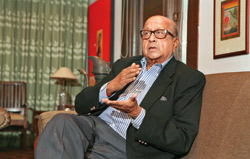
Q:When the government decided to opt for partial decontrol of cement prices, what was the reaction of the industry? What kind of a boost did it provide to the sector, where prices were dictated by the government for long?
A:You can judge that yourself from the fact that we never thought of getting into the cement business, but when partial decontrol came into force all of a sudden, we could see a great opportunity and started giving a serious thought to putting up cement plants. It was not only us, but others like Modi Cements and JK Cementsalso jumped into the bandwagon once the government decided to partially decontrol cement prices. Many cement plants across India were set up during that phase adding a huge amount of capacity. It was as if the sector got a fresh breath of life.
Q:But that also led to some serious troubles as well...
A:True. This led to a massive glut. See cement is a sector where demand grows gradually, but capacities are added in one go. That’s what happened but on a huge scale. Almost all those plants, which were set up after the decontrol of cement prices, started production around the same time. This resulted in increased supply which massively outstripped demand. So much so that a lot of producers had to sell their produce below cost. The pricing decontrol did lure a lot of players into the sector, but glut and price war made it a real challenge. Cost management became the survival mantra. Those who could keep their costs under control and sell their products innovatively were the ones who managed to survive. Many went out of business. Players like Modi Cement and Sidhi Cement became sick. Nevertheless, one can not deny the very fact that without decontrol of prices in the 1980s, the industry would have never looked forward to setting up new plants. If that was the case,we could have come across severe shortages during the 1990s or may be later when the country geared up for growth and the infrastructure sector was finally given some serious attention.
Q:You just mentioned that it was a phase of glut which resulted in the demise of many players. What were the other reasons associated with this?
A:Certainly there were a lot many reasons. Cement at that point of time was more of a regional product. Producers used to cater to specific regions. But when they increased capacity to take benefit of the decontrol, their output went past the regional demand and they had to move on to other regions to sell their products. That was when logistics emerged as a great barrier in the form of huge cost. For example Andhra Pradesh (AP) at that time witnessed a number of plants set by players like Rashi Cement, India Cement and so on. All of a sudden the total cement output in AP shot up and players were forced to send their cement to markets like UP and West Bengal. Owing to this, transport cost started constituting for a huge portion of their selling price making products less competitive in the market putting further pressure on the players.
Q:Earlier when cement was put under government control, the logic was that it was an essential commodity. It still is. But prices are now fixed by individual players and market dynamics. At times, this gives rise to price rigging by players and post decontrol we have come across the term ‘cement cartels’ quite frequently. What do you have to say about it? Don’t you think this has been a huge drawback of the cement price decontrol policy?
A:Historically, cement has been bracketed with cartelisation. Media has used terms like cement cartels and cement barons at random. We have been defamed without sufficient investigation. But I want to ask one question, don’t you think when air fares move up, all players play a role in it? Doesn’t that happen in case of petroleum products as well? Cartelisation represents a scenario wherein people join hands and curtail production to control prices. But if the market is grows, everybody benefits. Cement is not a product that can be stored for long. Therefore, at times when demand is lower than expected, the produce is disposed at a regular flow as storage spaces get filled up. In such a situation, producers might be forced to stop production because they feel that situation is such that everybody is losing. And when this happens, people start blaming that there is some kind of a cartel in place. But this has never been the case. I don’t think that players ever stop production to create scarcity. Whenever this happens, it’ is to avoid over supply.
Q:Do you think the present policy environment is apt and supportive for growth of the cement industry?
A:I don’t think so. For development of the cement industry, you need to take care of three key areas – power, coal and environmental clearance for new projects. But the policy environment for none of these is in good shape at present, more so for the environment part. You do not get lime stone in the heart of Delhi. You need to move out and that is where we face a great deal of environmental issues. The same is the case with coal. Worse, our dependence on imported coal has ended up playing spoilsport. Prices have moved up wildly in the recent past. If you talk about power, we are still dependent on thermal and that again requires coal. So overall, cement producers are again getting into a phase of troubles. To be honest, if things are not fixed right now, a serious situation may perspire in the next two years, which will eventually become a significant deterrent to the growth of the sector.
Q:But don’t you think the environment issue is something that companies also need to pay attention to?
A:Definitely they have to. They have to take a serious note of these concerns. The industry will fail if they do not do so. But what troubles me are the laws. They’re drafted in a manner that their implementation is next to impossible. It is now time that policy makers attempt to strike a balance and focus on ease of implementation as well.


 Issue Dated: Feb 5, 2017

