


- Article
- Comments (0)
Where the past breathes again
Tags : Cannes | Cannes Film Festival | Charulata | The Last Emperor | Cleopatra |
.gif) For a decade now, the past has been coming alive every May on the Croisette, with the Cannes Film Festival showcasing restored prints of cinematic masterworks in its Classics section. So, even as the glitzy French Riviera event celebrates the finest and the most provocative of contemporary films, it also turns the spotlight on the steadily spreading global campaign to save world cinema heritage through the systematic restoration and digital re-mastering of old movie negatives.
For a decade now, the past has been coming alive every May on the Croisette, with the Cannes Film Festival showcasing restored prints of cinematic masterworks in its Classics section. So, even as the glitzy French Riviera event celebrates the finest and the most provocative of contemporary films, it also turns the spotlight on the steadily spreading global campaign to save world cinema heritage through the systematic restoration and digital re-mastering of old movie negatives.
The festival, in its 66th edition, has expanded the scope of the Cannes Classics sidebar to include 20 full-length features films and three documentaries. Among these films is Satyajit Ray’s iconic Charulata (1964), based on a Rabindranath Tagore novella. Its screening will be part of the Cannes celebrations of the 100th anniversary of the Indian film industry.
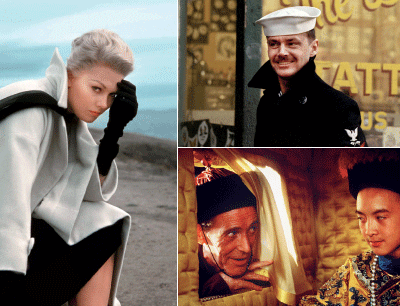
Many landmark films like Joseph L. Mankiewicz’s Cleopatra (1963); a 3-D restored print of Bernardo Bertolucci’s The Last Emperor (1987); and a mint-fresh print of Alfred Hitchcock’s Vertigo (1958) will be unveiled in the course of the festival, which runs from May 15 to 26.
Also in Cannes Classics this year are two French Nouvelle Vague (new wave) path-breakers – Alain Resnais and Jacques Demy. The latter’s Palme d’Or-winning 1964 film, The Umbrellas of Cherbourg, the restoration of which was supervised by his 84-year-old widow, celebrated filmmaker Agnes Varda (herself a Nouvelle Vague pioneer), her daughter, Rosalie Varda Demy, and son Mathieu Demy.
Resnais, 90, competed for the Palme d’Or last year with You Ain’t Seen Nothin’ Yet and is set now to start shooting a new film, Aimer, boire et chanter, based on British playwright Alan Ayckbourn’s Life of Riley.
Hiroshima Mon Amour, made in 1959, was Resnais’ first fiction film and a major catalyst for the French New Wave. The film, “reborn in sparkling digital form”, will be a major highlight of Cannes Classics 2013.
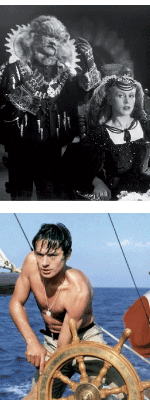
 So will Jean Cocteau’s La Belle et la Bete (Beauty and the Beast), which was selected for the very first Cannes Film Festival in 1946. A digitally re-mastered print will be screened to mark 50 years after the death of the influential writer, poet, filmmaker and painter who had an active association with the festival in the 1950s.
“As cinema’s link to its own history was about to be turned upside down by the arrival of digital and because films from the past are an integral part of the Festival de Cannes, 2004 saw the creation of Cannes Classics, a programme presenting old films and masterpieces from cinematographic history that have been carefully restored,” the festival’s website declares.
“A natural, vital part of the Official Selection – and an idea which has made its way into other international festivals – Cannes Classics is also a way to pay tribute to the essential work being down by copyright holders, film libraries, production companies and national archives throughout the world. Thus, Cannes Classics lends the prestige of the Festival de Cannes to great works from the past, accompanying their release in theatres or on DVD.”
The screening of the four-hour-plus Cleopatra will be hosted by Hollywood star Jessica Chastain (Coriolanus, The Tree of Life, Zero Dark Thirty) and attended by Richard Burton’s daughter Kate Burton and Elizabeth Taylor’s son, Chris Wilding. The restored print of the film goes into distribution from May 22 in the US and elsewhere in the world.
Eighty-year-old Kim Novak is slated to be a guest of honour of the 66th Cannes Film Festival for the screening of Vertigo, a film that is generally regarded as the defining work of Hitchcock’s career. She will also attend the closing ceremony of the festival and give away one of the awards.
Legendary Japanese director Yasujiro Ozu died 50 years ago, in 1963, but that isn’t the anniversary that Cannes Classics is observing this year. Instead, the screening of his 1962 film Sanma No Aji (Autumn Afternoon) commemorates the 110th year of his birth.
Autumn Afternoon was Ozu’s final film – he died the following year. But his reputation has continued to grow over the years thanks to the many formal innovations he made in the art of cinematic storytelling and in the use of a stagnant camera often looking up at the actors.
Autumn Afternoon featured Ozu regular Chishu Ryu in the role of a widowed patriarch supervising the wedding of his daughter.
 Cannes Classics will also honour 83-year-old Joanne Woodward (although her participation in person has not been confirmed yet) with a screening of the 2012 documentary, Shepard & Dark. The film about American playwright and actor Sam Shepard’s 50-year friendship with comedian Johnny Dark was produced by Woodward, renowned actress and wife of Hollywood icon Paul Newman from 1958 until the actor’s death in 2008.
French screen legend Alain Delon, 77, will be feted by Cannes Classics with a screening of the restored print of Rene Clement’s Plein Soleil (Purple Noon), a 1960 adaptation of the thriller novel The Talented Mr. Ripley.
Legend has it that the handsome Delon’s screen acting career began at the Cannes Film Festival. After being unceremoniously dismissed from the military in the mid 1950s, he befriended an actress and followed her to Cannes. There, he was spotted by a talent scout working for producer David O. Selznick. He was soon seducing the world with his Gallic charm. Plein Soleil was one of his earliest successes. It is only fitting that his breakthrough film is being screened in a restored form in the very place where it all began for him.
The 40th anniversary of the release of Francesco Rosi’s Lucky Luciano will be marked by the screening of the film. The 1973 film has been restored to 4K digital glory at the initiative of Martin Scorsese.
Scorsese’s World Cinema Foundation was launched at the 60th Cannes Film Festival in 2007 and has since been instrumental in rescuing many classics from being lost to the world.
Rosi, 90, is one of the leading lights of the highly politicized post-neorealist Italian cinema along with Gillo Pontecorvo, Pier Paolo Pasolini and the Taviani Brothers.
Two other films restored by World Cinema Foundation – Ousmane Sembene’s 20-minute short Borom Sarret (1963) and Lino Brocka’s Manila in the Claws of Light (1975) – are in the Cannes Classics package.
For lovers of movie history will be looking forward in particular to Billy Wilder’s Fedora, one of the famed director’s most unfairly underrated films, and Marco Ferreri’s La Grande Bouffe (The Big Feast), which, in 1973, sparked one of the Croisette’s biggest ever scandals. The dark satire was a frontal attack on the moral hypocrisy of modern consumer society.
Two North American films of significance – Canadian director Ted Kotcheff’s The Apprenticeship of Duddy Kravitz, winner of the Golden Bear at the Berlin Film Festival in 1974, and Hal Ashby’s The Last Detail (1973), for which Jack Nicholson bagged the prize for the best actor at the Cannes Film Festival – are also part the Cannes Classics this year.
The screening of The Apprenticeship of Duddy Kravitz will be attended by the 82-year-old Kotcheff and representatives of the Toronto International Film Festival, which has piloted the restoration of the film.
Among the three documentaries in the Cannes Classics is Visions of Eight, the 1973 film of the Munich Olympic Games made by eight directors – Youri Ozerov, Milos Forman, Mai Zetterling, Claude Lelouch, Arthur Penn, Michael Pfleghar, John Schlesinger and Kon Ichikawa.
Each director was given a free hand to focus on that part of the Olympiad that interested him the most and the film, as a whole, became a tribute to the spirit of athletic competition although the cameras did capture the tragic death of Israeli athletes in the Munich Games Village. The film’s 4K digital restoration has been done by Warner Bros.
Ever since Cannes Classics began formally in 2004, India has featured regularly in the section in contrast to the nation’s rather sparse presence in the festival as a whole.
Beginning with Mehboob Khan’s Mother India in 2004, the festival has showcased Satyajit Ray’s Pather Panchali (2005), Vijay Anand’s Guide (2008), Mrinal Sen’s Khandhar (2010), Ritwik Ghatak’s Titash Ekti Nadir Naam (2010) and Kalpana (2012).
Back in 2002, the festival had organized a three-film tribute to Raj Kapoor, calling him the “Prince of Bollywood”, with the screening of Aag, Barsaat and Awara. In Cannes, Indian cinema’s glorious past clearly overshadows its glitzy present.


 Issue Dated: Feb 5, 2017

