



- Article
- Comments (0)
Volkswagen gets into vibrator mode!
The German carmaker has generated another innovative advertisement. But besides the cacophony they create, are such ads really helping?
Tags : volkswagen ad | ddb mundra |
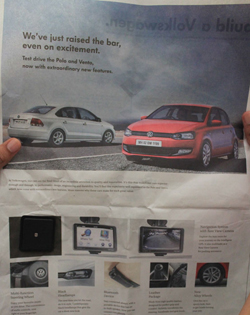 On September 11, 2012, German carmaker Volkswagen did it again. It managed to capture eye balls with its recent series of advertisements that were run in leading newspapers like TOI , Hindustan Times and The Hindu across six metros in the country. VW launched this new campaign for the Polo and Vento cars, which talks about new and exciting features. The company, which is known for its innovative ad campaigns, attached a light-sensitive chip to the papers. The chip vibrates as soon as it is opened. Designed by DDB Mundra, the gimmick is meant to convey the thrill and excitement associated with VW cars. With this campaign, the company is trying to boost its sales, which have seen a slump as compared to last year. In the April to August period this year, Volkswagen sold 25,306 vehicles, a drop by 18.87 pc yoy (SIAM figures).
Clutter breaking activities like these do capture the attention of the consumer. But the question is who the consumer is in this case, and has Volkswagen been able to capture his/her attention in the right way? And it is not exactly the no-brainer you would be anticipating. Spending too much on mass marketing in this manner doesn't really help to proportionately boost sales of the company, as per experts. When asked about the activity, Naresh Gupta CSO, Managing Partner, Bang in the Middle, comments, "People talk & notice your ad but the issue is that it is the content that matters. They did not convey what they have in mind clearly. From a content perspective, it did not work. For me, it was a mixed effort." And apparently, it had mixed results as well. K. V. Sridhar, National Creative Director, Leo Burnett India, said "It is a very expensive exercise (estimated budget between Rs.50 million to 70 million) and it's fine if it's relevant. For example, when Hutch turned Vodafone, their campaign had relevance as they needed to change their identity overnight. Roadblock activities are very expensive, so a company should have specific and generic reasons to do them."
The auto major has been previously involved in such expensive promotional adventures. The first roadblock in print was seen on November 11, 2009, when all editions and all ad spaces in The Times of India were taken by the auto major in a campaign created by Mediacom. It advertised different brands like Jetta, Passat and Touareg using this campaign. The same was repeated on September 22, 2010 when the company came out with a talking newspaper ad for its Vento sedan, which instantly became the talk of the town.
But now, the real challenge for Volkswagen is its positioning as a premium player in a value conscious market that it targets through national media. For that reason, the company may need to come up with campaigns that really encourage people to come to the showrooms and understand its value proposition, rather than stay away.


 Issue Dated: Feb 5, 2017

