



- Article
- Comments (0)
The sound of tradition
Haroon Reshi joins a Sehar Khawan for the pre-dawn rounds of a centuries-old tradition in the Valley…
Tags : Sehar Khawan | RAMAZAN | DHOL DRUMMERS |
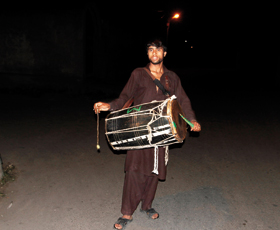 It is yet another day in the month of Ramadan, the holiest period in the Islamic calendar. Khan Mir Ahmad (32), comes out from his rented room in Shaheed Gunj, an uptown area of Srinagar city, at 2 AM (two hours before dawn) and makes his way through the dark streets and the narrow lanes of residential areas, thumping drums to wake people up for sehari (a pre-fast meal).
Khan, a labourer by profession, hails from Kalaroos, a village in Kupwara town and once the hotbed of militancy in the Valley. For the past few years, he has undertaken the job to alert people in time for the meal before dawn-to-dusk fast during Ramadan.
The dawn drummers are a traditional part of the holy month in Kashmir and their job has a spiritual significance.
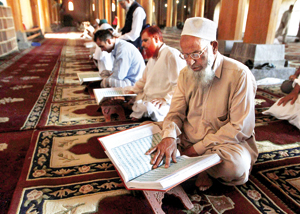
Hundreds of them, called ‘sehar khawans’ in the native language, set about the Muslim-majority Valley, as soon as the Ramadan starts. “Drum beating before dawn by the sehar khawans has been a centuries-old tradition in Kashmir, because in those days hardly anyone owned watches and alarm clocks. So people would rely on these drum thumpers to get up in time for the meals.” Muhammad Yusuf Teng, a noted historian told TSI.
Interestingly, even in this modern era, when cell phones and sophisticated alarm clocks are available in every other home, the tradition of drum beating enthusiastically continues here.
Like Khan Mir Ahmad, most of the sehar khawans do the job for the monetary benefits. In the last week of the Ramadan, the drum beaters go door-to-door to collect ‘service charges’ in terms of money and one or two bowls of rice from every household.
“Last year I received more than five thousand rupees and about two quintals of rice as nazrana (gift) from the residents. Every household rewards me anything between Rs 10 and two to three hundred rupees. For me this is a big addition to my income. I wait eagerly over eleven months for this revenue. It helps me a lot and I also enjoy it.” Khan tells this reporter who had joined him for one of the nightly rounds.
But not all of these self-appointed volunteers are in it for the money. Many of them do the job for ‘heavenly rewards’. Like Ali Muhammad Wani, a 55-year old drum beater who has been waking people up for sehari in the holy month for the last 35 years.
Ali, who performs what he calls his ‘religious duty’ of drum beating during Ramadan in the Soura and Buchpora areas in the outskirts of Srinagar city, says, "I never collect money or rice from people because that is not my objective. I am doing all this just to please the almighty Allah and to get sawab (spiritual merit). I firmly believe I will get my returns in the Hereafter (life after death).” As he goes about in the dark early hours, Ali loudly chants "Wakht-e-Sehar" (‘time for the pre-fast meal’) to the thumping of drums.
“My sons and other family members have tried to stop me from doing this any more but I have decided that I will continue till my health allows me,” he added. “My father Khalil Wani who was also a sehar khawan used to loudly recite the Quranic verses and the couplets praising Prophet Muhammad. He used to blow a sheep horn pipe, which was a common practice in those days,” Ali recalls of his childhood.
The Islamic calendar is a lunar one, wherein every month begins with the first crescent of a new moon being sighted. The lunar year is always 11 to 12 days shorter than the solar year, so Ramadan has a cycle that crosses every season. It is not always summer during the holy month like it is now. “I have performed this duty even when it snowed during harsh winters.” Ali says.
During the years when militancy was at its peak, the tradition was badly hit as most of the sehar khawans stayed in due to fear of militants and security forces, who would incessantly patrol the roads and streets and target dissidents. “Those were horrifying days. I stopped the practice from 1991 to 1996. I resumed only when the conditions improved,” Ali remembers.
More than a billion Muslims around the globe, who believe that God revealed the first verses of the holy Quran around 610 AD through Prophet Muhammad in the ninth month of the Islamic calendar that is Ramadan, respectfully observe fasting and abstinence from dawn to sunset. The general rules are the same everywhere but the tradition of ‘human alarm clocks’ is unique to the Kashmir valley.
Irrespective of the motivations of the sehar khawans, any tradition that adds to the feeling of community and service is a beautiful one. As the Valley prepares for the joie de vivre of Eid at the end of Ramadan, may there be restored permanently another forgotten tradition in the land: that of peace and bliss.


 Issue Dated: Feb 5, 2017
